
AI detectors have become the new gatekeepers of authenticity, yet most users struggle to understand what makes them reliable or where they consistently fall short. If you’re navigating content verification for your business or personal projects, knowing which features actually matter and which challenges to anticipate can save you from costly missteps.
ChatGPT 247 helps individuals and businesses cut through the noise by offering practical insights into AI technologies that shape how we create and validate content today. This guide breaks down the essential capabilities you should demand from any detector, the persistent limitations even advanced tools face, and how to make smarter decisions when authenticity is on the line.
Understanding AI Detectors in 2026
By 2026, AI detectors sit at the center of how organizations manage content authenticity, from classrooms and newsrooms to compliance teams and marketing departments. The rise of advanced language models such as ChatGPT, GPT 5, Gemini, Claude, Llama, and others has driven an unprecedented volume of synthetic text, making it harder to distinguish human writing from machine output at a glance. As a result, demand for dependable AI detection has surged across sectors that depend on trust, originality, and regulatory compliance.
These tools are now embedded in learning management systems, editorial workflows, legal review pipelines, and even browser extensions that let users scan any page they visit. For example, platforms such as Originality.ai and GPTZero let educators, web publishers, and businesses paste or upload documents and receive a probability score indicating how likely it is that the content was generated by AI, often with sentence level highlighting and detailed reports. At the same time, lighter weight tools such as Grammarly’s AI detector integrate checks into everyday writing, catching potential issues as users draft emails, proposals, or blog posts.
Why AI Detectors Matter Today
AI generated content has moved from the margins to the mainstream, influencing academic submissions, SEO driven blogs, financial commentary, and even legal drafts. This ubiquity raises practical questions: can an AI written research summary distort scientific discourse, or might an AI drafted earnings blog post mislead investors if it contains hallucinated numbers? Reliable AI detectors help organizations address these risks in several ways:
- Protecting academic integrity: Universities and schools now face cohorts of students with constant access to advanced chatbots and writing assistants. AI detectors used at scale can flag likely AI written essays and assignments, prompting human review before grades or admissions decisions are finalized. In practice, combining detection scores with manual evaluation helps institutions uphold honor codes without penalizing legitimate, well written human work.
- Supporting transparent business communication: Companies are increasingly expected to disclose AI use in customer facing material, especially where trust and safety are at stake. Marketing, HR, and customer support teams use AI detectors to verify the origin of campaign copy, support articles, and policy documents, ensuring that heavily AI generated content is vetted and, where necessary, clearly labeled. This transparency is particularly important in regulated sectors such as finance and healthcare, where misstatements can trigger legal or reputational damage.
- Safeguarding publishing and media: Newsrooms and research publishers use AI detectors to ensure that submissions are original, responsibly authored, and not undisclosed AI rewrites of existing material. In investigative or high stakes reporting, editors can scan drafts to check for AI overreliance and then use tools like ChatGPT 247 for fact checking, sourcing, and policy compliant rewriting. This layered approach helps maintain journalistic standards in an environment where synthetic news and automated content farms are proliferating.
Even the best AI detectors are probabilistic, not oracles. They sometimes flag human text as AI written or underestimate the AI share of a carefully human edited document. For this reason, many institutions now treat detector outputs as signals, not verdicts, and combine them with human judgment, contextual information, and clear policies. ChatGPT 247 can help teams interpret these signals by explaining how detectors scored a given text, what patterns they likely reacted to, and how to document their decisions for internal audits.
How AI Detectors Work: Technology and Methodology
Modern AI detectors rely on a mix of statistical modeling, natural language processing, and increasingly, dedicated neural networks trained specifically for detection. Instead of searching for obvious markers such as specific phrases, they evaluate deeper properties of text that tend to differ between humans and large language models. Tools like GPTZero, Originality.ai, and Copyleaks all follow this general pattern, though each uses proprietary models and feature sets.
At a high level, most detectors analyze three categories of signals:
- Text predictability and perplexity: Generative models are trained to predict the next word in a sequence. As a result, AI generated text often has lower statistical surprise, especially when using safety optimized or default settings. Detectors estimate how predictable the sequence of words is; if the writing is unusually smooth, consistent, and low in randomness compared to typical human prose in similar contexts, the detector’s AI likelihood score increases.
- Burstiness, sentence structure, and rhythm: Human writing tends to mix short and long sentences, occasionally breaking patterns or introducing idiosyncratic phrasing. Detector models measure variation in sentence lengths, clause patterns, and syntactic complexity. AI outputs that maintain a narrowly consistent rhythm, such as similarly sized sentences and evenly distributed transition phrases, can be flagged as machine like, especially in longer documents.
- Linguistic fingerprints and model specific cues: Each generation model family has subtle stylistic signatures, from favorite transitional phrases to characteristic ways of structuring explanations. Advanced detectors are trained on large corpora of AI outputs and can recognize these recurring patterns, sometimes even distinguishing between models such as GPT style, Gemini style, or Claude style writing. This is particularly useful when organizations want to know whether a text involved specific platforms that fall under their internal policies.
The most capable detectors in 2026 use deep neural architectures and so called ensemble methods that combine several analytical strategies. A document might first pass through a fast statistical layer to compute perplexity and burstiness, then into a transformer based classifier that has been trained on millions of labeled human and AI samples, and Lastly through heuristics that check for known artifacts such as repeated generic phrases. Because generative models evolve quickly, these detectors require frequent retraining with fresh samples from new model versions.
Detection Techniques Explained
Ensemble detection is now considered a baseline for serious tools. GPTZero, for example, reports using hundreds of factors and has published performance claims such as over 96 percent accuracy on mixed human AI documents when evaluated on its internal benchmarks. Originality.ai has reported 99 percent or higher accuracy on some of its detector modes in independent testing, especially on content directly generated by popular AI platforms under default settings. These numbers are typically measured on curated datasets, so real world performance can be lower, but they illustrate how far detection has come in a short period.
Critically, AI detectors do not function like traditional plagiarism checkers. Plagiarism tools compare text against large databases of existing documents, flagging direct matches or close paraphrases. By contrast, AI detectors can flag a completely novel paragraph that has never appeared anywhere online, simply because its statistical and stylistic properties resemble those of generative models. Many platforms now combine both features: Copyleaks, Originality.ai, and others offer joint AI detection and plagiarism scanning so that organizations can simultaneously check for both AI authorship and uncredited copying.
Comparison of Leading AI Detector Tools in 2026
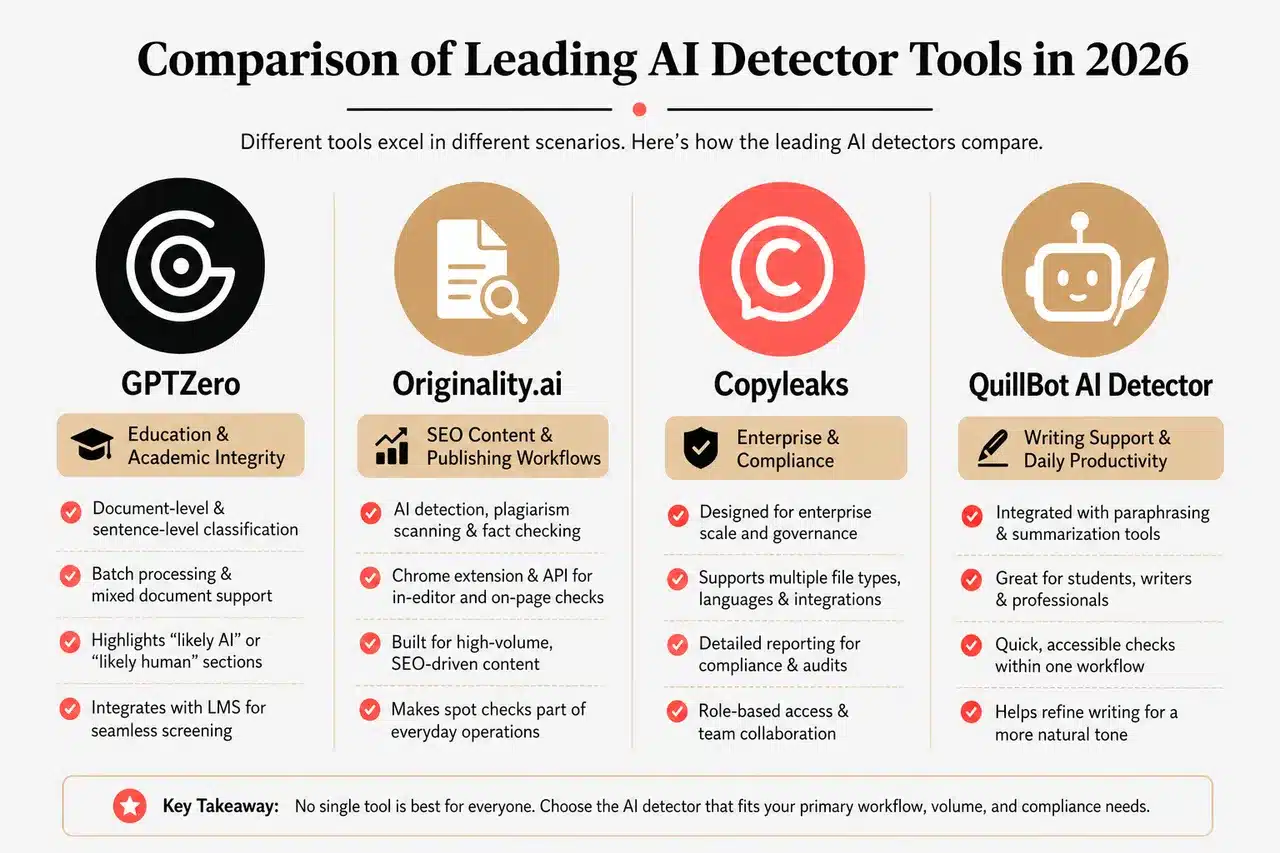
The AI detection ecosystem has matured into a diverse market, with tools targeting everyone from individual writers to global enterprises. Rather than a single winner, there are clusters of solutions that excel in particular scenarios: education, SEO heavy publishing, corporate governance, and day to day writing support. ChatGPT 247 regularly analyzes these tools to help users map them to their specific workflows.
- GPTZero: Originally popular with educators, GPTZero has expanded into research and corporate environments by emphasizing document level and sentence level classification, batch processing, and support for mixed documents. It is commonly integrated into learning management systems so that instructors can automatically screen submissions and then manually review high risk cases. The platform highlights specific sections as « likely AI » or « likely human, » giving instructors practical guidance instead of just a single score.
- Originality.ai: This tool has become a staple for content marketers, site owners, and agencies that manage large volumes of SEO driven content. It offers AI detection, plagiarism scanning, and even fact checking features for online publishers. With a Chrome extension and API, Originality.ai lets users check content inside editors or on live webpages, making spot checks part of everyday operations rather than a separate task.
- QuillBot AI Detector: Built into a broader suite that includes paraphrasing and summarization, QuillBot’s AI detector serves writers who want to verify whether their drafts resemble AI generated text. This is especially useful for authors using heavy AI assistance who want to ensure the final result feels human and passes basic detection thresholds. Because it lives in a writing environment, the detector can be used iteratively while revising.
- Grammarly AI Detector: Grammarly has integrated an AI detector into its existing grammar and style platform, allowing professionals to check for AI writing as they edit their documents. Its value lies in convenience: users do not need to switch tools to get a quick sense of AI involvement. This is attractive for teams that already rely on Grammarly for quality assurance and now want a first pass AI check without deploying new infrastructure.
- Copyleaks AI Content Detector: Copyleaks focuses on enterprise and education, pairing AI detection with robust plagiarism checking and extensive language support. The company highlights high claimed accuracy rates, including for content that attempts to evade detection through paraphrasing. Its APIs and LMS integrations make it well suited for organizations that want to embed detection deeply into existing systems and track results for audits.
- Other specialized tools: Emerging detectors such as Decopy, Pangram, and Monica’s AI content detector position themselves with specific strengths, from no sign up free checks to independent third party validation of accuracy. These options give smaller teams or privacy conscious users more choice, especially when they need quick, low friction scanning without the overhead of subscription setups.
| Tool | Primary Focus | Notable Capabilities | Typical Users |
|---|---|---|---|
| GPTZero | Education and research | Sentence level detection, mixed content analysis, batch processing | Universities, schools, research supervisors |
| Originality.ai | Publishing and SEO content | AI detection plus plagiarism and fact checking, browser extension, API | Agencies, web publishers, freelance writers |
| Grammarly AI Detector | Everyday professional writing | Inline AI detection inside grammar and style checks | Knowledge workers, managers, small teams |
| Copyleaks | Enterprise and education | Multilingual AI detection, plagiarism integration, LMS and API support | Enterprises, schools, compliance teams |
| QuillBot AI Detector | Writer support | AI detection alongside paraphrasing and summarization tools | Students, content creators, bloggers |
| Lightweight tools (Decopy, Monica, Pangram) | Fast, accessible checks | No sign up options, public web interfaces, focus on simplicity | Individual users, occasional checkers, privacy focused readers |
Feature and Accuracy Comparison
Choosing an AI detector is less about finding an abstract « best » tool and more about matching capabilities to your risk profile and workflow. For example, a university might prioritize LMS integration and student privacy, while a media outlet cares more about batch scanning of drafts and transparent reporting it can show to editors. ChatGPT 247 can help teams map their requirements into a shortlist by asking structured questions about volume, regulatory exposure, languages, and integration needs.
- Model coverage and update cadence: Detection effectiveness depends heavily on how often a vendor updates its models to account for new generative systems. Tools that explicitly support a wide range of models such as GPT family, Gemini, Claude, Llama, and others are better prepared for the diversity of content seen in the wild. Asking when the detector was last retrained and how quickly new models are incorporated is now a standard part of procurement.
- Real world accuracy on your content type: Public benchmark numbers are useful, but detectors perform differently on informal emails, highly technical research, or creative writing. Running a pilot where you test known human content, known AI content, and mixed drafts from your environment can reveal which tool aligns best with your expectations. ChatGPT 247 can support this by generating controlled AI samples for testing and helping you design a basic evaluation protocol.
- Integration, reporting, and governance: For organizations that must justify decisions to regulators, boards, or clients, audit ready reporting is essential. Detectors that log scan history, scores, and reviewer notes make it easier to reconstruct how a particular piece was evaluated. Integrations with content management systems, learning platforms, or internal dashboards also reduce friction by letting staff run checks without switching tools or copy pasting sensitive material between systems.
| Decision Factor | What To Look For | Why It Matters |
|---|---|---|
| Supported Models | Explicit mention of multiple LLM families and regular updates | Ensures coverage for the evolving landscape of AI generated text |
| Accuracy on Your Use Case | Pilot tests using your actual content types and languages | Reveals real performance beyond marketing claims or lab benchmarks |
| Integration Options | APIs, LMS plugins, CMS connectors, browser extensions | Reduces friction, encourages consistent use across teams |
| Reporting Depth | Sentence level highlights, exportable reports, audit logs | Supports internal governance, training, and external accountability |
| Data Handling | Clear policies on storage, encryption, and deletion | Critical for compliance, especially for student or customer data |
Key Features, Use Cases, and Limitations
Across tools and sectors, a common set of core features has emerged as non negotiable for modern AI detectors. Understanding these capabilities helps you evaluate offerings more systematically and tailor them to your workflows with the help of platforms like ChatGPT 247.
- Real time, scalable detection: For high volume environments such as admissions offices or newsrooms, the ability to scan thousands of documents quickly is essential. Modern detectors provide APIs and batch upload features that can process large queues while still delivering detailed per document reports. This scalability means detection can run in the background as a standard step rather than a one off emergency measure when suspicion arises.
- Multi model and multilingual support: As more teams adopt diverse AI tools and publish in multiple languages, detectors that can handle different LLM families and non English text become increasingly valuable. Some providers emphasize their ability to detect AI content generated in languages such as Spanish, French, German, or Hindi, though accuracy can vary by language. Organizations with global operations often run internal tests to understand language specific performance before making detection a formal requirement.
- Detailed scoring, explanations, and visualizations: A single « AI or not » label is rarely enough for nuanced decisions. Instead, detectors increasingly offer probability ranges, segment by segment breakdowns, and confidence scores that show how certain the system is about its assessment. These outputs help human reviewers focus on the most concerning passages, explain their reasoning to stakeholders, and refine internal thresholds over time.
- Flexible integration and automation: Many teams now connect detectors to their existing tooling through APIs, webhooks, or built in connectors. For instance, a CMS can automatically trigger a scan when a draft is submitted, then display the results directly to editors. ChatGPT 247 can sit alongside these pipelines, both as a drafting assistant and as a companion that explains detector outputs, suggests rewrites, or identifies places where a more human tone would improve credibility.
Beyond pure text analysis, auxiliary AI capabilities are increasingly bundled into detection platforms. Some tools offer AI chatbots that guide users through interpreting scores or recommending next steps, while others provide automatic translation and summarization that help reviewers handle cross language content. Image and multimedia analysis is also growing, as organizations look to detect not just AI written text but also AI manipulated images and videos in a single workflow.
Practical Use Cases
- Academic integrity and assessment design: Universities use detectors to screen essays, project reports, and even exam answers submitted online. However, they also consult platforms like ChatGPT 247 to redesign assignments in ways that are less vulnerable to fully AI generated responses, such as by emphasizing personal reflection, oral defense, or project based evaluation. Detectors then act as a safety net rather than the primary line of defense, supporting a broader culture of integrity.
- Content marketing and SEO quality control: Agencies and in house marketing teams rely heavily on generative AI for outlines, first drafts, and ideation. They then use detectors and tools like Originality.ai to identify when a piece is still too close to generic AI output, which may harm search performance or brand voice. ChatGPT 247 can help refine such drafts, injecting unique insights, better sourcing, and company specific examples so that the final publication reads as expert human work.
- Corporate governance and regulatory compliance: In industries where regulations or internal policies limit AI use in certain documents, detectors help enforce these rules at scale. For example, a financial services firm might mandate that risk disclosures, prospectuses, and advisory reports be human led, with only minor AI assistance. Internal workflows can automatically scan drafts, flag suspicious ones for legal review, and record how any AI involvement was mitigated or disclosed.
- Trust and safety for user generated platforms: Platforms that host user generated content, such as forums, learning communities, or review sites, increasingly use AI detectors to spot large scale AI written spam or coordinated influence campaigns. By combining detection with rate limiting and behavioral signals, they can distinguish legitimate contributors from automated bots. ChatGPT 247 can further support moderators by summarizing patterns in flagged content and suggesting clearer community guidelines.
Challenges and Limitations
Despite rapid advances and impressive benchmark numbers, AI detection in 2026 faces structural challenges that users should understand before building hard rules around these tools.
- Arms race dynamics with evolving AI models: Each new generation of language models tends to produce more natural, diverse, and human like text, which in turn erodes the effectiveness of detectors trained on older patterns. Adversarial tools that intentionally rewrite AI output to evade detectors further complicate the landscape. This means that any detector’s performance is a moving target, and organizations must plan for regular reassessment rather than assuming a static solution will remain reliable indefinitely.
- False positives, false negatives, and fairness concerns: Highly polished human writing, especially from experienced writers or non native speakers using grammar tools, can sometimes be misclassified as AI generated. Conversely, cleverly edited AI text can slip through as human. Overly punitive policies that rely solely on detector scores risk unfairly accusing students or employees and can disproportionately impact groups whose writing style deviates from the training data. For this reason, many institutions explicitly forbid using detector scores as the sole basis for academic misconduct charges.
- Hybrid and collaborative content: In practice, much modern writing is a blend of human and AI contributions: an AI generated outline with human expansion, or a human draft polished with AI rewrites. Detectors can often flag such hybrid content but struggle to quantify the proportion of AI involvement in a way that maps neatly onto policies. Organizations therefore need nuanced guidelines that focus on disclosure and responsible use rather than strict percentage thresholds.
- Privacy, security, and data governance: Running sensitive documents through third party detectors raises questions about data retention, model training, and cross border transfers. Some vendors commit not to train on user submissions and offer on premises or private deployment options, but users must verify these claims. ChatGPT 247 can help by generating due diligence checklists that legal and IT teams can use when evaluating detection vendors.
In response, many organizations are adopting layered verification strategies: detectors for initial triage, human reviewers for context, explicit AI use disclosures, and training programs that teach staff how to interpret and challenge automated judgments. This ecosystem, in which tools like ChatGPT 247 play a dual role as both assistant and subject of detection, reflects a broader shift from simple « AI or not » questions to more mature governance of AI assisted work.
Emerging Frontiers: Watermarks, Images, and Multimodal Detection
As text detectors mature, attention is shifting to broader ecosystems of authenticity, including watermarked AI outputs and non textual content. These developments complement traditional detection approaches and will shape how individuals and organizations design trustworthy content pipelines in the years ahead.
Invisible Watermarks and Platform Level Signals
One promising direction is embedding imperceptible watermarks into AI generated outputs at the model or platform level. Tools such as Google DeepMind’s SynthID, for instance, aim to mark images, audio, video, and even text created by specific AI systems, allowing dedicated detectors to later verify whether a piece of content bears that watermark. For organizations, this means that future authenticity workflows may combine statistical detectors with direct watermark checks, especially when working within ecosystems that standardize these practices. ChatGPT 247 can help teams design policies that anticipate watermarked content, including how to log and act on watermark verification results.
Image and Deepfake Detection
Beyond text, AI image detectors analyze visual patterns, textures, and artifacts to determine whether a picture was generated or manipulated by machine learning models. Services like DeepAI’s image detector take uploaded photos and produce classification scores that label them as likely real, AI generated, or edited, with confidence levels. Media outlets, e commerce platforms, and government agencies increasingly combine these tools with text detectors to evaluate entire stories or submissions, making sure that both words and visuals meet authenticity standards.
Multimodal and Cross Channel Verification
As generative models become multimodal, producing text, images, audio, and video in a unified way, detection strategies are also moving toward cross channel verification. A single story might include a written narrative, illustrative images, and a short video clip, all of which could be synthetic. In such scenarios, authenticity checks may involve running text through AI detectors, checking images against watermarking tools, and using deepfake detectors for audio or video. ChatGPT 247 can coordinate with these tools conceptually by helping teams design end to end verification playbooks and by generating clear documentation that explains to stakeholders how each layer contributes to Generally trust.
Data Driven Insights: Adoption, Accuracy, and User Behavior
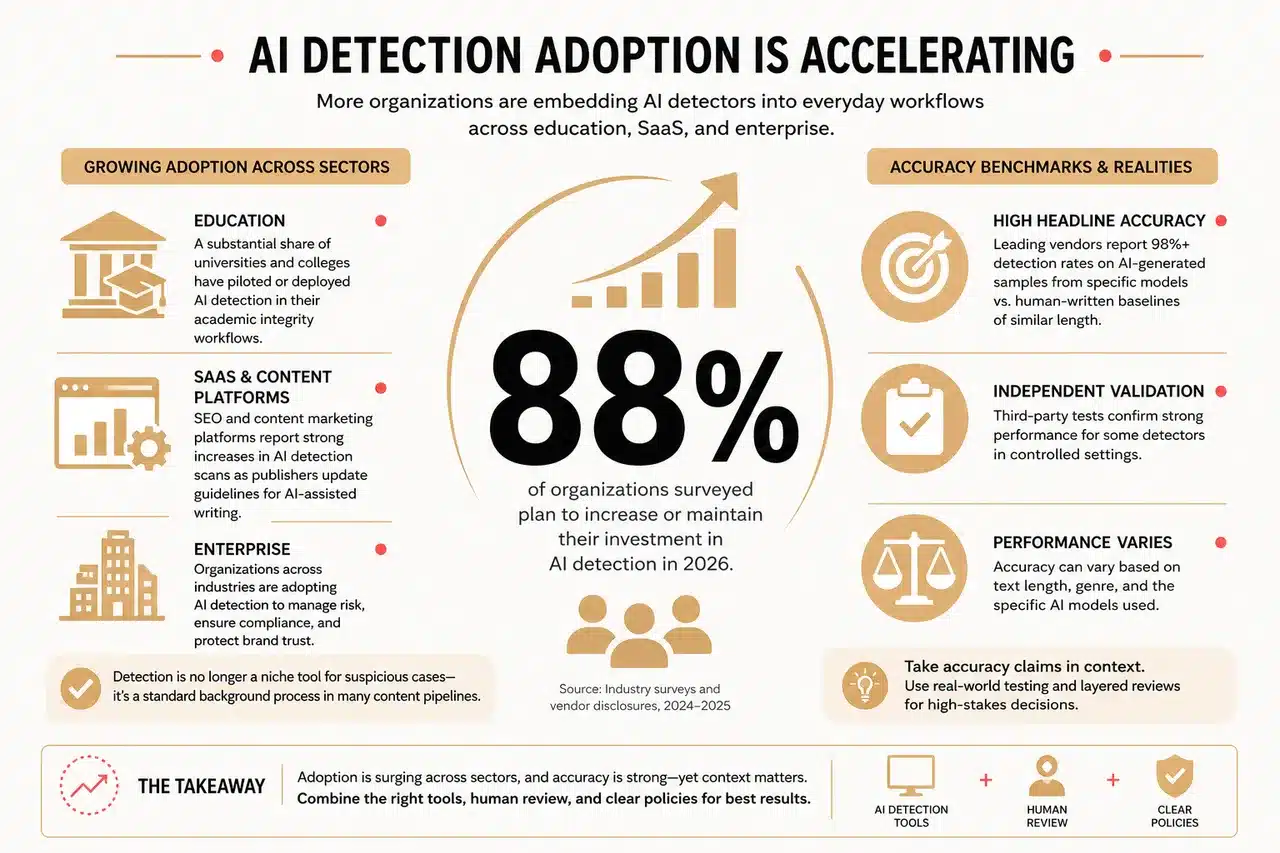
Although detailed market size numbers vary by source, recent industry surveys and vendor disclosures point to rapid growth in AI detection adoption as organizations grapple with generative AI’s impact. Several trends stand out and can inform how you plan your own detection strategy with the support of ChatGPT 247.
Growing Adoption Across Sectors
Over the past year, education technology reports and vendor usage data suggest that a substantial share of universities and colleges have either piloted or fully deployed AI detection in their academic integrity workflows. At the same time, SaaS platforms focused on SEO and content marketing report strong increases in AI detection scans as publishers adjust their guidelines for AI assisted writing. This pattern reflects a broader shift: detection is no longer a niche tool for suspicious cases, but a standard background process in many content pipelines.
Accuracy Benchmarks and User Expectations
Several AI detector vendors publish headline accuracy claims, often in the high nineties, based on controlled evaluations. For example, some tools report 98 percent or higher detection rates on AI generated samples from specific models when those samples are compared to human written baselines of similar length. Independent tests commissioned by agencies or research groups have confirmed strong performance for certain detectors in constrained settings, though they also highlight that performance can vary significantly with text length, genre, and editing. Users are therefore learning to interpret these numbers as upper bounds, adapting their expectations and policies accordingly.
User Strategies for Working With Detectors
As detectors become common, users are also experimenting with ways to make AI assisted writing feel more human, whether for authenticity, engagement, or in some cases to avoid being misclassified as AI. Common strategies include introducing more personal anecdotes, varying sentence structure deliberately, and revising AI generated drafts heavily. Tools that advertise « AI humanization » features aim to systematize this process, though their effectiveness against sophisticated detectors is limited and often short lived. ChatGPT 247 can help users focus instead on genuine value addition, such as incorporating unique data, domain expertise, and lived experience that pure AI models cannot easily replicate.
| Trend | Implication for Users | How ChatGPT 247 Helps |
|---|---|---|
| Widespread adoption in education and publishing | Detector scores will increasingly influence how content is assessed and accepted | Assists in drafting policies, assignment designs, and communication templates that account for detection |
| High published accuracy with caveats | Users must interpret accuracy claims in light of their own content and risk tolerance | Explains metrics, suggests pilot tests, and helps design evaluation frameworks |
| Rise of hybrid human AI workflows | Policies must focus on disclosure and value, not only on binary AI vs human labels | Guides teams on responsible AI use, disclosure language, and documentation practices |
Policy, Ethics, and Best Practices for Using AI Detectors
As AI detectors influence academic outcomes, hiring decisions, and public discourse, questions of fairness, transparency, and responsible use have moved to the forefront. Detectors can support integrity, but they can also cause harm if used without clear guardrails or recourse mechanisms. Thoughtful governance, supported by tools like ChatGPT 247, can help ensure that detection strengthens trust rather than undermining it.
Designing Clear and Fair Policies
Organizations that rely on detectors should articulate in plain language how these tools are used, what their limitations are, and what rights users have if they are affected by detection based decisions. In academic settings, this might mean publishing a policy that specifies that detector scores alone will never be used as proof of misconduct, instead triggering a human led review where the student can provide drafts or notes. In business contexts, policies can clarify which document types are expected to be human led, which may involve AI assistance, and how any AI involvement should be disclosed to clients or regulators.
Transparency and Communication With Stakeholders
Transparency extends beyond internal documents. Students, employees, freelancers, and partners should understand when their work will be scanned, what data is stored, and how results might impact them. Providing access to detector reports, offering appeal processes, and explaining decisions in everyday language all contribute to a healthier relationship between automated tools and the people whose work they evaluate. ChatGPT 247 can help draft explanatory materials, FAQs, and training modules that translate technical detection concepts into accessible guidance.
Continuous Training and Human Oversight
Lastly, successful use of AI detectors depends on ongoing education and human involvement. Reviewers need to understand that detector scores are probabilistic and context dependent, not absolute truths. Regular training sessions, case studies, and calibration exercises can align reviewers’ interpretations and reduce inconsistent or biased decisions. ChatGPT 247 can assist by generating anonymized example cases, facilitating scenario based training, and suggesting prompts that reviewers can use to question and cross check detector outputs.
FAQs About AI Detectors in 2026
AI detectors have redefined how we maintain trust in digital content across education, publishing, and business. Their use is now common in many workflows, but effective adoption still depends on understanding their strengths, limitations, and best practices. The following questions address some of the most frequent concerns that users bring to ChatGPT 247.
- How accurate are AI detectors in 2026?
Leading detectors report high accuracy on benchmark datasets, often above ninety percent for detecting pure AI generated text from mainstream models. However, performance can vary on shorter texts, heavily edited AI content, or specialized domains. It is wise to treat vendor numbers as indicative rather than definitive and to run your own tests on representative content. - Can AI detectors spot content from every AI model?
Detectors tend to perform best on widely used models such as the GPT family, Gemini, Claude, and Llama, which provide abundant training data. They may be less reliable on obscure, fine tuned, or rapidly evolving models until their training datasets are updated. This is another reason why organizations should periodically reassess detector performance as the AI landscape shifts. - What is the best way to use an AI detector responsibly?
Use detectors as one input among several, not as the final arbiter. Combine automated scores with human review, contextual information, and clear policies about what constitutes inappropriate AI use. For high stakes decisions, maintain documentation that shows how detector results were interpreted and weighed against other evidence. - Are AI detectors suitable for all industries and content types?
Most industries can benefit from AI detection, but some contexts require extra caution. Highly technical, legal, or creative writing may challenge detectors and produce more false positives, so policies should emphasize human oversight in these areas. Sectors handling sensitive data also need to scrutinize how detectors store and process content for privacy and regulatory compliance. - How can I reduce false positives and build trust in detection results?
To minimize false positives, choose detectors that allow configurable thresholds, invest in reviewer training, and avoid treating borderline scores as conclusive evidence. Encourage writers to retain drafts, notes, or outlines that demonstrate their process when needed. ChatGPT 247 can help you design communication strategies that explain detection practices to your community and provide constructive guidance instead of punitive surprises.
AI detectors are now a central component of digital content management, helping individuals and organizations navigate the opportunities and risks of generative AI. Used thoughtfully, in combination with tools like ChatGPT 247, they can support authenticity, strengthen governance, and foster more honest conversations about how humans and AI collaborate in everyday work.
If you are ready to enhance your content verification process, explore the latest AI detector technologies, connect them with your existing systems, and define clear policies that reflect your values. With a layered approach that blends automation, human judgment, and transparent communication, you can maintain credibility and trust even as AI capabilities continue to advance.