

AI detectors claim they can tell human writing from machine-generated text with near-perfect accuracy, yet they flag Shakespeare as synthetic and greenlight obvious bot work. You’ve probably wondered whether these tools actually work or if you’re one typo away from being falsely accused of using AI. As AI tools like ChatGPT become essential for content creation, understanding how detectors analyze perplexity, burstiness, and linguistic patterns matters more than ever.
ChatGPT 247 helps individuals and businesses navigate AI technologies confidently, offering clear insights into how these detection systems operate and, crucially, where they fail. This guide breaks down the science, the pitfalls, and what you need to protect your work.
Introduction to Artificial Intelligence Detectors
The Rise of AI-Generated Content
AI-generated writing is everywhere these days, from news headlines and blog posts to business emails and product descriptions. Over the past few years, large language models have improved so much that short-form marketing copy, technical explanations, and even policy summaries can be generated in seconds and often look indistinguishable from competent human work. Traditional plagiarism tools that rely on simple text matching or web-index comparisons are not equipped to deal with this shift, because AI-generated text is often genuinely new rather than copied.
This rapid expansion has created a new market for artificial intelligence detectors that try to infer whether text was written by a human, produced entirely by an AI model, or refined with AI assistance. Modern tools such as GPTZero, Copyleaks, and Scribbr’s AI detector explicitly advertise support for popular models like ChatGPT, GPT 4, GPT 5, Gemini, Claude, and Llama, and are updated frequently as new versions of these models appear. Some detectors now work across more than 20 languages and promise very low false positive rates in order to be usable in high-stakes contexts like education and hiring.
Why Detection Matters in 2026
AI-generated content does not just shape blog posts, it can sway opinions, influence assessments, and alter business outcomes. In education, instructors worry that essays may be drafted entirely by AI, undermining learning and assessment. In commerce, automated reviews, support emails, and proposals can be produced at scale, raising questions about authenticity and trust. In politics and media, AI-written posts and comments can amplify misinformation and make orchestrated campaigns harder to spot.
- Academic integrity and assessment: Universities report that a significant share of academic integrity cases now involve suspected AI use rather than traditional copy-paste plagiarism. AI detectors are therefore integrated into learning management systems and used alongside oral defenses or follow-up questions to verify whether a student understands the submitted work.
- Brand trust and regulatory compliance: Businesses use detectors to verify that sensitive documents such as investor reports, regulatory filings, or legal briefs are not unintentionally drafted by AI where this would violate internal policies or external rules. For regulated industries, being able to show that content has been checked with a detector can become part of risk and compliance documentation.
- Platform integrity and moderation: Social networks, online marketplaces, and community platforms increasingly deploy detectors behind the scenes to flag large volumes of similar, formulaic submissions that look like AI-generated spam or review manipulation. Detectors help triage what should be examined by human moderators.
How Artificial Intelligence Detectors Work
Natural Language Processing (NLP) and Machine Learning
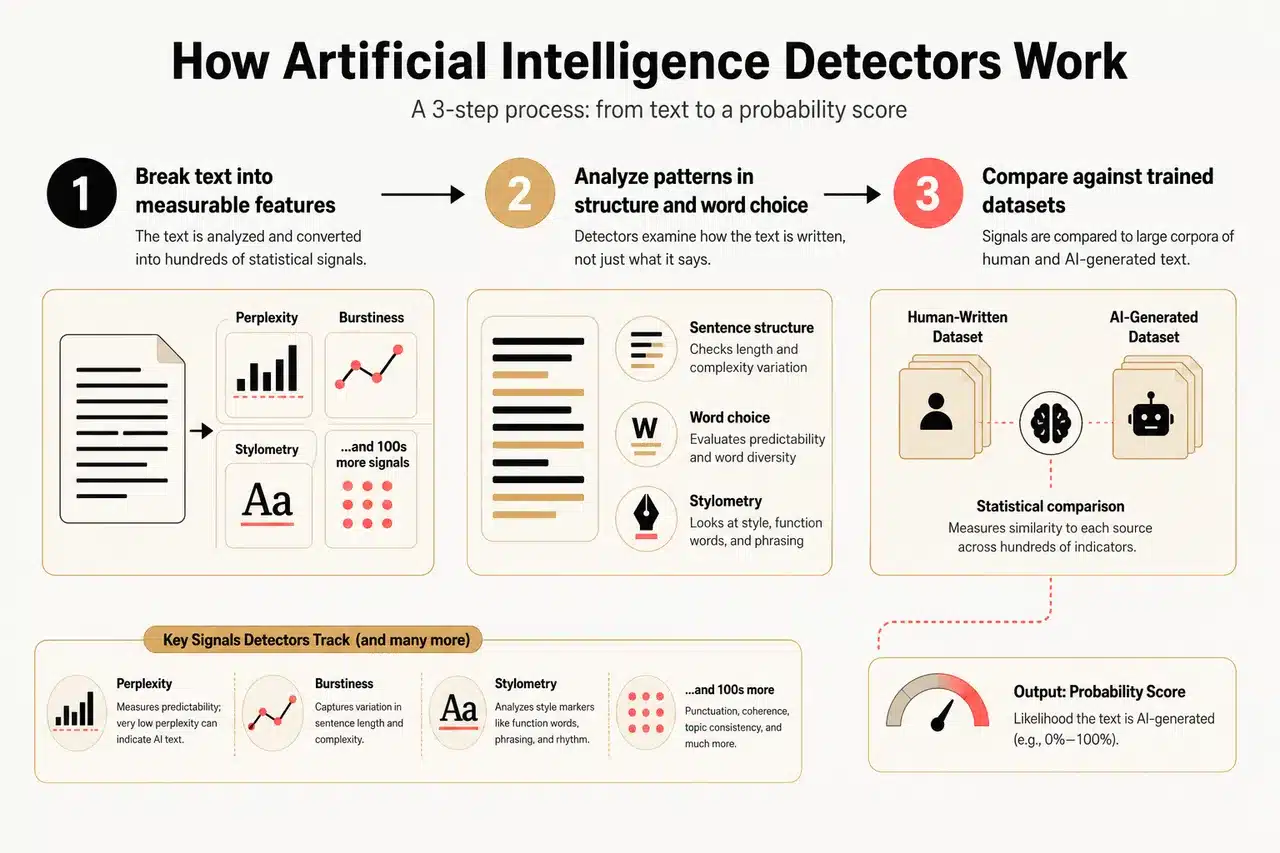
At their core, artificial intelligence detectors use advanced natural language processing and machine learning to break down text into measurable features. Instead of scanning for specific phrases that look like prompts, detectors model sentence structure, word choice, and rhythm in a statistical way. They are trained on large corpora of human-written documents and synthetic text generated by different AI models so that they can learn patterns that are more typical of one source or the other.
Three of the most discussed signals are perplexity, burstiness, and stylometry, but commercial detectors often track hundreds of indicators at once:
- Perplexity: Perplexity measures how predictable a given sequence of words is for a language model. AI text often has lower perplexity because it tends to choose high-probability next words, whereas human writers sometimes choose unusual phrasing or surprising turns of thought. GPTZero explicitly lists perplexity as one of its primary signals and explains that extremely uniform predictability is often a sign that a model, not a human, is writing.
- Burstiness: Burstiness describes variation in sentence length and complexity. Human writing usually includes a mix of short, punchy sentences and longer, more complex ones. Model-generated text can fall into an overly regular cadence, especially in low-temperature settings. Detectors therefore calculate variance across sentences and paragraphs, looking for patterns that are smoother than typical human output.
- Stylometric fingerprinting: Stylometry captures habits such as how often a writer uses passive voice, specific function words like « however » or « moreover », or particular punctuation patterns. Historically, stylometry has been used to attribute authorship in literature and forensics. Modern detectors extend this idea to distinguish machine style from human style and, in some cases, to estimate whether a text was human written but then lightly polished by AI.
Detection Algorithms and Techniques
Most artificial intelligence detectors combine multiple approaches to improve robustness, since no single signal is reliable enough on its own. Research benchmarks and industry documentation highlight three broad families of techniques that are commonly blended in commercial products:
- Statistical and n-gram analysis: Basic detectors compute frequencies of short word sequences (n-grams), parts of speech, and syntactic structures and compare them with reference distributions derived from human and AI corpora. Sudden spikes in rare n-grams that show up frequently in model outputs, or an unusually narrow distribution of sentence structures, can raise the suspicion score.
- Deep learning classifiers: More advanced tools such as GPTZero, Copyleaks, and ZeroGPT describe proprietary models that ingest entire passages of text and output a probability that it came from an AI system. These neural networks are trained on millions of examples produced by different models and are tested on independent benchmarks to estimate false positive and false negative rates. Some detectors highlight individual sentences or phrases the model is most confident are AI-generated.
- Ensemble and multi-step methods: Leading detectors now advertise multi-component pipelines that combine perplexity analysis, stylometry, deep classifiers, and rule-based heuristics. For example, GPTZero mentions that its model includes seven distinct components and has been tested on a third-party benchmark called RAID, where it reportedly detected more than 95 percent of AI texts while misclassifying about 1 percent of human texts. Combining signals helps reduce the risk of overfitting to one specific model family.
Accuracy, Limitations, and Challenges of AI Detectors
False Positives and Negatives
Even the strongest artificial intelligence detector can misfire. A false positive occurs when human writing is classified as AI-generated, and a false negative occurs when AI text is labeled as human. Real-world testing shows that both errors still happen, especially on edge cases like highly polished human writing, heavily edited AI output, or content in languages with less training data.
Public data from vendors and independent evaluations underscores the gap between marketing claims and practical performance. Copyleaks and GPTZero both reference accuracy figures above 95 percent on certain benchmarks and narrow conditions, including mixed human and AI documents. At the same time, independent research summarized by Scribbr’s AI detector team reports that, across a broad range of free and paid tools, the highest Generally accuracy observed in their comparative study was about 84 percent for a premium tool and 68 percent for the best free option. This mismatch illustrates that real-world accuracy depends heavily on the kinds of text being tested and how those texts differ from the data the detector was trained on.
Ethical Considerations and the Arms Race
Detection is not just a technical problem; it has important ethical dimensions. Deploying an AI detector in a classroom, workplace, or legal context can affect people’s reputations and opportunities, so false accusations based on a single score can be deeply unfair. Several universities now recommend that instructors treat detector results as one piece of evidence, to be combined with interviews, drafts, and knowledge of a student’s usual writing style, rather than as conclusive proof of misconduct.
- Bias and language coverage: Detectors often perform best on English and on text types that resemble their training data, such as standard essays. Non‑native English writers, creative writing, and highly technical material are more likely to trigger false positives. This means that students and professionals who already face language barriers may be disproportionately impacted unless institutions adopt careful review processes.
- Adversarial tactics and prompt engineering: On the other side, people who want to evade detection can use paraphrasing tools, iterative prompt strategies, or human post editing to reduce the telltale patterns that detectors look for. There are online guides that show how to repeatedly regenerate or rewrite AI text until a detector classifies it as human, making it a constant cat and mouse game between generation and detection.
- Privacy and consent: Using a detector typically involves uploading text to a cloud service. Organizations have to examine where that text is stored, how long it is retained, and whether it might be used to train future models. Tools aimed at education and research, such as those highlighted by university library guides, often emphasize that they do not reuse submitted student work, but policies vary by vendor and should be reviewed carefully.
Practical Applications and Use Cases
Education: Safeguarding Academic Integrity
Schools and universities routinely use artificial intelligence detectors as part of their academic integrity toolkits. When a student submits an essay through a learning management system, it may be automatically scanned by Turnitin’s AI detector, GPTZero, or a similar tool that highlights segments that look suspicious. Instructors then compare those segments with earlier drafts, in class writing, or oral explanations to determine whether the student likely used AI improperly or simply writes in a style the detector finds unusual.
- Layered verification workflows: Many institutions now recommend a layered approach in their policies: detectors flag potential issues, instructors review the flagged portions, and students can be invited to explain their process or show notes and drafts. This reduces the risk of treating the detector as a final judge and allows students to learn how to use AI tools responsibly, for brainstorming or editing rather than full essay generation.
- Support for responsible AI use: Some campuses integrate ChatGPT 247 as a teaching resource alongside detectors. Students are encouraged to use AI for outlining, language support, or idea generation, but they also learn how detectors might interpret heavily AI-shaped text. This combination helps them understand where the line lies between ethical assistance and inappropriate outsourcing of academic work.
- Accessibility and language learning: For non‑native speakers, AI tools can be invaluable in improving grammar and clarity. Institutions that adopt detectors are therefore also exploring « AI refined » classifications that distinguish between text written entirely by a model and text written by a human but polished with AI, so that students are not penalized for using assistive technology transparently.
Publishing and Content Moderation
Media organizations, publishers, and platforms use artificial intelligence detectors not only to catch cheating but to keep their content ecosystems trustworthy. An editor at a journal or blog might run submitted articles through tools like Copyleaks or Scribbr’s AI detector to see whether the prose appears entirely synthetic, AI refined, or predominantly human. This is especially important when editors want to ensure that expert bylines reflect genuine expertise rather than automated rewriting.
- Misinformation and synthetic news: Detectors can help flag clusters of similar articles or posts that share suspiciously uniform phrasing. Combined with fact checking and network analysis, this allows newsrooms and platforms to detect coordinated campaigns that rely on AI to flood the information space with aligned talking points.
- User generated content and reviews: Online marketplaces and apps now embed detectors in their review and comment systems to spot bursts of near-identical five star or one star reviews that look like they were generated programmatically. These reviews can then be downranked, hidden, or queued for human moderation to protect consumers.
- Editorial transparency: Some publishers have adopted policies that require authors to disclose any significant AI assistance. Detectors are sometimes used as a backstop to confirm that obviously fully automated manuscripts are not slipping through under a human byline, thereby preserving trust between authors and readers.
Global Market and Adoption Trends for AI Detectors
Growth, Spending, and Adoption Patterns
Behind the technical details, artificial intelligence detectors now represent a rapidly growing software segment that cuts across education, publishing, enterprise communications, and platform infrastructure. Market research and industry surveys paint a picture of fast adoption and evolving expectations:
- Rapid market expansion: Industry analysts estimate that spending on AI content detection and authenticity tools has climbed sharply since the first wave of generative AI. While exact forecasts vary, many reports describe compound annual growth rates well into double digits as detectors become standard add-ons for plagiarism platforms, learning systems, and enterprise security suites. Vendors that started as pure plagiarism checkers, such as Turnitin and Copyleaks, now highlight AI detection as a core revenue driver.
- Education as an early anchor, enterprises catching up: Universities and schools were among the first to adopt dedicated AI detectors at scale, often under institutional licenses. More recently, enterprises have begun integrating detectors into email gateways, document management systems, and knowledge bases to track where AI is used in customer facing communication. ChatGPT 247 regularly encounters organizations that want a combined stack of chatbots, translation, and detection rather than separate point solutions.
- Rise of multi purpose authenticity suites: A growing number of tools, including ZeroGPT and others cataloged by university library guides, now offer detection for text, images, and in some cases audio and video. This reflects a broader shift from « AI text checker » to « AI content integrity platform », where one service helps verify written reports, marketing visuals, and even deepfake style clips using related techniques.
Comparison of Leading AI Detector Tools
Overview of Popular AI Detection Tools
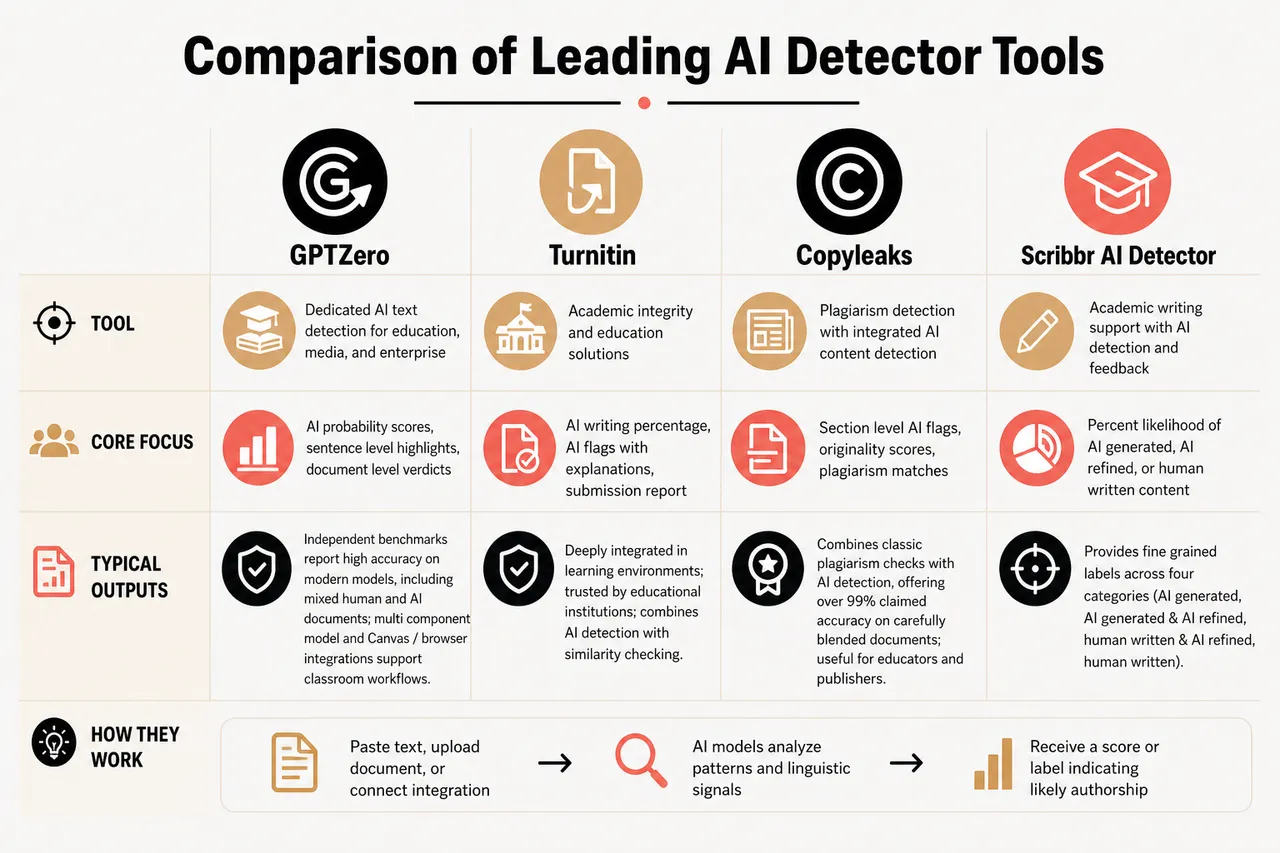
There is no shortage of artificial intelligence detector options, and the landscape evolves quickly. Most tools follow a similar user experience where you paste text, upload a document, or connect an integration, then receive a score or label indicating whether the content is likely AI generated, AI refined, or human written. The table below summarizes some commonly referenced tools and their distinguishing characteristics based on publicly available information.
| Tool | Core focus | Typical outputs | Notable strengths |
|---|---|---|---|
| GPTZero | Dedicated AI text detection for education, media, and enterprise | AI probability scores, sentence level highlights, document level verdicts | Independent benchmarks report high accuracy on modern models, including mixed human and AI documents; multi component model and Canvas / browser integrations support classroom workflows. |
| Copyleaks | Plagiarism detection with integrated AI content detection | Section level AI flags, originality scores, plagiarism matches | Combines classic plagiarism checks with AI detection, offering over 99 percent claimed accuracy on carefully blended documents; useful for educators and publishers who need both capabilities. |
| Scribbr AI Detector | Academic writing support with AI detection and feedback | Percent likelihood of AI generated, AI refined, or human written content | Provides fine grained labels across four categories (AI generated, AI generated & AI refined, human written & AI refined, human written) and highlights specific segments to help students understand where AI might be too dominant. |
| ZeroGPT | Text and image AI detection | Sentence highlights, Generally AI percentage, visual gauges | Markets a multi stage DeepAnalyse approach trained on diverse datasets and supports detection of text produced by many leading language models, as well as AI generated images. |
| Turnitin AI Detector | Educational integrity, built into plagiarism workflows | AI similarity indicators integrated into originality reports | Embedded directly into Turnitin workflows used by thousands of institutions, giving instructors a combined view of possible plagiarism and AI assistance in one report. |
| Grammarly AI Detector | Writing assistance with AI use transparency | AI usage score, guidance on responsible AI use | Integrates detection directly into the Grammarly writing assistant so professionals can see how much of a document appears machine generated and adjust when transparency is required. |
| Quillbot AI Detector | Paraphrasing and AI detection for content workflows | AI likelihood percentage for submitted text | Useful for writers who already rely on Quillbot for paraphrasing and want a quick check to see whether text might still be flagged as AI generated in external systems. |
Key Features and Considerations
Choosing the right artificial intelligence detector depends on your context, risk level, and existing tools. For individuals and organizations using ChatGPT 247 to experiment with generative AI, it is often helpful to pilot two detectors in parallel to see how they behave on the specific documents you care about. When evaluating vendor claims, consider the following dimensions in depth:
- Accuracy on your content types: Vendor reported accuracy figures are usually averaged across specific benchmarks. Before committing, test detectors on real texts that match your use case, such as short responses, long essays, technical documentation, or marketing copy. Look for consistent results and reasonable explanations of borderline cases.
- Granularity of feedback: Some detectors only provide a single percentage score for an entire document, while others highlight sentences or categorize segments by type of AI involvement. In education and editorial workflows, detailed highlighting helps reviewers focus on the most relevant parts and have more informed conversations with writers.
- Integrations and workflow fit: Detectors that offer browser extensions, LMS plug-ins, or APIs can be embedded into existing processes instead of requiring manual copy and paste. GPTZero and Copyleaks, for example, offer Canvas or Chrome integrations, while others provide REST APIs for custom applications built around ChatGPT 247 or internal chatbots.
- Privacy, security, and data handling: Before sending sensitive documents to a third party detector, review its privacy policy. Check whether text is stored, for how long, and whether it might be used to train future models. Enterprise deployments may prefer on premises solutions or strict data processing agreements to keep proprietary information safe.
Making AI Detectors Work for You with ChatGPT 247
Building Responsible AI Content Pipelines
Artificial intelligence detectors are most effective when they are part of a broader content governance strategy rather than used in isolation. ChatGPT 247 often helps teams design end to end workflows where generative tools, detectors, and human review are combined to balance productivity with trust.
- From generation to verification: A typical workflow might start with ChatGPT 247 powering an internal chatbot that drafts customer emails or support articles. Before publication, these drafts are automatically passed through a detector such as Copyleaks or GPTZero to estimate the degree of AI involvement. If the AI share is high and the content is sensitive, the system can require an additional human review step before the message is sent.
- Content labeling and transparency: Some organizations choose to label content that was substantially AI generated while keeping purely human content unlabeled. Detectors can be used to audit whether labeling policies are being followed in practice and to spot cases where AI assisted content has slipped through without the appropriate disclosure.
- Continuous monitoring and improvement: As models evolve, both generation and detection behavior will change. ChatGPT 247 encourages clients to schedule periodic audits where fresh samples of AI and human content are evaluated against their chosen detectors to see whether accuracy remains acceptable. This proactive approach helps avoid surprises when a model update alters detector performance.
Combining Detectors with Other AI Tools
Detectors are only one part of a modern AI toolkit. Many organizations want an integrated platform that includes chatbots, translation, and image generation as well, all governed by shared policies. ChatGPT 247 specializes in helping individuals and businesses assemble such stacks in a coherent way.
- AI chatbot integration: Customer facing chatbots built on top of ChatGPT 247 or similar models can boost productivity, but their outputs may need to be screened for tone, compliance, or hallucinations. Lightweight detection can be used internally to flag outputs that look overly generic or formulaic, prompting an agent to personalize the message before sending.
- Image generation and authenticity checks: As image generators become more capable, some detectors now provide tools for spotting AI generated visuals and watermarks. While this article focuses on text, many of the same governance questions apply, and content authenticity platforms increasingly offer unified dashboards for both text and images.
- Automated translation and localization: AI translation services can dramatically accelerate localization, but they also risk creating uniform, model-like phrasing across multiple languages. Detectors can help localization teams identify sections that may sound too machine like in a target language and prioritize them for human editing.
Looking Ahead: Staying Ahead in the Age of AI Content
Artificial intelligence detectors have quickly moved from niche experiments to standard components in education systems, editorial workflows, and enterprise content pipelines. At the same time, generative models continue to advance, making it easier to produce sophisticated and highly customized text at scale. This dynamic ensures that detection will remain a moving target rather than a solved problem.
For individuals and organizations experimenting with ChatGPT 247 and related tools, the most resilient strategy is to view detectors as one part of a broader commitment to transparency, responsible use, and ongoing learning. Combining clear policies, well chosen detectors, and regular human review helps maintain trust, even as the technical line between human and machine authored content continues to blur.
The landscape will keep changing, but a thoughtful mix of generative tools, robust detection, and human judgment will remain the best way to protect both creativity and credibility in an AI saturated world.