
Content creators and marketers face a real problem: distinguishing human writing from AI-generated text has become nearly impossible without the right tools. As AI technologies evolve, so does the sophistication of detection methods designed to verify authenticity and maintain trust. ChatGPT 247 helps individuals and businesses navigate this landscape by offering insights into the most effective AI detector tools available in 2026.
This guide breaks down how these solutions work, what features matter most, and which platforms deliver reliable results. You’ll walk away knowing exactly how to verify content authenticity, protect your brand’s credibility, and make informed decisions about the AI tools shaping your workflow.
Introduction to AI Detectors in 2026
AI detectors have quickly become essential for anyone managing digital content. With AI-generated text showing up everywhere, from blogs and news articles to academic papers and internal reports, these tools help answer a really important question: Was this written by a human or a machine? Whether you run a business, teach at a university, or publish online, an effective ai detector is now a must-have for maintaining trust and transparency.
Think about a university professor using an ai detector to check student essays, a compliance officer at a financial institution validating analyst reports, or a brand manager verifying that campaign messages are genuinely original. In 2026, these scenarios are everyday realities. AI detectors serve as a frontline defense against misinformation and help uphold standards in industries that rely on clear, authentic communication.
- Guarding credibility at scale: AI detectors spot machine-generated content before it reaches customers, subscribers, or regulators, helping you maintain a consistent, trustworthy voice across websites, social media, emails, and product documentation.
- Supporting institutional integrity: In education, journalism, and research, detectors reinforce honor codes and editorial standards by flagging AI-assisted work that has not been properly disclosed or cited.
- Enabling responsible AI adoption: By pairing tools like ChatGPT 247 with robust detection, organizations can use generative AI confidently, knowing they can audit outputs and prove due diligence when needed.
Why Content Authenticity Matters
Trust is everything in digital communication. When readers cannot tell if a piece is authentic, your reputation is at stake. News outlets risk amplifying misinformation if AI-generated stories slip through undetected without fact checking. Academic institutions face challenges to assessment fairness if essays are covertly written by AI. Businesses that rely on original content can face legal and reputational fallout if AI-written copy is presented as human, especially in regulated sectors such as finance or healthcare. An ai detector helps prevent these issues, supporting compliance, documenting due diligence, and keeping your messaging honest and reliable.
How AI Detectors Work: Technology and Methodologies
Modern ai detector tools use a blend of advanced algorithms and linguistic analysis to spot subtle differences between human and AI writing. At their core, these tools break down the text, looking for patterns in sentence structure, word choice, coherence, and Generally style. They then compare these features to large datasets of known AI and human writing styles, often tuned for popular models such as GPT, Gemini, Claude, Llama, and others.
- Hybrid modeling approaches: Leading detectors combine classic statistical measures like perplexity and burstiness with deep learning models trained on millions of examples of human and AI text. This layered approach allows systems to catch both obvious machine-like passages and more polished AI outputs that mimic human rhythm.
- Model-agnostic pattern recognition: Instead of targeting a single AI model, commercial tools increasingly learn generic patterns that appear across families of large language models. This helps keep accuracy high even as new models such as GPT-5 or improved Gemini versions are released.
- Continuous retraining: Top providers operate detection as a living system, retraining on fresh AI outputs and human writing samples to reduce false positives on legitimate content and keep pace with rapidly evolving generation techniques.
Core Detection Techniques
Most ai detector solutions focus on a mix of linguistic signatures and statistical signals that reveal how a piece of text was produced.
- Linguistic patterns and consistency: Detectors inspect repetition, sentence length variation, idiom use, and topic drift. AI outputs often maintain a steady, polished tone with limited personal detail, while human writing tends to reveal quirks, uneven phrasing, and richer local context.
- Probability distributions and perplexity: Many systems compute how predictable each next word is, given what came before. AI text often follows highly probable word paths, resulting in lower perplexity, whereas authentic human writing may introduce unusual but meaningful phrasings.
- Burstiness and stylistic rhythm: Burstiness captures how much variation exists in sentence length and structure. Human writers naturally produce bursts of complex and simple sentences, while AI outputs often remain more uniform unless specifically prompted otherwise.
- Model fingerprinting and watermarking: Some detectors attempt to identify subtle statistical fingerprints left by specific models. Others are beginning to read cryptographic or probabilistic watermarks embedded by compliant generation systems, which makes detection more robust when publishers cooperate.
Several platforms now combine deep neural networks, feature-based classifiers, and rule-based heuristics into a single scoring pipeline. The result is faster, more nuanced identification of AI-generated content, with clearer visual feedback on which passages triggered the detector.
Advancements in 2026
AI detectors have come a long way. In 2026, they are capable of flagging paraphrased or heavily rewritten AI content that older systems often missed. Providers such as Copyleaks, GPTZero, Originality.ai, and Monica’s composite detector have moved to adaptive learning pipelines that update as soon as new AI writing styles appear in the wild. This makes it harder to bypass checks simply by running AI output through multiple paraphrasers.
Another key advance is multi-model coverage. Modern detectors explicitly advertise support for text created by GPT-4, GPT-5 experimental variants, Gemini, Claude, Llama, and specialized domain models. Some services now test detection against more than eight of the most widely used large language models so enterprises can be confident that alternative AI tools used by vendors or freelancers do not slip under the radar.
Comparison of Leading AI Detector Tools
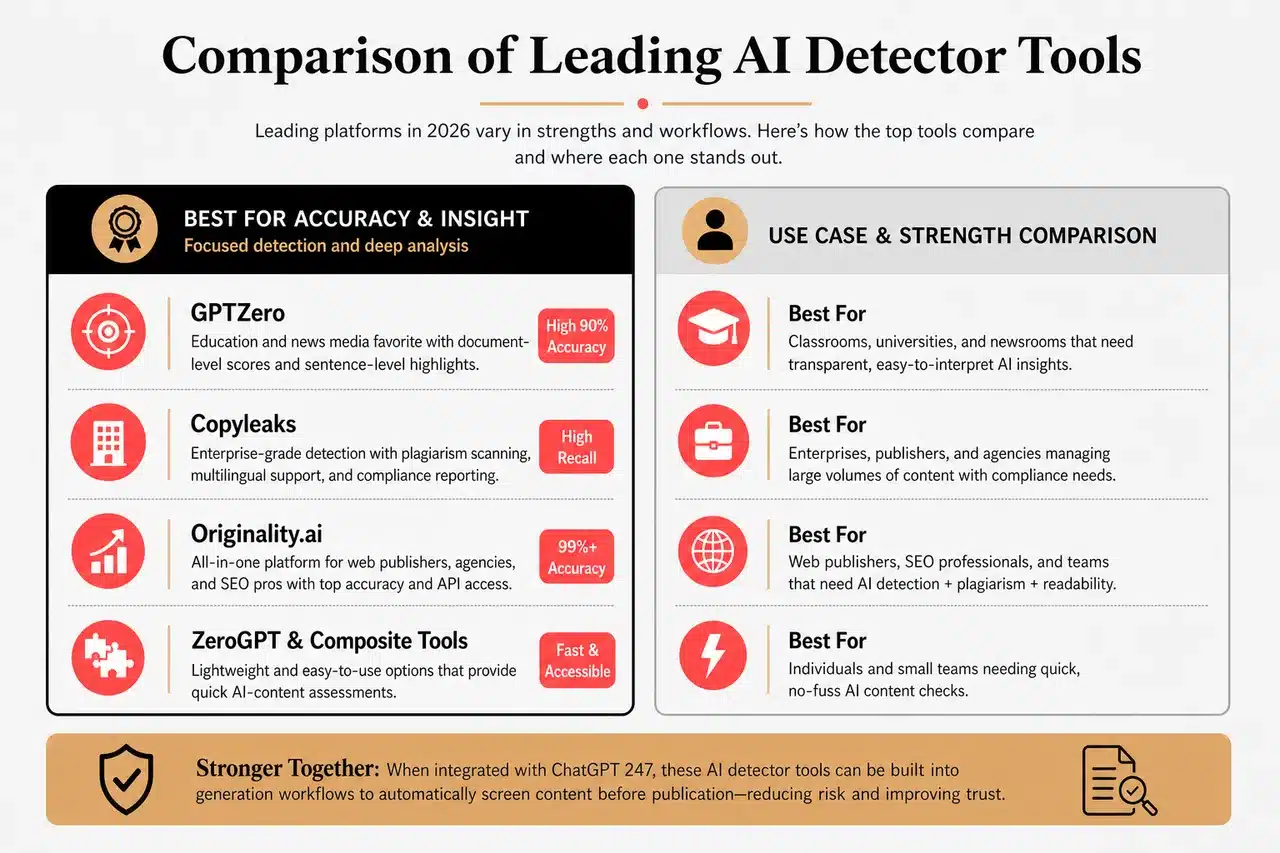
With so many options on the market in 2026, choosing the right ai detector depends on your goals, risk tolerance, and workflow. Below is an overview of leading platforms and where they stand out. When integrating with ChatGPT 247, these tools can be combined with generation workflows so that content is automatically screened before publication.
- GPTZero: Known for its focus on education and news media, GPTZero provides document-level scores and sentence-level highlights that help teachers, editors, and managers understand exactly where AI influence may exist. Independent lab tests have reported accuracy rates in the high 90 percent range when differentiating clearly human and clearly AI text, which explains its adoption by universities and media groups.
- Copyleaks: Favored by enterprises, Copyleaks offers AI detection alongside plagiarism scanning, multilingual support, and compliance-grade reporting. Its models are tuned for high recall even when AI content is blended with human edits, making it attractive to publishers and agencies who manage large content catalogs.
- Originality.ai: Positioned for web publishers, agencies, and SEO professionals, Originality.ai combines AI detection with plagiarism and readability checks inside one dashboard. Its latest benchmarks advertise accuracy near or above 99 percent on major models, and its API makes it straightforward to embed into content pipelines or connect with ChatGPT 247.
- ZeroGPT and composite tools: Services such as ZeroGPT and Monica’s AI detector aggregate multiple detection engines, including GPTZero and Copyleaks, and return consolidated scores. This ensemble strategy can reduce the risk of relying on a single model, especially for borderline or highly edited content.
- Quillbot, Grammarly, and Turnitin: These widely used writing and academic platforms now ship with built-in AI detection. Grammarly integrates detection into its browser extensions and desktop apps for real-time feedback, Turnitin embeds checks directly into learning management systems, and Quillbot offers both paraphrasing and detection for users who edit AI drafts.
- MyDetector, RewriteGuru, and Humanize-style tools: A newer wave of services combines detection with “humanization,” giving users suggestions for editing AI text so that it reads more naturally and passes stricter authenticity checks. These are often used by agencies and freelancers refining drafts produced by systems like ChatGPT 247.
Feature and Pricing Overview
Because each platform emphasizes different strengths, it is helpful to compare them across core capabilities that matter to individuals and businesses using ChatGPT 247 as part of their workflow.
| Tool | Primary Focus | Key Features | Typical Pricing Model | Best For |
|---|---|---|---|---|
| GPTZero | Education and journalism | Sentence-level highlights, document scores, LMS integrations, Chrome extension | Free tier plus paid plans for higher volume and institutional licenses | Schools, universities, newsrooms using ChatGPT 247 for research with strict disclosure rules |
| Copyleaks | Enterprise compliance | AI detection, plagiarism, multilingual support, API, LMS and CMS connectors | Subscription and per-scan pricing for teams and enterprises | Regulated industries, agencies, and large brands running bulk content from ChatGPT 247 |
| Originality.ai | Web publishing and SEO | AI detection, plagiarism, readability metrics, team management, API | Pay-as-you-go per credit with volume discounts | Blog networks, affiliate sites, and SEO teams vetting AI-assisted content |
| ZeroGPT / Monica | Multi-engine detection | Combined detectors, fast scans, simple interface, basic editing suggestions | Free basic checks with premium tiers for higher limits | Freelancers and small teams who want a quick second opinion on ChatGPT 247 outputs |
| Grammarly, Turnitin, Quillbot | Integrated writing workflows | Real-time detection within editors, LMS integrations, paraphrasing support | Freemium models and institutional licenses | Writers and educators who prefer detection inside their existing tools |
- Batch analysis at volume: Tools like ZeroGPT, Copyleaks, and Turnitin offer bulk upload and folder-based scanning, which is essential for teams auditing thousands of blog posts, documents, or student submissions generated with or alongside ChatGPT 247.
- APIs for workflow integration: GPTZero, Copyleaks, Originality.ai, and others provide APIs that can be connected to content management systems, custom dashboards, or ChatGPT 247 workflows. This enables real-time checks whenever a new draft is created, edited, or scheduled for publication.
- Plugins and browser extensions: Grammarly, GPTZero, and several newer tools offer browser extensions that surface AI detection scores directly inside Gmail, Google Docs, WordPress, or other web editors, minimizing friction and helping non-technical users stick to best practices.
- Flexible pricing tiers: Most providers use a mix of free tiers, pay-as-you-go credits, and enterprise subscriptions. Smaller teams can start with free or low-cost plans to cover critical use cases, then scale up as ChatGPT 247 adoption grows and compliance needs become more demanding.
Accuracy and Reliability
Accuracy remains one of the most scrutinized metrics in the ai detector market. Independent benchmarks and vendor reports often claim accuracies between 95 and 99 percent on test corpora that include both cleanly human and clearly AI-generated text. In practice, results depend heavily on the genre, language, and degree of editing applied after generation.
- Performance on unedited AI text: When detectors analyze raw outputs from major models like GPT-4, GPT-5 prototypes, or Gemini without additional human editing, many tools report accuracies in the high 90 percent range. This matches the situations where ChatGPT 247 outputs are pasted directly into blogs or emails without significant revision.
- Handling mixed or edited content: Accuracy drops when humans heavily edit AI drafts or splice machine-generated passages into otherwise human-written documents. Modern systems tackle this by highlighting suspicious segments and assigning per-sentence probabilities instead of a single pass-or-fail judgment.
- Trade-off between false positives and false negatives: Some platforms prioritize catching as much AI content as possible, accepting a higher rate of false positives, while others tune their models to reduce false accusations at the cost of occasionally missing subtle AI passages. Organizations should choose a calibration that matches their risk tolerance and clearly document how scores will be interpreted.
Step-by-Step Guide: Using AI Detectors for Content Verification
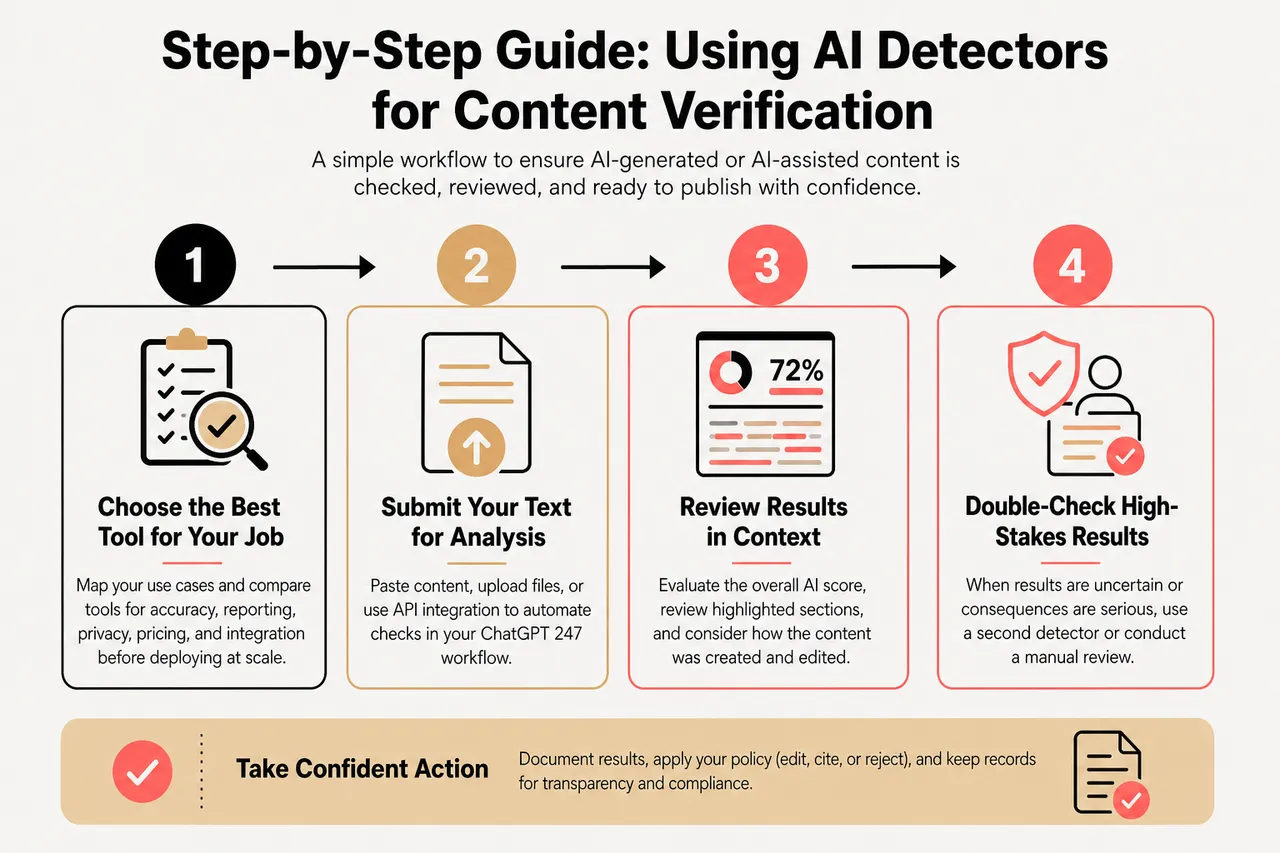
Adding an ai detector to your workflow does not have to be complicated. With a clear process, you can ensure that every piece of content generated or assisted by ChatGPT 247 is checked before it goes public.
- 1. Choose the best tool for your job: Start by mapping your use cases: classroom integrity, marketing copy, technical documentation, or regulatory reporting. If compliance and advanced reporting matter, Copyleaks or Originality.ai are strong candidates; if you need tight LMS integration, GPTZero or Turnitin may make more sense. Review their privacy policies, pricing, and integration options before deploying them at scale.
- 2. Submit your text for analysis: Most platforms allow you to paste content, upload files, or send text via API. For ChatGPT 247 workflows, it is often best to connect your detector through automation, so that drafts are checked automatically when they are saved, approved, or scheduled in your CMS.
- 3. Review the detection results in context: Detectors usually return an Generally AI probability score, sentence-level highlights, and sometimes explanations of why a passage was flagged. Instead of focusing solely on the headline percentage, compare highlighted segments to your knowledge of how the content was created and edited.
- 4. Double-check uncertain or high-stakes results: When results are borderline or consequences are serious, cross-check with a second detector or conduct a manual review. Combining two reputable tools can significantly reduce uncertainty, especially for long documents or research papers influenced by ChatGPT 247.
- 5. Document and store your reports: For organizations that answer to regulators, clients, or academic boards, keeping a record of detection reports is really important. Export and archive key scans so you can demonstrate due diligence and show how AI was used and verified at each stage.
Integrating with ChatGPT 247
Many top ai detector tools now offer direct integration with platforms like ChatGPT 247 through APIs and webhooks. This makes it possible to build a workflow where every generated draft is automatically scored for AI involvement before a human editor sees it. For example, a marketing team using ChatGPT 247 to produce blog outlines can configure an integration that sends final drafts to an ai detector when they are moved to the “ready for review” stage in the CMS.
The detection results can then be fed back into ChatGPT 247 as structured feedback, prompting the system or a human editor to adjust tone, insert additional original research, or rewrite flagged sections. Over time, this loop helps teams develop internal guidelines describing when AI assistance is appropriate, how it should be disclosed, and what detection thresholds must be met before publication.
Pros and Cons of AI Detectors for Content Verification
While ai detector tools are powerful allies in the era of generative AI, they must be deployed thoughtfully. Understanding the benefits and limitations helps you design policies that are both effective and fair.
Benefits of AI Content Detection
- Time savings and scalability: Manual line-by-line review of AI-assisted content does not scale. Detectors automate the first pass, quickly triaging thousands of pages so humans can focus on genuinely ambiguous or high-risk cases. For organizations that rely heavily on ChatGPT 247, this can transform content governance from an ad hoc effort into a manageable, repeatable process.
- Compliance and audit readiness: Many industries are starting to ask for documentation on how AI is used in content creation. Detector logs and reports provide a clear evidence trail that shows leadership, clients, and auditors that AI-generated content was identified, reviewed, and approved under defined rules.
- Brand and reputation protection: By detecting undisclosed or sloppy AI usage, organizations reduce the likelihood of public backlash, search engine penalties, or accusations of low-quality, “thin” content. This matters both for consumer trust and for long-term SEO, where search engines continue to stress quality and originality, regardless of whether AI was involved.
- Support for fair evaluation and learning: In schools and corporate training programs, detectors help educators distinguish between legitimate assistance from tools like ChatGPT 247 and unauthorized outsourcing of entire assignments to AI. When combined with clear policies, they support skill development rather than replacing it.
Limitations and Ethical Considerations
- False positives and human impact: Incorrectly labeling a human-written essay or article as AI-generated can damage trust and, in academic settings, unfairly affect a student’s record. Institutions need transparent appeal processes and guidelines explaining that detector scores alone are not sufficient evidence for serious sanctions.
- Privacy and data protection: Many detectors process text via cloud-based services. Before uploading confidential documents, evaluate where data is stored, how long it is retained, and whether it is used to train models. For sensitive industries, self-hosted or on-premise options may be preferable when integrating with ChatGPT 247.
- Arms race with evolving AI models: As generative models improve, they become harder to distinguish from human writers, particularly in languages and genres with less training data. Detectors must continually update to avoid obsolescence, and users should assume that no system is perfect, particularly on edge cases.
- Transparency and informed consent: Ethical use of ai detectors involves telling people when and how their work will be scanned. In education, journalism, and employment contexts, clear communication helps avoid feelings of surveillance and supports a culture of responsible AI use rather than fear.
Real-world Metrics: Adoption, Accuracy, and User Behavior
As ai detector technology matures, several measurable trends are shaping how individuals and organizations incorporate these systems into their workflows alongside tools like ChatGPT 247.
Market Growth and Adoption Patterns
Industry reports over the past one to two years consistently show rapid growth in AI content detection as a service. Providers report that enterprise usage and education sector demand have more than doubled as generative AI has entered everyday writing tasks. This surge is especially visible in sectors that publish at scale, such as digital media, e-commerce, and online education platforms.
User Demographics and Use Cases
Early adopters were primarily universities and plagiarism-focused organizations. In 2026, usage is far broader, including content agencies, SaaS companies, government departments, and freelance writers. Many of these users do not seek to ban AI entirely; instead, they want verifiable transparency about where tools like ChatGPT 247 were used so they can maintain quality standards and comply with emerging guidelines.
Behavioral Shifts Around Detection
The availability of detectors has changed how people interact with generative AI. Some users now routinely run their own drafts through detectors before submission to ensure they fall within acceptable thresholds, while editors and team leads rely on background scans as an additional safety net. This shared responsibility model reduces conflict, since both creators and reviewers see detection as a normal part of professional writing with AI.
Beyond Text: Emerging Detection Frontiers
Although this guide focuses on text-based ai detector tools, content verification in 2026 increasingly spans multiple media types, reflecting how people use AI systems, including ChatGPT 247, to generate images, audio, and video.
AI Image and Deepfake Detection
Specialized detectors for images and video analyze visual patterns, noise, and texture inconsistencies to determine whether a photo or clip was generated or manipulated by AI. These tools help newsrooms verify user-submitted visuals, support platforms in moderating deepfakes, and assist brands in confirming that product photos match reality rather than fabricated renders.
Multimodal Content Workflows
As multimodal AI models generate text, images, and audio together, organizations are beginning to combine text detectors with image and deepfake checkers inside the same pipeline. A single campaign produced with ChatGPT 247 might route copy to a text detector and visuals to an image classifier, creating a unified verification record for every asset that goes live.
Regulation, Policy, and SEO Implications
Regulators, search engines, and professional bodies have started to respond to the surge of AI-generated content, shaping how detection technology is used and what organizations must disclose.
Evolving Regulatory Expectations
Policy discussions in multiple regions now address disclosure of AI-generated content, algorithmic accountability, and data protection. While rules vary, a common theme is that organizations should be able to explain when and how AI systems influenced the information they publish. AI detectors provide the technical foundation for these explanations by documenting where generative tools were involved.
Search Engine and Platform Guidelines
Major search engines emphasize that high-quality, helpful content is the primary ranking factor, regardless of whether AI helped create it. However, low-effort, purely automated pages continue to be penalized. Detectors, combined with editorial review, help SEO teams ensure that ChatGPT 247 outputs are enriched with original analysis, data, and unique value before they are indexed.
Internal Governance and Policy Design
Organizations that use ChatGPT 247 at scale increasingly formalize AI usage policies: which teams can use generation tools, which content types require detectors, and what thresholds must be met before publication. Detection logs become part of governance dashboards, helping leaders track AI dependence and adjust training or oversight where needed.
FAQs About AI Detectors in 2026
- How accurate are AI detectors? Leading ai detector tools, such as GPTZero, Copyleaks, and Originality.ai, often report accuracy above 95 percent on benchmark datasets for clearly human versus clearly AI-generated text. Accuracy can be lower on heavily edited or mixed content, which is why many organizations rely on both detection scores and human review for critical decisions.
- Is my data safe when using AI detectors? Reputable tools publish clear privacy and data-handling policies, including whether text is stored, for how long, and whether it is used to train models. Before uploading confidential material, especially when working with ChatGPT 247 in sensitive domains, confirm that your detector offers encryption in transit and at rest and supports regional data residency if needed.
- How do I choose the right AI detector? Start with your primary use case: academic integrity, brand protection, compliance, or SEO. Then compare tools on accuracy, transparency of scoring, integration options with platforms like ChatGPT 247, and cost. Running trial scans across several detectors with your own sample content is often the fastest way to see which one aligns with your expectations.
- Can AI detectors identify content from all models? Most modern detectors are trained on outputs from multiple large language models, including GPT, Gemini, Claude, Llama, and others. However, performance may vary for niche or proprietary models. If your organization relies on a specific generator connected to ChatGPT 247, ask vendors whether they have tested on that model family.
- What should I do if a detector flags my human-written work? False positives are possible. Document how the content was created, request a review, and if necessary, have it checked by an alternative tool. Institutions should avoid taking severe action based solely on one detector’s score and instead treat it as one piece of evidence within a broader review process.
The Future of AI Detectors and Content Authenticity
AI-generated content is now a permanent part of the digital landscape, and the need for robust verification tools will only increase. As we move further into 2026, ai detector solutions are expected to become more accurate on nuanced, heavily edited content, faster in large-scale batch scanning, and more tightly integrated into platforms like ChatGPT 247, content management systems, and collaboration suites.
For individuals and organizations alike, mastering the use of ai detector tools is now part of the content creation process. Teams that embrace detectors as a normal checkpoint, rather than a punitive surveillance tool, are better positioned to harness the strengths of generative AI while maintaining high standards of quality and transparency. By staying informed about the latest technology, choosing the right solutions for your needs, and blending automation with human expertise, you can confidently protect your brand and your audience from the risks of unauthentic or undisclosed AI-generated content.
- AI detectors as essential safeguards: In 2026, detectors function like spellcheck for authenticity, providing a routine but really important layer of protection whenever ChatGPT 247 or other AI tools are involved in drafting content.
- Choosing tools that fit your ecosystem: The most effective solutions align with your existing platforms, governance requirements, and team habits, minimizing friction while maximizing coverage across all your communication channels.
- Human expertise as the decision-maker: Even as detection models improve, the most trustworthy results emerge when AI signals are interpreted by experienced editors, educators, and leaders who understand the broader context of how and why content was created.