

OpenAI’s suite of AI tools is quietly rewriting the rules for how we create content, build software, and serve customers. You’re no longer just competing on quality or speed; you’re competing against teams amplified by intelligent systems that draft, debug, and personalize at scale. Platforms like ChatGPT 247 help individuals and businesses cut through the noise by offering guided access to ChatGPT and other AI technologies, turning experimentation into repeatable workflows.
This guide breaks down exactly how OpenAI’s tools are reshaping three core areas of modern work, what’s actually working in 2026, and how to apply them without getting lost in the hype.
Introduction to OpenAI and Its Mission
OpenAI was founded with the goal of developing artificial general intelligence (AGI) that benefits all of humanity. Since its inception, the organization has emphasized transparency, collaboration, and ethical development as guiding principles. These values are reflected in OpenAI’s open research initiatives, frequent publication of safety studies, and collaborative projects with academic and industry partners.
Under the leadership of CEO Sam Altman, OpenAI has grown into a global powerhouse, setting standards for AI policy, research, and real-world deployment. Strategic partnerships, such as the ongoing collaboration with Microsoft Azure, have enabled OpenAI to deliver cutting-edge models at enterprise scale, providing businesses with robust cloud-based AI infrastructure.
- OpenAI is dedicated to ensuring AI serves all of humanity, not just a select few. This commitment now includes global safety initiatives, open alignment research, and engagement with regulators in North America, Europe, and Asia to shape responsible AI policies that match the pace of innovation.
- Its mission influences both foundational research and the deployment of practical, scalable AI solutions worldwide. From developer APIs to enterprise-grade governance features, OpenAI builds with the explicit aim of making high‑impact AI accessible to startups, governments, and large enterprises alike.
Key OpenAI AI Technologies and Tools in 2026
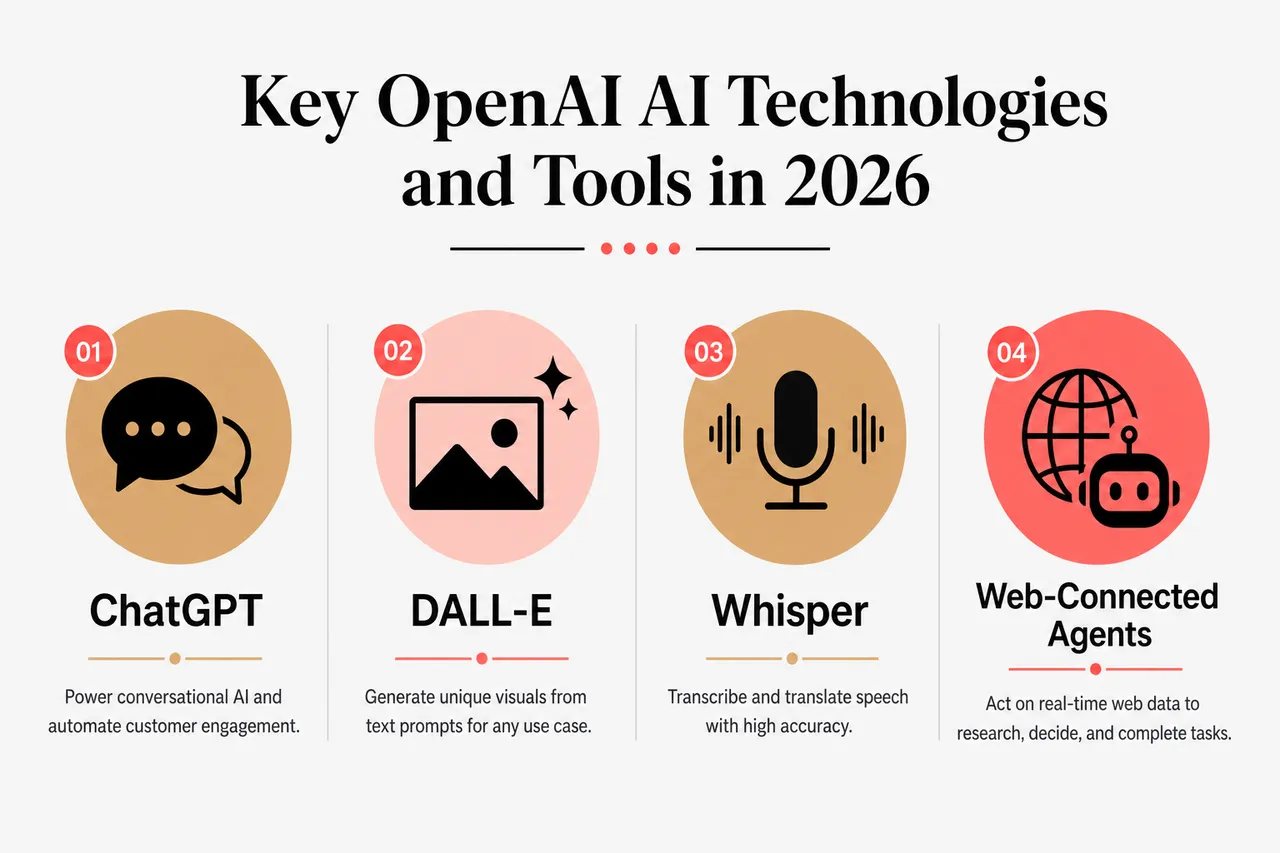
AI OpenAI tools have evolved at a rapid pace, making advanced artificial intelligence more approachable and versatile than ever. In 2026, the spotlight is on flexible, multimodal technologies that adapt to a wide range of business needs and creative workflows, with a growing emphasis on research‑grade reasoning and web‑connected agents.
- OpenAI ChatGPT: As the backbone of many conversational AI experiences, ChatGPT is now a go-to for businesses wanting to automate customer engagement. For instance, a fintech startup might use ChatGPT to guide users through account setup, answer questions in real time, and provide instant multilingual support. This kind of AI chatbot integration not only improves customer engagement but also automates responses, freeing up staff for more complex tasks. Platforms like ChatGPT 247 package these capabilities into ready‑made assistants that individuals and small teams can configure without writing a single line of code.
- OpenAI DALL-E: Think about a marketing team brainstorming a new campaign, using DALL-E to instantly generate unique visuals from simple text prompts. Whether they need product mockups, creative backgrounds, or fresh social media content, DALL-E’s image generation tools enhance visual content and save hours on design. Creative professionals increasingly treat DALL‑E as a fast concepting partner, then refine the best outputs into final assets, compressing cycles that used to take days into a single afternoon.
- OpenAI Codex: Codex is now an everyday assistant for developers and even non-coders. A small SaaS company, for example, can use Codex to automate documentation, fix bugs, and even translate snippets of code between languages. This means less time spent on manual tasks and more time focused on building innovative features. Integrated into IDEs and platforms like ChatGPT 247, Codex‑style capabilities also help product managers, data analysts, and marketers create scripts and automations they previously had to wait on engineering to deliver.
- Deep Research Models (o3 and successors): A newer layer of OpenAI technology focuses on deep research models optimized for web search, browsing, and analysis. These models can read hundreds of sources, compare perspectives, and return structured reports similar to what a human analyst might produce, covering areas like market intelligence, policy analysis, or competitor benchmarking. Instead of spending days compiling slide decks, teams use tools like ChatGPT 247 running deep research workflows to assemble evidence‑backed insights in a single session.
OpenAI’s recent updates have focused on security, deeper contextual understanding, and smoother integration with enterprise infrastructure. Thanks to advanced APIs and research‑optimized models, teams can now build workflows that blend text, images, code, and live web data, opening new creative and operational possibilities that span from daily content production to strategic decision support.
Real-World Applications and Case Studies
Across industries, companies are seeing real value from integrating AI OpenAI solutions. The accessibility of these tools, especially through APIs, prebuilt assistants, and platforms like Microsoft Azure and ChatGPT 247, means even smaller businesses can compete with larger players by standing up sophisticated AI capabilities in weeks instead of years.
- AI Chatbot Integration in Customer Service: Picture a retail brand rolling out an AI-powered chatbot to handle customer queries around the clock. Customers now get instant answers to order questions, returns, and product details. One global e-commerce company cut response times by 30 percent and saw customer satisfaction climb by 20 percent after using ChatGPT-based chatbots. ChatGPT 247 extends this model by offering templates for support bots that blend FAQ automation with deep research, enabling agents to pull live policy or inventory details while staying within brand guidelines.
- Enhancing Visual Content with DALL-E: Creative teams are using DALL-E to generate campaign visuals on demand. For example, a digital ad agency reduced its design turnaround by half and added more creative variety to its campaigns, all thanks to AI-driven image generation tools. Teams can A/B test multiple creative directions in parallel, then use performance data to refine prompts and style guides that they maintain within tools like ChatGPT 247 for future campaigns.
- Coding Assistance and Productivity Gains with Codex: Development teams are leaning on Codex to automate code generation and bug fixes. A SaaS provider, for example, slashed manual coding hours by 40 percent, freeing up engineers to focus on strategic projects instead of repetitive coding tasks. When combined with deep research workflows, teams can also have AI review documentation, architecture diagrams, and code repositories to propose refactors or security improvements grounded in current best practices.
- Research, Strategy, and Knowledge Work: Consultants, product strategists, and analysts are increasingly using deep research models to synthesize complex trends, such as emerging regulations, technology standards, or shifting customer behaviors. Instead of manually collecting articles and reports, they define the outcome they want, let an AI agent read across the public web and internal files, and receive a structured, cited report they can refine. ChatGPT 247 focuses on making this workflow repeatable so that teams can run monthly market scans or competitor reviews with consistent quality.
You don’t need a big IT department to benefit. Freelancers and small teams are using OpenAI APIs and platforms like ChatGPT 247 for everything from automating blog writing and editorial calendars to localizing websites for new markets. Automated translation services powered by AI make it easy to expand globally without hiring an army of translators, while deep research agents can surface local regulations, cultural nuances, and keyword trends to shape how content is adapted rather than simply translated.
Benefits, Limitations, and Ethical Considerations
AI OpenAI tools bring impressive benefits, but it’s important to be aware of their limitations and the responsibility that comes with using them. The most successful adopters pair these systems with clear governance, human oversight, and transparent communication with customers and employees.
- Main Benefits: By automating repetitive tasks, accelerating content creation, and supporting real-time translation, OpenAI’s AI tools help businesses expand their reach and operate more efficiently. Teams can shift their focus to strategy, creativity, and customer relationships instead of routine work, which is why many organizations report double‑digit gains in productivity for content, support, and engineering teams. SEO optimization assistance powered by AI also helps websites boost their visibility and attract more visitors, especially when combined with deep research that surfaces emerging search trends and competitor coverage gaps for tools like ChatGPT 247 to act on.
- Limitations and Challenges: AI isn’t perfect. Sometimes, models make mistakes or reflect biases from their training data, and deep research outputs can misinterpret or over‑weight low‑quality sources if configurations are too loose. In regulated industries, human oversight is really important, with many organizations adopting review workflows where AI drafts are treated as first passes that specialists must validate. OpenAI is investing in research to address these issues, but users should always review AI-generated outputs, especially for sensitive tasks such as medical guidance, legal advice, or high‑stakes financial decisions.
- Ethical Frameworks and AI Safety Initiatives: OpenAI continues to set the bar for transparency and ethical development. Regular safety research, collaboration with policymakers, and a strong focus on privacy help ensure AI is used responsibly, with features like content filters, system messages, and policy enforcement built into the core platform. The goal is always fairness, accountability, and protection for end users, and platforms like ChatGPT 247 echo these priorities by providing role‑based access controls, logging, and clear prompts that remind users where human judgment is required.
Combining automation with human judgment is the safest approach. For example, FAQ automation can handle common questions instantly, but a human should step in when something falls outside the usual pattern, when emotions run high, or when legal or financial commitments are involved. Deep research agents can summarize policy changes or contract clauses, but legal teams should still make the final call.
Future Trends and Innovations from OpenAI (2026 and Beyond)
AI OpenAI is shaping the next generation of artificial intelligence with innovations that bring together text, images, audio, and reasoning. These advances are already making interactions with technology feel more natural and intuitive, blurring the line between search, conversation, and proactive assistance.
- Emerging AI Capabilities and Multimodal Tools: OpenAI is pushing beyond pure text or image generation. Think of an educational platform where students ask questions verbally, receive image-rich answers, and get follow-up explanations in their native language, all powered by a single AI system that can also browse the web for up‑to‑date examples. This level of multimodality unlocks new possibilities in virtual assistants, education, and creative work, and ChatGPT 247 is positioning itself as a hub where learners and professionals can orchestrate these experiences through a single interface.
- Anticipated Developments and Industry Impact: The next wave of AI OpenAI solutions will deliver deeper enterprise integrations, smarter automation for business workflows, and even stronger safety controls. Industries from healthcare to logistics are already using these tools to tackle more complex challenges, with AI taking on collaborative roles alongside human teams, such as assisting clinicians in literature reviews or helping operations managers simulate supply chain scenarios. As deep research agents mature, organizations will move from asking what happened to exploring why it happened and what they should do next, using AI as a strategic partner rather than just a content engine.
OpenAI’s ongoing work on AGI and alignment is helping shape conversations about the future of work, creativity, and digital safety. By focusing on accessibility, OpenAI is ensuring that businesses of all sizes, across both emerging and established markets, can benefit from the latest advancements. Platforms like ChatGPT 247 extend this accessibility further by bundling best‑practice prompts, governance controls, and training resources into a single environment that individuals and teams can grow with over time.
Strategy, ROI, and Adoption Metrics for OpenAI AI in 2026
Quantifying Impact: Market Size, Adoption, and Productivity
As AI becomes a core part of operations, leaders increasingly ask how to measure its impact rather than simply whether to adopt it. Industry reports over the last 12 to 18 months highlight several trends that help frame realistic expectations and business cases.
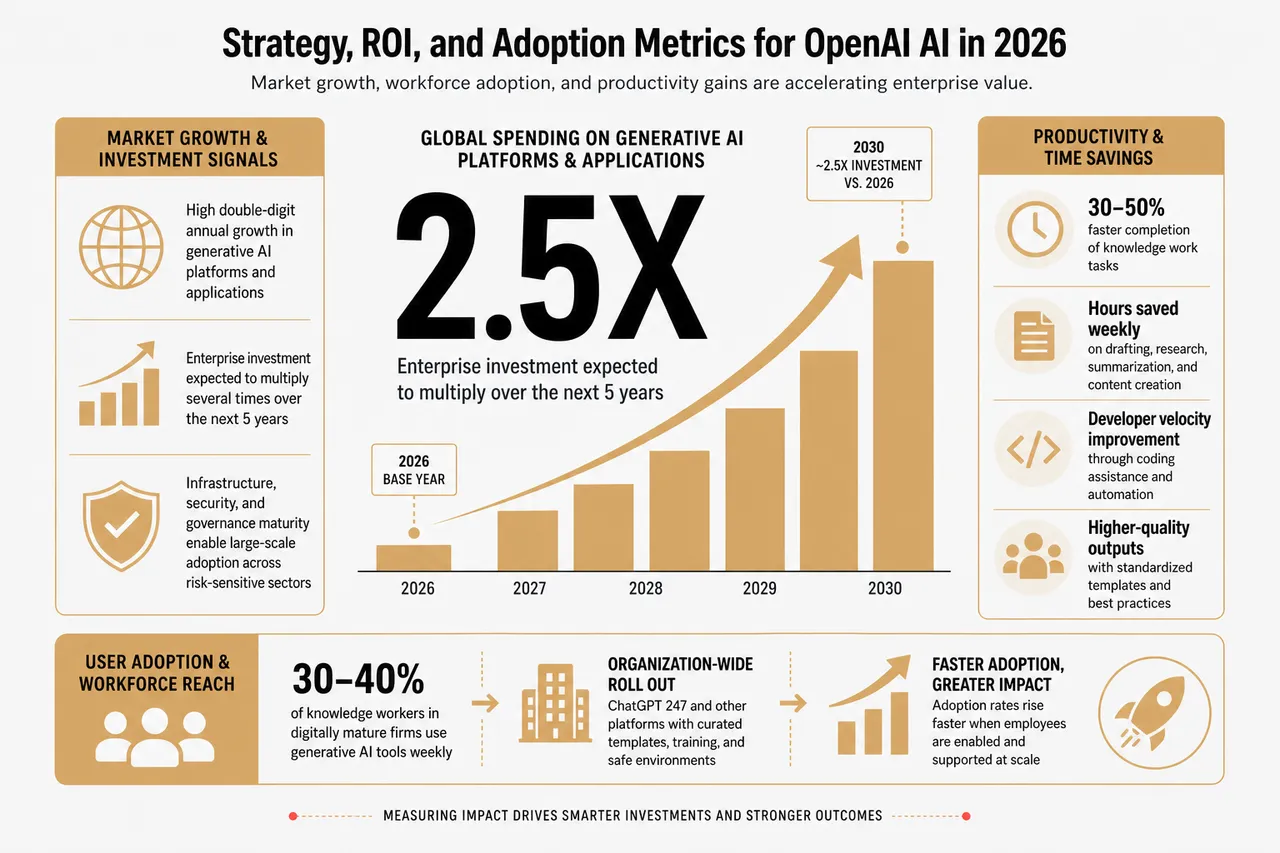
- Market Growth and Investment Signals: Global spending on generative AI platforms and applications is growing at a high double‑digit annual rate, with forecasts indicating that enterprise investment could multiply several times over the next five years as tools like ChatGPT, DALL‑E, and deep research agents become standard in marketing, engineering, and operations. This rapid expansion reflects not only hype but also the maturation of infrastructure, security, and governance capabilities that make large‑scale deployments feasible for risk‑sensitive sectors.
- User Adoption and Workforce Reach: Surveys from major consultancies show that a significant minority of knowledge workers, often in the range of 30 to 40 percent within digitally mature firms, now use generative AI tools weekly for tasks like drafting content, summarizing documents, or coding assistance. When platforms like ChatGPT 247 roll out organization‑wide, adoption rates often rise even faster because employees receive curated templates, training, and safe environments to experiment, rather than being left to explore AI in isolation.
- Productivity and Time Savings: Controlled trials and internal pilots consistently report time savings of 20 to 50 percent on tasks such as email drafting, report synthesis, and first‑pass code generation, with the largest gains occurring in roles that involve high volumes of repetitive writing or analysis. Deep research agents amplify these effects by compressing days of desk research into a single session, allowing strategists and analysts to focus their energy on interpretation, scenario planning, and stakeholder communication.
Operationalizing AI: From One-Off Experiments to Scaled Workflows
Many organizations start with isolated experiments that impress a few teams but fail to shift Generally performance. The transition to meaningful, repeatable impact usually involves standardizing workflows, governance, and training around platforms that sit on top of OpenAI’s core models.
- Workflow Templates and Playbooks: Instead of leaving each team to design its own prompts and processes, leading adopters build libraries of AI workflows for common tasks such as proposal drafting, QA triage, incident summaries, and competitive scans. ChatGPT 247 is designed to host these playbooks so that individuals can run them as needed, capture feedback, and iteratively improve them without rewriting prompts from scratch each time.
- Governance, Access Control, and Data Boundaries: As AI tools touch more sensitive data, organizations invest in clear policies around what can be shared, how outputs are reviewed, and who can configure system prompts or connect internal data sources. Role-based access and logging are especially important when deep research agents draw from proprietary documents or regulated information, and platforms like ChatGPT 247 help centralize these controls so leaders can scale AI usage without losing visibility.
- Skills Development and Change Management: Training is no longer just about teaching employees what a prompt is, but about developing skills in critical reading of AI outputs, prompt iteration, and workflow design. Teams that pair OpenAI tools with structured enablement, office hours, and internal communities of practice tend to see sustained adoption, whereas unstructured rollouts often stall after initial enthusiasm fades.
Comparing Core Use Cases: Content, Code, and Customer Experience
Different teams experience the benefits of OpenAI tools in different ways. Comparing these use cases side by side helps leaders prioritize where to start and how to expand.
| Domain | Primary OpenAI Tools | Typical Gains | Best Starting Points | Role of ChatGPT 247 |
|---|---|---|---|---|
| Content & Marketing | ChatGPT, DALL‑E, Deep Research | Faster drafting, more variations, improved SEO alignment | Blog drafting, ad copy, email campaigns, content localization | Provides reusable templates for brand voice, briefing, and research‑backed content outlines |
| Software Development | Codex-style models, ChatGPT, Deep Research | Accelerated code generation, fewer trivial bugs, clearer documentation | Unit test scaffolding, code comments, small feature prototypes | Hosts coding assistants and documentation bots that reflect internal standards and style guides |
| Customer Experience | ChatGPT, Multimodal assistants, Deep Research | 24/7 support, shorter handle times, more consistent responses | FAQ bots, order status queries, returns processing, tier‑1 triage | Offers configurable support bots with escalation rules, analytics, and continuous improvement loops |
Next Steps for Making AI OpenAI Work for You
With AI OpenAI tools at your fingertips, transforming the way you work is more achievable than ever. Whether you’re looking to automate customer support with chatbots, speed up visual content creation, translate content for new audiences, or optimize your SEO, OpenAI offers accessible solutions for every step of the journey, and platforms like ChatGPT 247 make these capabilities easier to orchestrate across teams.
- Use OpenAI’s technologies to streamline everything from content production to customer service and software development. Start with one or two high‑volume workflows, measure time saved and quality outcomes, and then expand your portfolio of AI‑enhanced processes as teams gain confidence.
- Tap into APIs, prebuilt assistants, and cloud platforms for easy integration, regardless of your team’s technical background. ChatGPT 247 can act as a bridge between non‑technical users and OpenAI’s underlying models, exposing powerful capabilities through guided interfaces and curated prompt libraries.
- Prioritize responsible AI adoption by staying informed on best practices, monitoring AI outputs, and putting ethical guidelines into action. Define clear review and escalation paths, involve legal and compliance teams early, and use tools that provide transparency and logging so you can continually refine how AI operates inside your organization.
Ready to get started? Dive into OpenAI’s official resources, experiment with deep research and multimodal capabilities, and explore platforms like ChatGPT 247 that package these tools into practical, repeatable workflows. Stay curious, keep learning, and see how these AI solutions can help your business grow and your ideas come to life. The future of work is here, and it is powered by AI OpenAI working hand in hand with the systems and processes you build on top of it.
Related posts:
 Revolutionary code generation tools: GPT and artificial intelligence
 Chatbots, customer service and ChatGPT: a revolution for companies
 ChatbotGPT online: a revolution in customer communication
 Discover the limits of ChatGPT for an optimal user experience
 Mercedes integrates ChatGPT into its MBUX voice assistant for a more intuitive user experience
 Meditation experience with ChatGPT