
Choosing the wrong AI language model can cost you time, money, and credibility. With dozens of options flooding the market in 2026, each promising different capabilities, knowing which model fits your specific needs has become a strategic skill. Whether you’re automating customer support, generating content, or building conversational interfaces, the model you select directly impacts quality, speed, and cost-efficiency.
ChatGPT 247 helps individuals and businesses navigate this landscape by offering practical insights into AI technologies and tools that match real-world applications. This guide breaks down how different models work, what sets them apart, and a clear framework for choosing the one that delivers results for your use case.
Introduction to AI Language Models
AI language models are advanced algorithms designed to understand, generate, and manipulate human language. At their core, these models enable computers to process natural language, making them essential for applications such as translation, text summarization, and conversational AI. Their rise reflects the broader progress in natural language processing and generative AI, reshaping how technology interacts with people in daily life and business.
Definition and Purpose
AI language models work by analyzing huge amounts of text to grasp how people naturally communicate. They are the engines behind many everyday tools, from smart chatbots that answer customer questions around the clock to automated translation services that instantly localize content for global audiences. For instance, a retail business can deploy an AI assistant to respond to product availability questions in seconds, freeing human agents to focus on higher-value, complex interactions. This kind of seamless, automated communication is possible because of the powerful pattern recognition and language modeling at the heart of these systems.
Evolution of Language Models
Language models have evolved through several generations of technology. Early systems relied on strict, rule-based logic that could only handle narrow language tasks, followed by statistical models that learned from data but still struggled with nuance, long-range context, and ambiguity. The introduction of large language models such as GPT and BERT, trained on billions of words using deep neural networks, marked a major step change in fluency and adaptability. A legal tech platform in 2026 can now rely on an LLM Basically thousands of pages of contracts in minutes, where the same work once required days of manual review.
- Modern AI language models power everything from content creation platforms and smart assistants to multilingual communication tools, making them a core part of digital infrastructure rather than optional add-ons.
- Although these systems can mimic human-like understanding, their outputs are based on statistical associations in training and reference data rather than genuine comprehension or intent.
- AI language models now drive a wide variety of digital tools and platforms, including search assistants, knowledge management copilots, and domain-specific expert systems in finance, law, and medicine.
- Their effectiveness continues to grow as deep learning architectures improve, training data expands, and organizations adopt techniques such as retrieval-augmented generation to ground responses in real, up-to-date information.
How AI Language Models Work
The core capabilities of AI language models arise from machine learning, especially deep neural networks trained on very large text and multimodal datasets. During training, a model is exposed to books, articles, code, documentation, and curated web content, learning to predict the next token in a sequence. Over time, this simple prediction objective leads to sophisticated behaviors such as following instructions, reasoning across long documents, and generating detailed responses tailored to user prompts.
Neural Networks and Deep Learning
Most leading language models in 2026 use transformer-based neural networks. Transformers process all tokens in a sequence in parallel and use attention mechanisms to focus on the most relevant words or phrases, even when they are far apart in a sentence or document. This architecture is especially effective in preserving context over long conversations, complex documents, or multistep workflows.
For example, ChatGPT 247 uses transformer models configured to track prior turns in a dialogue so that the system can tailor responses to a user’s earlier questions, preferences, and clarifications. The same mechanisms enable enterprise assistants Basically entire project histories, codebases, or case files without losing critical detail. As context windows grow beyond 100,000 tokens in cutting-edge systems, a model can ingest whole books, long legal agreements, or years of support tickets in a single operation.
Tokens, Parameters, and Training
Tokens are the atomic units of text for language models; they may represent words, subwords, or characters. During training, the model observes sequences of tokens and adjusts billions or even trillions of parameters to minimize prediction errors. Each parameter is a weight inside the neural network that influences how the model combines and transforms token representations into meaningful outputs.
Larger models, such as frontier systems with hundreds of billions of parameters, typically demonstrate stronger reasoning, code generation, and generalization, but they also demand more compute and can be more expensive to run. In contrast, smaller models fine-tuned for a specific task or domain often achieve comparable or better performance on narrow problems at a fraction of the cost. This is one reason many organizations now deploy a mix of models: a compact assistant for fast, routine queries and a larger expert model for complex reasoning or high-stakes decisions.
- Training on diverse, high-quality data and regularly updating knowledge via retrieval or fine-tuning are critical for avoiding outdated or biased outputs, especially in regulated sectors like finance and healthcare.
- Choosing the right balance between model size, latency, and accuracy helps ensure a good user experience while keeping infrastructure costs manageable as usage scales.
- AI language models depend on robust deep learning architectures to deliver high performance in real-world tasks such as summarization, question answering, and code generation.
- Data curation, model design, and deployment strategy often matter as much as raw parameter count, which is why many high-performing systems in 2026 are specialized or augmented instead of simply being the largest available.
Leading AI Language Models in 2026: Comparison and Features
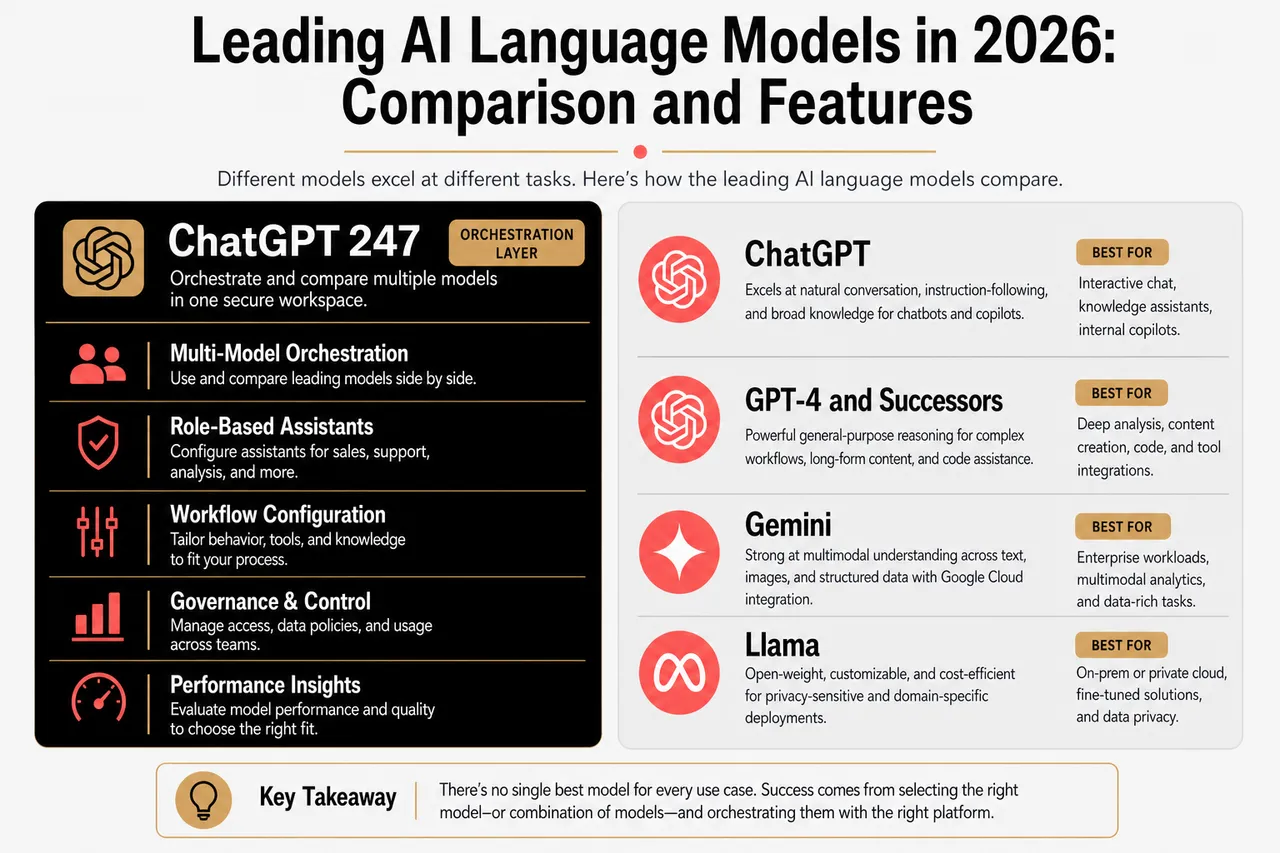
By 2026, the AI landscape has shifted from a handful of dominant general-purpose models to an ecosystem of specialized systems tuned for different workloads. Enterprises no longer ask which single model is best; instead, they evaluate families of models, open-weight options, and platform ecosystems. ChatGPT 247 sits on top of this evolving stack, helping users orchestrate and compare multiple models in one place.
ChatGPT, GPT-4, Gemini, and Llama: Overview
- ChatGPT: ChatGPT is widely recognized for its natural conversational tone, instruction-following behavior, and broad general knowledge. It works well for interactive chatbots, knowledge assistants, and internal copilots. Through platforms like ChatGPT 247, teams can configure role-based assistants for sales, support, or analysis, ensuring the same underlying model behaves differently depending on the workflow.
- GPT-4 and successors: GPT-4 and its follow-on variants remain strong general-purpose reasoning models that support complex workflows such as multi-document analysis, long-form content creation, and code assistance. Organizations adopt these models when they need sophisticated reasoning, high-quality output, and tight integration with tools such as spreadsheets, code repositories, and CRM systems.
- Gemini: Google’s Gemini family is tightly integrated with the Google Cloud ecosystem and excels in multimodal scenarios where text, images, and structured data must be processed together. Banks, telcos, and multinational enterprises often adopt Gemini to build multilingual assistants, automate back-office processes, and integrate AI into analytics pipelines while leveraging existing cloud security and governance.
- Llama and other open-weight models: Llama and similar open-weight models give organizations full control over deployment, customization, and data handling. They are attractive for research, niche domains, or use cases where data residency, on-premises deployment, or air-gapped environments are mandatory. Many companies now pair open-weight models with retrieval-augmented generation so internal documentation and knowledge bases can be securely accessed without sending sensitive data to external providers.
Comparison Table: Key Features and Use Cases
| Model family | Typical strengths | Deployment style | Relative cost profile | Best-fit applications |
|---|---|---|---|---|
| ChatGPT | Conversational fluency, broad knowledge, strong instruction following in everyday language. | Cloud API and hosted interfaces; often accessed via platforms such as ChatGPT 247 for configuration and orchestration. | Moderate; pricing is usage-based, which can be optimized by caching and routing simpler tasks to smaller models. | Customer support chatbots, website assistants, internal knowledge copilots, and FAQ automation. |
| GPT-4 and successors | High-end reasoning, long-context analysis, strong performance on coding and complex problem solving. | Cloud-first via APIs and enterprise integrations with major productivity suites and developer tools. | Premium; best used for high-value tasks or layered with smaller models for cost control. | Research support, multi-document summarization, code copilots, and high-stakes content generation. |
| Gemini | Multimodal inputs, deep integration with cloud analytics, and scalable enterprise deployment patterns. | Native to Google Cloud, with strong hooks into storage, security, and data platforms. | Custom or enterprise-tier; costs are often bundled into broader cloud spending and negotiated contracts. | Contact center modernization, multilingual knowledge search, and analytics copilots linked to enterprise data. |
| Llama and other open-weight models | Customizability, local deployment, and tight control over data and model behavior. | Self-hosted in data centers, private clouds, or even edge devices; frequently used inside secure networks. | Lower licensing costs, with infrastructure and operations as the main expenses. | Domain-specific applications, on-premises automation, research environments, and privacy-sensitive workloads. |
- There is no universal best model; many organizations achieve the best results by routing simple tasks to smaller, cheaper models and reserving frontier systems for complex reasoning or sensitive decisions.
- Pilot projects that compare two or three candidates on real workloads provide far more reliable insight than synthetic benchmarks alone, especially when latency, cost, and user satisfaction all matter.
- Some models excel at natural conversation and low-friction integration with everyday tools, while others are designed for dense technical content, code, or multimodal tasks.
- Taking time to benchmark candidate models against your real documents, queries, and workflows is one of the most reliable ways to avoid overpaying for performance that does not translate into your specific context.
Practical Applications and Use Cases
Across industries, AI language models have moved from experiments to core components of digital operations. Organizations of all sizes rely on them to automate routine tasks, assist human experts, and personalize experiences at scale. ChatGPT 247 focuses on making these capabilities accessible by packaging advanced models into approachable workflows for support, content, and analysis.
AI Chatbots and Virtual Assistants
During peak demand periods such as holiday sales or product launches, AI chatbots can handle thousands of simultaneous conversations, answering questions about orders, billing, and product features without forcing customers to wait in queues. In many deployments, human agents only step in when the model flags uncertainty or when a conversation touches on sensitive topics like refunds or contractual terms. Internally, virtual assistants help employees by drafting emails, preparing meeting summaries, and surfacing relevant documents, turning hours of manual work into a few minutes of review.
Content Creation and Translation
Content teams increasingly use language models as creative partners rather than simple text generators. A marketer might ask an assistant on ChatGPT 247 to propose five campaign concepts for a new product, then iterate on the most promising ideas with refined messaging and tone adjustments. The same model can localize the final copy into multiple languages while preserving intent and style, making it much easier to maintain a consistent brand identity across regions. For technical documentation and support articles, AI-driven translation and summarization help companies keep multilingual help centers aligned with frequent product updates.
Industry-Specific Applications
- Legal services: Law firms and in-house legal teams use AI to pre-screen contracts, extract key obligations, and identify unusual clauses that warrant deeper inspection. Instead of replacing attorneys, these tools accelerate early review and free legal experts to focus on strategy, negotiation, and risk assessment.
- Healthcare and life sciences: Language models assist clinicians by summarizing long patient histories, drafting clinical notes, and explaining complex procedures in patient-friendly language. In research settings, AI copilots help teams scan large volumes of scientific literature, compare trial protocols, and synthesize findings into concise overviews.
- E-commerce and customer experience: Retailers use AI to recommend products based on previous behavior, generate dynamic descriptions tailored to different audiences, and maintain always-on support across chat, email, and social channels. The result is a more personalized shopping journey, with AI quietly coordinating the right message at the right moment.
- AI language models now support full customer journeys, from pre-sales education and interactive demos to post-purchase support and retention campaigns.
- Combining language models with image generation, recommendation systems, and analytics allows businesses to deliver truly personalized experiences that adapt in real time to user behavior.
- From automating frontline support to augmenting specialist knowledge work, AI language models help teams operate with a blend of speed and depth that used to require much larger headcounts.
How to Choose the Right AI Language Model
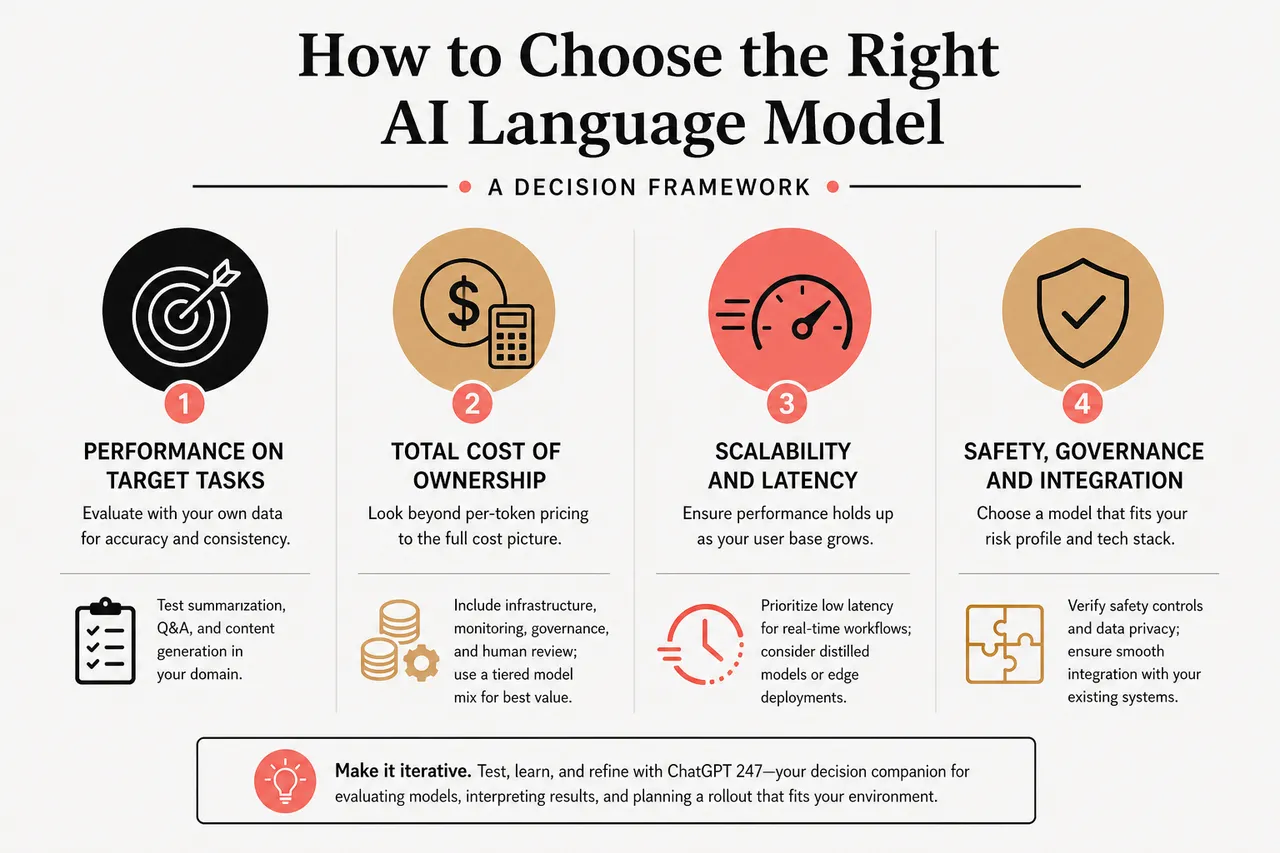
Choosing the best AI language model for your needs is less about brand names and more about strategic alignment with your goals, constraints, and risk tolerance. ChatGPT 247 acts as a decision companion in this process, helping you test models, interpret results, and design a rollout that fits your technical environment.
Evaluation Criteria and Decision Framework
- Performance on target tasks: Instead of relying solely on public benchmarks, design small test suites using your own anonymized data. Measure how well each model summarizes documents, answers questions, or generates content in your domain. Pay attention to both accuracy and consistency, since a model that performs brilliantly some of the time but fails unpredictably can erode user trust.
- Total cost of ownership: Look beyond per-token pricing to include infrastructure, monitoring, governance, and any human review required for high-risk outputs. In many cases, using a less expensive open-weight model for 80 percent of traffic and reserving a premium API for the most complex 20 percent yields a better Generally cost profile without sacrificing quality.
- Scalability and latency: Consider how model response times change as your user base grows. If you plan to embed AI into real-time workflows such as customer chat or interactive dashboards, latency becomes as important as accuracy. Smaller distilled models or edge deployments may offer better user experiences than always calling a large central model.
- Language and modality support: Verify that the model supports all required languages and, if needed, audio or image inputs. For global organizations, it is often more efficient to standardize on a multilingual model than to maintain separate, siloed systems for each region.
- Vendor reliability and ecosystem: Examine a provider’s track record on uptime, incident handling, and security. Also assess the strength of the surrounding ecosystem: SDKs, integrations with your existing tools, community resources, and third-party extensions. Platforms like ChatGPT 247 can help smooth integration by offering a consistent interface across multiple vendors.
- Ethics, compliance, and data governance: Ensure that any model you adopt can meet regulatory obligations in your jurisdiction. This includes options for data residency, audit logs, content filtering, and explainability where required. In sensitive sectors, open-weight models that you control directly may simplify compliance and security reviews.
Checklist: Selecting an AI Language Model
- Clarify your primary objectives, such as reducing support response times, increasing content production, or improving decision quality in a specific process. Rank these goals so that you can make clear trade-offs when models differ in strengths.
- Design a proof-of-concept that uses real, representative data and involves stakeholders from business, technical, and compliance teams. Track metrics such as accuracy, user satisfaction, cost per interaction, and time saved.
- Compare how easily each candidate model integrates with your current stack, including CRM systems, ticketing tools, document repositories, and identity providers. The smoother the integration, the faster you can move from pilot to production.
- Evaluate the availability of support, documentation, and community knowledge for each model and platform. Open-source models with active communities can be easier to troubleshoot and extend, while commercial providers may offer stronger SLAs and support channels.
- Review policies on data retention, access controls, and content moderation. Confirm how long prompts and outputs are stored, who can access them, and how you can configure settings to align with internal policies.
- Create a roadmap that includes phased rollout, user training, feedback collection, and regular model reviews. Plan ahead for updating or swapping models as new versions emerge or regulatory expectations evolve.
- Adopt a phased deployment: begin with a low-risk internal use case, such as drafting internal memos, then expand to customer-facing scenarios once you have validated performance and governance.
- Revisit your model and vendor choices on a regular cycle, since rapid innovation in 2026 means that pricing, capabilities, and regulatory requirements can shift within months.
- Clarifying your goals, data, and risk profile before talking to vendors or choosing open-source models helps you avoid costly rework and ensures a better fit from the start.
- Thinking in terms of an evolving AI portfolio rather than a one-time purchase allows your organization to keep pace with the rapid improvements in models, tooling, and best practices.
Future Trends and Ethical Considerations
AI language models are advancing rapidly, but their growing power brings new responsibilities. Organizations in 2026 are increasingly expected to treat AI as a governed capability, with policies, oversight, and monitoring comparable to other critical technologies.
Multimodal Models and Next-Generation AI
Newer models combine text with images, audio, structured data, and sometimes video, creating richer interfaces for support, analytics, and creative work. A troubleshooting assistant, for example, can now accept a photo of a malfunctioning device, read the error code, and walk the user through resolution steps using natural language. Research environments use multimodal models to link charts, tables, and narrative explanations, making it easier to explore complex datasets without deep programming expertise.
Ethics, Bias, and Transparency
As AI becomes embedded in decisions that affect access to services, employment, and healthcare, there is growing emphasis on fairness, accountability, and transparency. Many organizations now establish AI review boards that evaluate high-risk use cases, set red lines, and ensure that human oversight remains in place. Technical teams complement these efforts with bias testing, red-teaming exercises, and explainability tools that reveal how models handle sensitive inputs or edge cases.
- Prioritize responsible AI practices by integrating bias detection, red-team testing, and user feedback loops into your development lifecycle rather than treating them as optional add-ons.
- Stay engaged with regulatory guidance and industry standards so that your deployments remain compliant as expectations around disclosure, documentation, and user consent evolve.
- Staying alert to both technical breakthroughs and regulatory changes helps you avoid uncomfortable surprises and positions your organization as a trustworthy AI adopter.
- Investing in governance, documentation, and training around AI is often as important as the choice of model itself when it comes to long-term success.
Operational Realities: Reliability, Governance, and Model Stacks
Once an AI language model moves into production, everyday operational realities become just as important as benchmark scores. Enterprises in 2026 view LLMs as part of a broader AI stack that must be reliable, governable, and adaptable over time. ChatGPT 247 plays a role here by offering a structured environment to experiment, monitor, and refine deployments without starting from scratch on every project.
Reliability and Guardrails in Production
In real-world deployments, occasional incorrect or off-topic answers can have outsized impact, especially in customer-facing or regulated contexts. To manage this, teams layer models with validation checks, confidence scoring, and fallback behaviors such as escalating uncertain cases to human agents. They also maintain clear policies on what tasks the AI is allowed to perform and log all interactions so that issues can be investigated and addressed.
Model-Mix Architectures and Routing
Many organizations now deploy multiple models side by side, routing each request to the option best suited to the task, sensitivity, and cost target. A small, fast model might handle routine FAQs or classification tasks, while a larger, more capable model is reserved for complex reasoning or high-value decisions. Platforms such as ChatGPT 247 help orchestrate this routing, giving teams a single interface while the system transparently chooses the right engine behind the scenes.
Governance, Monitoring, and Human Oversight
Governance frameworks for AI typically include role-based access controls, audit trails, and clear accountability for review and approval of AI-assisted work. Monitoring dashboards track metrics such as error rates, user satisfaction, and unusual usage patterns that might indicate misuse or drift. Human reviewers remain in the loop for sensitive functions, ensuring that AI-generated recommendations or drafts are vetted before they lead to real-world consequences.
FAQs and Next Steps
AI language models are at the heart of digital innovation in 2026, enabling smoother customer journeys, more efficient operations, and new kinds of creative work. By understanding how they function, comparing leading options, and following a structured selection process, you can capture significant value while managing associated risks.
- AI language models power applications from customer support chatbots and internal copilots to multilingual content pipelines and research assistants, helping machines work with human language across formats and channels.
- The right choice for your use case comes from systematically evaluating performance, cost, integration complexity, and ethical considerations, rather than defaulting to the most well-known brand.
- Keeping up with emerging trends in multimodality, open-weight models, and governance practices helps ensure that your AI investments stay relevant as technology and regulations evolve.
If your priority is boosting customer engagement, a practical first step is to deploy a chatbot on your website or support channels using a platform like ChatGPT 247, which simplifies integration and configuration. If you aim to expand into new markets, automated translation and localized content generation can help you adapt documentation, marketing, and support materials far more quickly than manual processes alone. Organizations focused on internal efficiency often begin by automating FAQs, drafting routine communications, and summarizing long documents so that employees spend more time on judgment and creativity rather than repetitive tasks.
Now is a favorable moment to explore leading AI language models and assemble a model stack that fits your goals, budget, and risk profile. With clear objectives, thoughtful evaluation, and platforms such as ChatGPT 247 to guide experimentation and deployment, you can harness AI’s capabilities in a way that differentiates your organization and remains resilient as the landscape continues to evolve.