
Artificial intelligence has moved from boardroom buzzword to business backbone faster than most organizations anticipated. If you’re navigating the crowded landscape of AI solutions in 2026, you already know the challenge isn’t whether to adopt these technologies but which ones will actually move the needle for your team. ChatGPT 247 offers a comprehensive platform for exploring the AI tools reshaping how companies operate, from automating workflows to unlocking smarter customer interactions.
This guide breaks down the five AI technologies driving measurable results right now, showing you exactly how each one applies to real business problems and what implementation actually looks like beyond the hype.
Introduction to Artificial Intelligence Technologies
Artificial intelligence technologies have undergone a remarkable transition over the last decade. What began as academic curiosity and experimental pilots has become the core of business-critical operations. Companies across sectors such as finance, healthcare, logistics, and retail now rely on AI-driven systems for everything from predictive analytics to precision medicine.
The Evolution of AI
AI’s journey from theory to practice has been marked by significant milestones. The widespread adoption of machine learning in the late 2010s led to the emergence of deep learning, which enabled computers to recognize patterns in images, speech, and text with human-like accuracy. Natural language processing (NLP) then opened the door to conversational AI, allowing machines to understand and generate human language. These breakthroughs shifted AI from a back-office experiment to a real-time engine powering customer engagement, supply chain optimization, and fraud detection.
Over time, AI has expanded from narrow, rules-based systems to more adaptive models capable of learning from vast volumes of data. Early reactive systems could only respond to immediate inputs, while more advanced limited-memory systems, such as self-driving car prototypes, began to incorporate recent experience into their decisions. Today, businesses increasingly experiment with more sophisticated architectures that edge closer to human-like perception and reasoning, particularly in complex domains such as medical diagnosis and financial forecasting.
Why AI Matters in 2026
In 2026, AI’s impact is evident in every aspect of business. Automation has improved efficiency and reduced operational costs, while data-driven decision-making has unlocked new levels of agility. AI chatbots now serve as the first line of customer support, automated translation services enable global expansion, and personalized product recommendations drive revenue growth. Importantly, platforms like ChatGPT 247 make advanced AI capabilities accessible, even for organizations without a dedicated data science team.
Recent industry research shows how deeply embedded these technologies have become. According to leading market analyses, the global AI market is projected to surpass 900 billion US dollars in annual value by 2026, reflecting compound annual growth rates above 30 percent over the last several years. In parallel, enterprise surveys indicate that more than 80 percent of large organizations now deploy at least one AI application in production, with usage growing fastest in customer service, marketing automation, and operations planning. These figures illustrate not just hype, but real, sustained investment driven by measurable returns.
- AI technologies are now integral to business strategy and operations. Leadership teams increasingly treat AI as a board-level priority, incorporating it into digital transformation roadmaps, budgeting cycles, and long-term competitiveness planning, rather than viewing it as an isolated IT experiment.
- Platforms such as ChatGPT 247 have democratized access to advanced AI tools. By providing pre-built chatbots, content generation assistants, translation modules, and analytics features, ChatGPT 247 lets smaller organizations deploy sophisticated capabilities without hiring large in-house AI teams.
- Measured value is driving accelerated adoption, not just experimentation. Studies from major consulting firms report that companies scaling AI solutions across functions are achieving 10 to 20 percent cost reductions in targeted processes and 5 to 15 percent revenue uplift in areas like personalization and cross-selling.
It is a misconception that only large tech giants can capitalize on AI. Accessible platforms and cloud-based tools have leveled the playing field, empowering startups and SMEs to innovate with the same technologies as industry leaders. In many cases, smaller firms gain an advantage by adopting AI more quickly, avoiding legacy system constraints, and using tools like ChatGPT 247 to plug directly into ready-made solutions for support automation, sales enablement, and content workflows.
Core AI Technologies and Their Applications
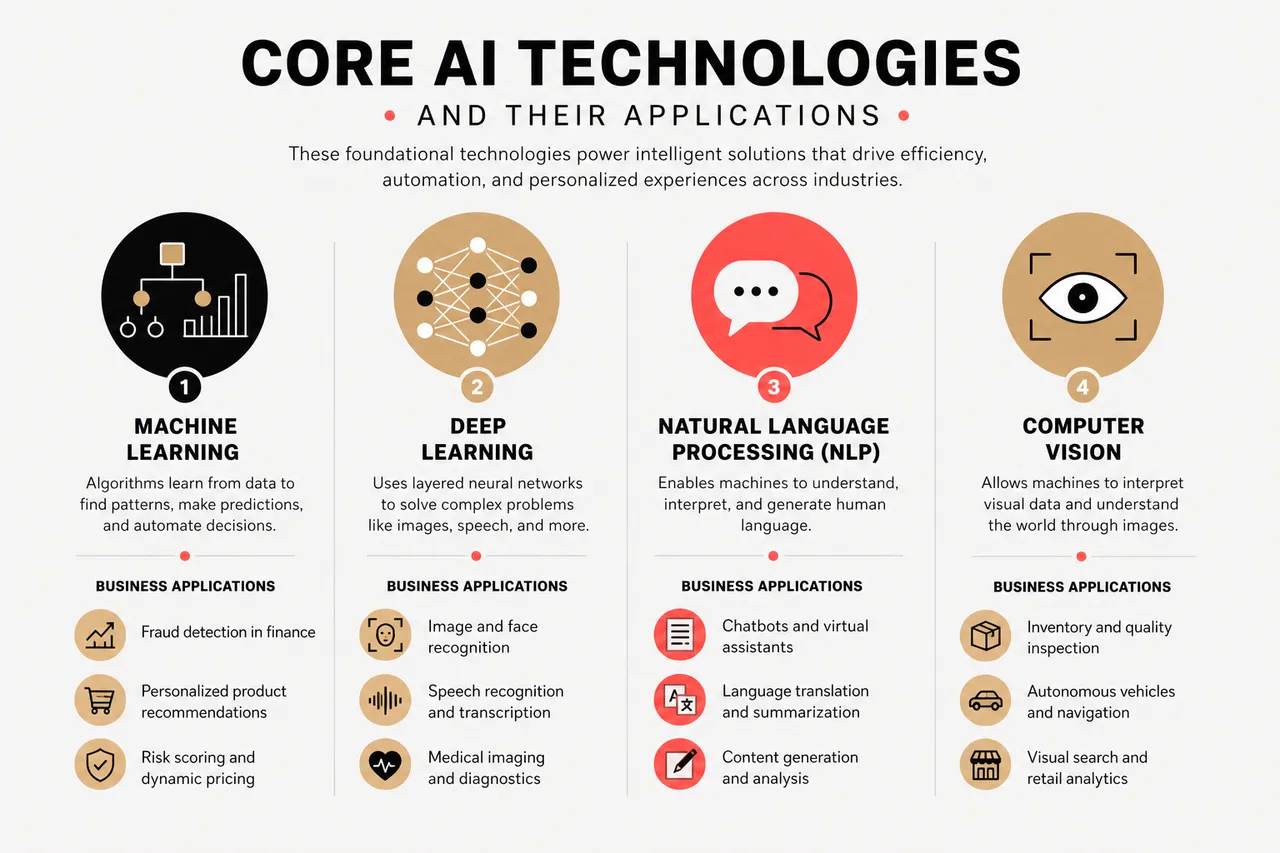
Modern artificial intelligence technologies are much more than just buzzwords. They are practical, powerful systems that can transform how organizations operate, from the smallest startups to global enterprises. As you evaluate options on platforms like ChatGPT 247, it helps to understand the foundational technologies behind the tools you deploy. Let’s look at how these core technologies are creating real results in the business world.
Machine Learning and Deep Learning
Machine learning algorithms sift through historical data to spot trends, make predictions, and automate decisions that used to take hours of manual work. Think about a bank that instantly flags suspicious transactions before they become a problem, or an e-commerce site that knows exactly what products to recommend to each shopper. Deep learning goes even further, using layered neural networks to tackle complex challenges like recognizing faces in images or understanding spoken language. Businesses across finance, healthcare, and retail are using these artificial intelligence technologies to drive efficiency and create more personalized experiences for their customers.
In practical terms, machine learning models underpin many of the most visible digital experiences. Streaming platforms rely on recommender systems trained on viewing behavior, while insurers use risk-scoring models to adjust pricing in near real time. Deep learning architectures, particularly transformers, fuel the large language models integrated into ChatGPT 247, enabling more nuanced conversations, better summarization, and domain-specific assistants that can be tuned to a company’s terminology and workflows.
Natural Language Processing (NLP)
NLP brings computers closer to understanding and using human language. This is the technology behind today’s smart AI chatbots, like those integrated with ChatGPT 247, which can handle customer questions around the clock with answers that sound natural and informed. Automated translation services powered by NLP now allow companies to communicate with customers worldwide, breaking down language barriers instantly. Even more, brands are using NLP for sentiment analysis, so they can track how people feel about their products in real time and adjust their marketing strategies on the fly.
Recent advances in NLP have dramatically improved accuracy and fluency in over 50 major languages, making it practical for global businesses to build multilingual experiences without hiring large regional teams. For example, customer support leaders report that intelligent virtual agents can now resolve 60 to 70 percent of routine inquiries without handoff to human agents when carefully designed and continually refined. On ChatGPT 247, this translates into configurable knowledge bases, tone controls, and integration hooks that embed NLP engines directly into websites, apps, and internal tools.
Computer Vision and Robotics
Computer vision gives machines the ability to interpret images and videos. For example, factories now use AI-driven inspection systems to catch product defects more accurately than ever before. Hospitals are turning to AI-powered imaging tools to help doctors diagnose diseases earlier and more precisely. In logistics, robotics combined with computer vision means warehouse robots can pick, pack, and ship orders efficiently, freeing up teams to focus on higher-value work. These advances show how artificial intelligence technologies are not just automating tasks, but raising the bar for accuracy and speed.
Across sectors, computer vision models are achieving performance that rivals or exceeds human-level accuracy in narrow tasks such as object detection, quality control, and document processing. Paired with robotics, these models enable flexible automation in environments that used to require manual labor, from sorting parcels to assembling customized products. While ChatGPT 247 focuses primarily on language-centric AI, many organizations use it in combination with vision-focused services, orchestrating workflows where visual data is analyzed by specialized models and interpreted or explained in natural language for business users.
- Machine learning delivers actionable predictions for finance, retail, and healthcare. Credit risk scoring, demand forecasting, and patient readmission predictions help organizations allocate resources more effectively, with some hospitals reporting 10 to 20 percent reductions in avoidable readmissions after deploying AI-driven risk models.
- NLP powers advanced chatbots and seamless multilingual support for global businesses. Customer experience teams use platforms like ChatGPT 247 to design conversational flows, integrate knowledge articles, and monitor performance, achieving faster resolution times and higher satisfaction scores across markets.
- Computer vision enhances quality control and innovation in sectors like healthcare and transportation. Diagnostic imaging tools assist radiologists by highlighting potential anomalies, while transportation providers use video analytics to improve safety, optimize traffic flow, and monitor infrastructure conditions in real time.
Rather than a single tool, artificial intelligence technologies form a toolkit. When used together, they tackle challenges that once seemed impossible, opening the door to new business models and higher efficiency across industries. The most successful organizations treat AI as a modular stack: vision, language, prediction, and automation components plugged into a common data and governance foundation.
Emerging Trends and Innovations in AI (2026)
This year, artificial intelligence technologies are evolving faster than ever. Generative AI, agentic AI, and the integration of AI with other advanced systems are giving businesses new ways to automate, innovate, and connect with customers. Platforms like ChatGPT 247 sit at the center of this convergence, enabling companies to experiment quickly while maintaining control over quality and brand voice.
Generative AI and Content Creation
Generative AI is changing the game for content creation. Teams can now use tools like ChatGPT 247 to draft marketing copy, generate custom images, and even translate content in seconds. For example, a retailer might use AI to create thousands of personalized product descriptions, while a design agency can whip up unique visuals for client campaigns without waiting days for a graphic artist. Entertainment companies are also jumping in, using generative AI to script dialogue or compose original music, speeding up production and boosting creative output.
Recent surveys of marketing and creative professionals show that over 70 percent now use generative AI tools in some part of their content pipeline, from ideation and outlining to final copy polishing and asset localization. Enterprises integrating generative AI into their workflows report content production time reductions of 30 to 50 percent, alongside increases in testing volume as teams can generate and evaluate more variations. ChatGPT 247 builds on these trends by offering templates, brand style controls, and collaboration features that help teams safely scale their content operations.
Agentic AI and Autonomous Systems
Agentic AI is taking automation to the next level. Instead of just following instructions, these systems make complex choices and act on their own. Picture an AI platform managing your supply chain, ordering inventory, rerouting shipments, and solving problems as they arise, all without constant human input. Cybersecurity teams are using agentic AI to spot and respond to unusual activity in real time, while smart buildings use it to monitor and adjust energy usage, saving money and reducing waste automatically.
Agentic systems rely on a loop of perception, planning, and action, allowing them to carry out multi-step tasks across different tools and data sources. In customer support, for instance, an AI agent can interpret an incoming request, consult relevant knowledge, trigger actions in back-end systems, and update the customer with progress, all while escalating edge cases to human staff. ChatGPT 247 supports this paradigm through agent frameworks that connect conversational interfaces with external APIs, workflow engines, and business applications.
Integration with Other Technologies
AI is also teaming up with technologies like IoT, cloud computing, and blockchain. In manufacturing, AI-powered sensors predict equipment failures before they happen, keeping factories running smoothly. Cloud-based AI makes it easy for businesses to scale up their operations as they grow, while blockchain integration adds transparency and security, especially in finance. These combinations are creating smarter, more resilient business models that can adapt to change quickly.
As organizations modernize their architectures, AI is becoming a shared capability embedded in many systems rather than a standalone platform. Data from industry cloud providers indicates that usage of AI services alongside IoT and analytics has grown at double-digit rates annually, with industrial, energy, and logistics companies leading adoption. ChatGPT 247 fits naturally into this ecosystem by providing API access, webhooks, and plug-ins that connect conversational agents to devices, data warehouses, and line-of-business applications.
- Generative AI gives every business the ability to create content at scale. From automated reports and sales emails to product imagery and training materials, organizations can maintain consistent quality while dramatically increasing volume and personalization.
- Agentic AI takes on critical business tasks independently, boosting efficiency and reliability. When combined with human oversight, these systems can manage repetitive, multi-step processes around the clock, reducing bottlenecks and freeing teams to focus on complex, high-value work.
- Integrating AI with IoT, cloud, and blockchain unlocks new opportunities across industries. Predictive maintenance, real-time supply chain visibility, and verifiable transaction records allow companies to reduce risk, improve resilience, and build trust with partners and regulators.
Artificial intelligence technologies are not just about cutting costs or automating the basics. The latest tools empower teams to be more creative, make better decisions, and explore ideas that were not feasible before. As generative and agentic AI mature, they increasingly act as collaborators and co-pilots, augmenting human capabilities rather than replacing them outright.
Ethical Considerations and Challenges in AI Adoption
As artificial intelligence technologies become more powerful and woven into daily business, companies face new responsibilities around ethics and compliance. Balancing innovation with fairness and transparency is key to building trust and protecting long-term value. Customers, employees, and regulators are paying close attention to how organizations design, deploy, and monitor AI systems.
Bias and Transparency
AI systems can only be as fair as the data and logic behind them. Sometimes, hidden biases sneak in during data collection or model training, leading to unfair outcomes. To address this, many organizations are now using explainable AI frameworks that make it clear how decisions are made. This transparency is especially important in areas like hiring, lending, and healthcare, where the stakes are high and every decision matters.
Regulators and standards bodies increasingly recommend or require documentation of training data sources, model assumptions, and performance across demographic groups. For businesses using ChatGPT 247, this can mean configuring guardrails, monitoring outputs for problematic patterns, and maintaining clear guidance for staff on responsible use. Some enterprises are establishing AI review boards that include legal, technical, and ethical perspectives to evaluate high-impact systems before they go live.
Regulatory Developments in 2026
In 2026, governments worldwide have put comprehensive rules in place for artificial intelligence technologies. These regulations require clear explanations for automated decisions, strong data privacy practices, and regular risk assessments for high-impact AI systems. Many companies have set up dedicated AI ethics committees and use automated tools to monitor compliance, ensuring that their AI systems stay trustworthy and meet evolving standards.
Emerging regulatory frameworks in regions such as the European Union, North America, and parts of Asia classify AI systems by risk level and impose stricter requirements on applications that affect fundamental rights, safety, or critical infrastructure. For example, providers of AI-powered credit scoring or hiring platforms may need to perform formal impact assessments and provide channels for human review. ChatGPT 247 supports compliance efforts by offering data residency options, role-based access controls, and logging features that help organizations track how AI is used across teams.
- Ethical AI depends on ongoing oversight, clear accountability, and active risk management. Leading organizations assign named owners for each AI system, define escalation paths for issues, and regularly review performance metrics to catch unintended consequences early.
- New regulations emphasize transparency and responsible use of artificial intelligence technologies. This includes documenting how models are trained, providing explanations to affected users where feasible, and giving individuals appropriate control over their data and automated decisions.
- Platforms like ChatGPT 247 can help operationalize AI governance. By centralizing configuration, access, and monitoring, the platform makes it easier for risk, compliance, and security teams to enforce policies across all AI use cases, from chatbots to content assistants.
It is a common myth that AI systems are always neutral. In reality, human input is still essential to spot and fix bias, making sure that artificial intelligence technologies serve everyone fairly. Responsible innovation means combining cutting-edge tools with thoughtful policies, training, and oversight.
From Strategy to Execution: Operationalizing AI in Your Organization
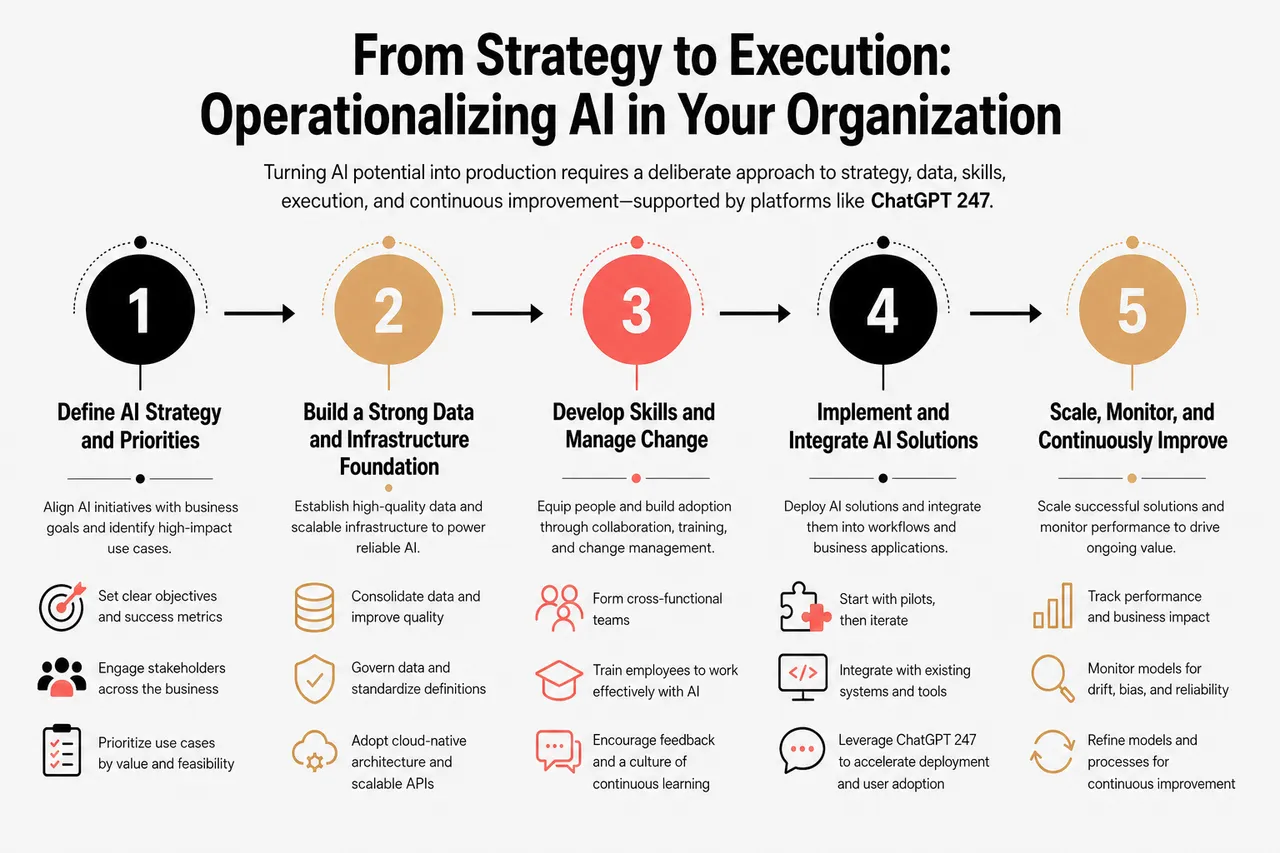
Understanding artificial intelligence technologies is only the first step; the real challenge lies in turning potential into production. Many organizations have experimented with pilots but struggle to scale AI in a consistent, manageable way. Bridging that gap requires a deliberate approach to strategy, data, skills, and change management, supported by platforms like ChatGPT 247 that reduce technical barriers.
Building an AI-ready Data and Infrastructure Foundation
High-performing AI systems depend on high-quality data and robust infrastructure. Companies that succeed typically invest in consolidating data from fragmented sources into well-governed platforms, standardizing definitions, and addressing data quality issues before training models. Cloud-native architectures and scalable API layers then make it easier to integrate AI into multiple applications, from customer-facing chatbots built on ChatGPT 247 to internal analytics dashboards. Without this foundation, even the most advanced models will underperform or prove difficult to maintain over time.
Developing Skills and Change Management for AI Adoption
Sustainable AI adoption requires more than data scientists and engineers. Organizations increasingly create cross-functional teams that include business stakeholders, UX designers, legal experts, and frontline staff to define use cases and refine solutions. Training programs that teach employees how to work effectively with AI tools, interpret outputs, and provide feedback are critical to building trust and avoiding resistance. Platforms like ChatGPT 247 help by offering intuitive interfaces, governance features, and documentation that non-technical users can understand, turning AI from a niche capability into a company-wide asset.
Measuring ROI and Scaling Successful Use Cases
To move beyond experimentation, organizations need clear metrics that tie AI initiatives to business outcomes. This often involves setting baseline performance for key processes, such as response times, conversion rates, or error rates, and tracking how AI-driven changes affect those indicators. Many companies that systematically measure impact find that a small set of high-value use cases, such as AI-assisted customer support or marketing personalization, account for a disproportionate share of returns. ChatGPT 247 supports this approach with analytics that reveal how chatbots, content assistants, and other agents are performing, enabling leaders to prioritize investments and replicate successful patterns in new domains.
Key AI Adoption Metrics at a Glance
To put these operational considerations in context, the table below summarizes representative metrics that organizations often monitor when scaling AI with platforms like ChatGPT 247 and complementary tools. Exact figures vary by industry and maturity, but the patterns highlight where value typically concentrates.
| Metric | Description | Typical Impact Range |
|---|---|---|
| Customer inquiry automation rate | Share of support requests resolved fully by AI chatbots or virtual agents without human intervention. | 40 to 70 percent of routine inquiries, when knowledge bases and flows are well maintained. |
| Content production time reduction | Decrease in time needed to produce marketing, documentation, or support content using generative AI. | 30 to 50 percent faster production, with increased capacity for A/B testing and localization. |
| Process cost savings | Operational cost reduction in targeted workflows where AI handles repetitive tasks and decision support. | 10 to 20 percent cost reduction in mature use cases such as claims handling or order routing. |
| Revenue uplift from personalization | Incremental revenue attributed to AI-driven recommendations, tailored offers, and dynamic pricing. | 5 to 15 percent increase in revenue in segments where personalization is applied at scale. |
| Employee productivity gain | Improvement in output per employee when AI assists with research, drafting, and repetitive tasks. | 10 to 30 percent productivity increase in roles heavily reliant on information processing. |
Looking Ahead: Maximizing Value from AI in 2026
Artificial intelligence technologies are rewriting the rules of business in 2026 and opening up opportunities that simply did not exist a few years ago. As tools like AI chatbot integration, automated translation, image generation, and SEO optimization assistance become more accessible, companies of all sizes can now engage customers, streamline operations, and expand globally with ease. Whether you are automating your FAQ responses to free up your support team or using AI-powered image generation to enhance your brand’s visuals, these technologies are reshaping what is possible for modern organizations.
Staying Ahead with AI
To make the most of artificial intelligence technologies, You really should keep learning and adapting. Upskill your teams, encourage experimentation, and stay on top of new regulations as they emerge. Embracing responsible AI use not only drives growth and innovation, it also helps you build trust with your customers and partners, an advantage that is more important than ever as competition intensifies.
- Continuous education and flexibility are vital for future-proofing your business with AI. Regular training, communities of practice, and internal knowledge sharing help employees understand both the strengths and limitations of tools like ChatGPT 247, reducing misuse and unlocking new ideas.
- Responsible AI use builds a foundation for long-term innovation and customer trust. Transparent policies, clear communication about where AI is used, and accessible feedback channels show stakeholders that you are committed to using these technologies in their best interests.
- Strategic partnerships can accelerate your AI journey. Collaborating with platforms such as ChatGPT 247, cloud providers, and specialized consultancies gives you access to best practices, reference architectures, and support that would be difficult to replicate alone.
By weaving artificial intelligence technologies into your company’s DNA and making ethics a priority, you will be ready to navigate whatever comes next. The future is bright for those who are willing to lead with both technology and responsibility, unlocking new possibilities every day while building stronger relationships with the people they serve.
Frequently Asked Questions about Artificial Intelligence Technologies
How can a small or medium-sized business start using AI without a large budget?
Smaller organizations can begin with targeted, high-impact use cases such as customer support automation, basic analytics, or marketing content generation. Platforms like ChatGPT 247 provide pre-configured chatbots, templates, and integrations that reduce upfront investment, allowing businesses to pay only for the capabilities they actually use and scale over time as value becomes clear.
What are the biggest risks of adopting AI too quickly?
Implementing AI without sufficient planning can lead to biased outcomes, security vulnerabilities, and poor user experiences that damage trust. Organizations should start with clear objectives, robust data governance, and pilot programs that include human oversight, using platforms like ChatGPT 247 to enforce access controls, logging, and content policies as they grow.
How do AI regulations affect the way businesses can use tools like ChatGPT 247?
New AI regulations focus on transparency, data protection, and accountability, especially for applications that affect individuals’ rights or access to services. Businesses using ChatGPT 247 should document how they configure and deploy AI agents, ensure that personal data is handled appropriately, and provide mechanisms for human review of important decisions, aligning their practices with regional legal requirements and industry standards.