
Automation isn’t stealing jobs in 2026; it’s redefining which work actually matters. You’re probably already using AI tools like ChatGPT to handle repetitive tasks, but knowing what to delegate and what to protect is where most people stumble. The difference between thriving and falling behind isn’t about resisting automation, it’s about strategic delegation.
ChatGPT 247 helps individuals and businesses explore AI technologies that handle the grunt work while you focus on creative problem-solving and relationship-building. This guide breaks down exactly which tasks to hand off, which ones demand your human touch, and how to build a workflow that amplifies your strengths instead of replacing them.
AI Automation in 2026: Capabilities, Limitations, and Trends
AI has moved from buzzword to business essential in 2026. Today’s AI models do much more than crunch numbers or answer simple questions; they are increasingly embedded into everyday workflows, reshaping how work is organized and delivered. In the United States alone, analysts estimate that AI could reshape around half of all jobs over the next two to three years, not by eliminating roles outright but by changing the mix of tasks inside them.
Across industries, AI systems are now handling a growing share of routine, data-heavy work while humans focus on judgment, creativity, and relationship-building. You’ve probably noticed AI-driven chatbots on e-commerce sites answering questions in real time, or financial apps flagging unusual transactions before you even notice them. In manufacturing, smart robots check every product for defects before it ever leaves the factory floor, while predictive maintenance reduces downtime and saves costs. These use cases illustrate a broader pattern: AI excels when the problem is clearly defined, the data is abundant, and the rules are consistent.
Let’s look at how specific industries are putting AI to work:
- Manufacturing: Factories now run with far fewer interruptions as machine learning systems predict equipment issues before they occur. By combining sensor data with historical performance, AI forecasts when a machine is likely to fail and schedules maintenance in advance. At the same time, computer vision systems inspect products at scale, catching tiny flaws instantly and reducing waste. Many plants report double-digit reductions in defects and downtime after integrating these tools into their production lines.
- Logistics: Delivery companies rely on AI to optimize routes, balance vehicle loads, and manage warehouse inventory in real time. Route optimization systems process traffic, weather, and delivery constraints to cut fuel use and delivery times. In warehouses, AI-driven robotics and smart shelving automate picking and packing, allowing human workers to oversee exceptions and quality checks rather than manual sorting. This shift increases throughput and reliability, especially during peak seasons.
- Finance: Financial institutions use AI to spot fraudulent activity in seconds, automate compliance checks, and support advisors with predictive insights. Transaction-monitoring algorithms learn normal patterns of behavior and flag anomalies for review, reducing the time it takes to catch potential fraud. Regulatory teams use AI to scan large volumes of documentation and monitor new rules, freeing specialists to handle complex interpretations and policy decisions. Advisors combine AI-generated portfolio analysis with their understanding of client goals to deliver more relevant recommendations.
- Retail: Behind every personalized recommendation and dynamic promotion is a powerful AI engine. Retailers analyze browsing history, purchase behavior, and inventory constraints to decide which items to feature for each customer. In physical stores, AI supports cashierless checkouts and demand forecasting, helping managers avoid stockouts and markdown-heavy overstocks. This combination improves the shopping experience and supports more efficient merchandising.
Even as AI becomes more capable, there are boundaries. Systems still struggle with tasks that require subtle judgment, open-ended creativity, or understanding context beyond the data provided. An AI chatbot can handle most procedural questions and routine support requests at any hour, but a frustrated or emotional customer still benefits from a human’s ability to listen, empathize, and flex policies when needed. Similarly, AI can summarize a contract or identify key clauses, yet interpreting ambiguous language or negotiating terms remains a human responsibility, because it involves values, risk tolerance, and long-term relationship considerations.
The myth that AI will simply replace humans is giving way to a more nuanced reality: most jobs are being transformed rather than eliminated. Global labor market studies suggest that hundreds of millions of roles contain tasks exposed to AI automation, yet they also project net job creation as new categories of work emerge and existing roles are redesigned. For example, analysts expect that a significant share of workers’ core skills will change by 2030, with nearly two-fifths of skills updated or replaced. This shift supports the idea that success will depend less on defending existing tasks and more on learning how to work alongside AI.
Recent Advancements in AI Automation
Recent breakthroughs in generative AI, language models, and computer vision have pushed automation far beyond simple rule-based processes. Modern AI can now generate and review text, images, and code, analyze complex datasets, and interact conversationally across multiple languages. For knowledge workers, this means a growing share of cognitive tasks can be augmented, not just manual or clerical work.
- Advanced language models: Tools similar to ChatGPT can summarize lengthy legal documents, generate first drafts of reports, and propose options for emails or marketing copy in seconds. For a 30-page contract, AI can highlight risks, obligations, and unusual clauses, giving lawyers and business leaders a faster starting point. With platforms like ChatGPT 247, companies can embed these capabilities into workflows, standardizing document reviews and freeing experts to focus on negotiation strategy and bespoke advice.
- Next-generation vision systems: High-resolution cameras paired with AI can detect microscopic defects in manufacturing and evaluate medical images with high sensitivity. In industrial settings, these systems support continuous inspection, catching issues before they become systemic and reducing rework. In healthcare, AI tools assist radiologists by highlighting suspicious areas on scans, improving diagnostic accuracy and consistency when combined with human expertise.
- Multilingual and omnichannel assistants: AI chatbots now handle customer inquiries across web, mobile, and messaging platforms in dozens of languages. They can parse natural language, recognize intent, access knowledge bases, and respond in real time, making support more accessible and scalable. ChatGPT 247 enables businesses to centralize this capability, automate FAQs, and integrate responses with CRM systems so that human agents see the full context when they join a conversation.
These capabilities also change who can benefit from automation. Small and medium-sized businesses that previously lacked resources for custom software can now assemble AI-powered workflows using off-the-shelf tools. ChatGPT 247, for example, helps teams automate content translation, generate images on demand, and combine SEO optimization with chatbot support, turning complex digital operations into manageable processes for non-technical users.
Industries Most Affected by AI Automation
While AI is reaching across the economy, certain sectors are moving faster or feel more immediate impact. Understanding where change is most intense can help both workers and leaders plan for reskilling and new opportunities.
- Manufacturing and industrial operations: These sectors have long used automation, but AI brings a new level of flexibility and intelligence. Predictive maintenance, dynamic scheduling, and AI-assisted quality control reduce unplanned downtime and variability. As a result, traditional roles such as machine operators are evolving into technician and analyst positions that oversee integrated human-robot systems and interpret performance data.
- Logistics, transport, and warehousing: From route planning to supply chain risk analysis, AI helps companies anticipate disruptions and optimize flows. Automated picking systems and robotic forklifts work alongside human supervisors who manage complex exceptions and safety. Job growth is shifting from purely manual roles to hybrid positions that combine physical work with digital coordination and monitoring.
- Finance and professional services: AI has begun to reshape finance, accounting, and legal services by automating repetitive analysis and documentation. Standard reconciliations, basic contract drafting, and compliance checks are increasingly handled by AI, leaving professionals to focus on interpretation, client relationships, and strategic advice. This change demands stronger data literacy and comfort with AI tools, even for roles that were once primarily interpersonal.
- Retail, marketing, and digital commerce: Personalization engines, dynamic pricing algorithms, and AI-driven creative tools help brands move faster and tailor offerings to specific audiences. Marketing teams use AI to analyze campaign performance, generate alternative creatives, and segment audiences. Human strategists guide positioning, narrative, and brand voice, while platforms like ChatGPT 247 support rapid content creation and translation to reach new markets.
- Healthcare, education, and public services: These traditionally human-centered sectors are integrating AI carefully, often with strong oversight. In hospitals, AI assists with diagnostics and resource planning, while clinicians maintain responsibility for treatment decisions and patient communication. In education, AI-driven tutoring tools personalize practice exercises, allowing teachers to focus on coaching, motivation, and deeper learning. Governments experiment with AI to streamline citizen services, but they also face important questions about transparency and accountability.
Human Work: Unique Strengths and Evolving Roles
As AI absorbs routine and repetitive tasks, uniquely human strengths are becoming the main differentiator in the labor market. In 2026, the most valuable roles emphasize flexible thinking, communication, and ethical judgment over rote execution. This shift is visible in hiring criteria: many organizations now list adaptability, empathy, and creative problem-solving alongside technical skills, and pay premiums for candidates who can successfully combine both.
- Critical thinking and complex problem-solving: Humans excel at connecting disparate information, evaluating trade-offs, and making decisions in ambiguous situations. For instance, when a company weighs entering a new market, AI can model scenarios and provide data, but leaders must consider cultural nuances, organizational readiness, and long-term strategy. Workers who can interrogate AI outputs, ask better questions, and synthesize multiple perspectives become essential partners rather than passive recipients of recommendations.
- Emotional intelligence and relationship-building: Trust, motivation, and collaboration still depend on human interactions. Managers resolve conflicts, read subtle cues, and support colleagues through change, while sales and account teams build long-term relationships with clients. AI can suggest talking points or sentiment analysis, yet the ability to listen deeply, respond empathetically, and tailor communication to individuals remains human work.
- Ethical judgment and value-based decisions: As AI systems influence hiring, lending, healthcare, and justice, organizations need humans to define values and guardrails. Ethics officers, policy experts, and business leaders consider fairness, privacy, and societal impact, especially when algorithms make recommendations that affect people’s livelihoods. These responsibilities cannot be outsourced to AI, because they require weighing moral considerations, stakeholder perspectives, and long-term consequences.
Job descriptions are changing accordingly. A marketing manager might start the day reviewing AI-generated performance dashboards and audience insights, then spend the afternoon shaping campaign narratives and coordinating creative teams. A project lead no longer focuses only on workloads and timelines; they orchestrate collaboration between human colleagues and AI tools, ensuring that the right tasks are automated while key decisions remain in human hands. In this environment, tools like ChatGPT 247 act as everyday collaborators, supporting research, drafting, and ideation while humans provide the final judgment and context.
It is a misconception that only engineers or data scientists will thrive in the AI era. Studies of leading organizations show that firms investing in leadership, creativity, and communication skills tend to innovate faster and keep employees more engaged. Technical proficiency is important, but it is most powerful when paired with the human capabilities that frame problems, mediate trade-offs, and mobilize people around shared goals.
Key Human Skills in the Age of AI
Critical thinking, emotional intelligence, and ethical oversight sit at the core of future-ready roles. These skills allow individuals to challenge assumptions, interpret AI outputs responsibly, and ensure that technology serves human needs rather than dictating them.
- AI literacy plus domain expertise: Workers who understand both their field and how AI systems operate can design better workflows and catch problems early. For example, a recruiter familiar with AI-based screening tools can adjust criteria to avoid bias and interpret why certain candidates are surfaced. ChatGPT 247 helps professionals build this literacy by providing accessible interfaces for experimenting with prompts, data analysis, and content generation.
- Collaboration and cross-disciplinary thinking: As AI intertwines with business, technical, and social questions, teams must operate across traditional boundaries. Product managers blend user research with AI capabilities, while operations leaders coordinate data engineers and frontline staff. Strong collaboration skills ensure that AI projects are grounded in real-world needs and integrated smoothly into existing practices.
- Learning agility and resilience: Because nearly two-fifths of workers’ core skills are expected to change within a few years, the ability to learn new tools, adapt to changing expectations, and recover from setbacks becomes essential. Those who see AI as an opportunity to expand their capabilities, rather than a threat to existing expertise, tend to capture more of the gains in productivity and career mobility.
How Human Roles Are Evolving
Many jobs are becoming hybrids that combine AI tool use with human judgment and interaction. Employees are increasingly expected to work alongside AI, interpret its suggestions, and decide when to accept, adjust, or override automated outputs.
- Redesigned knowledge work: Analysts, consultants, and researchers now use AI to gather data, model scenarios, and draft initial findings. Their role shifts toward verifying assumptions, exploring non-obvious implications, and crafting narratives that decision-makers can act on. This evolution tends to increase the complexity and impact of their work, even as some routine tasks disappear.
- AI supervision and orchestration: New roles have emerged to oversee AI systems, manage training data, and monitor outcomes. Positions such as AI product owner, AI ethicist, and prompt engineer coordinate how models are deployed, what metrics are tracked, and how models are updated. ChatGPT 247 users often take on similar responsibilities when they design prompt libraries, set content policies, and align AI behaviors with brand guidelines.
- Human-centered service and experience design: In customer-facing sectors, human roles increasingly focus on experience, trust, and personalization. Service designers map journeys that blend AI-assisted self-service with human support at critical moments, while frontline staff handle escalations and sensitive conversations. AI may manage the queue and basic triage, but humans still shape how customers feel and whether they stay.
Case Studies: Effective AI and Human Collaboration
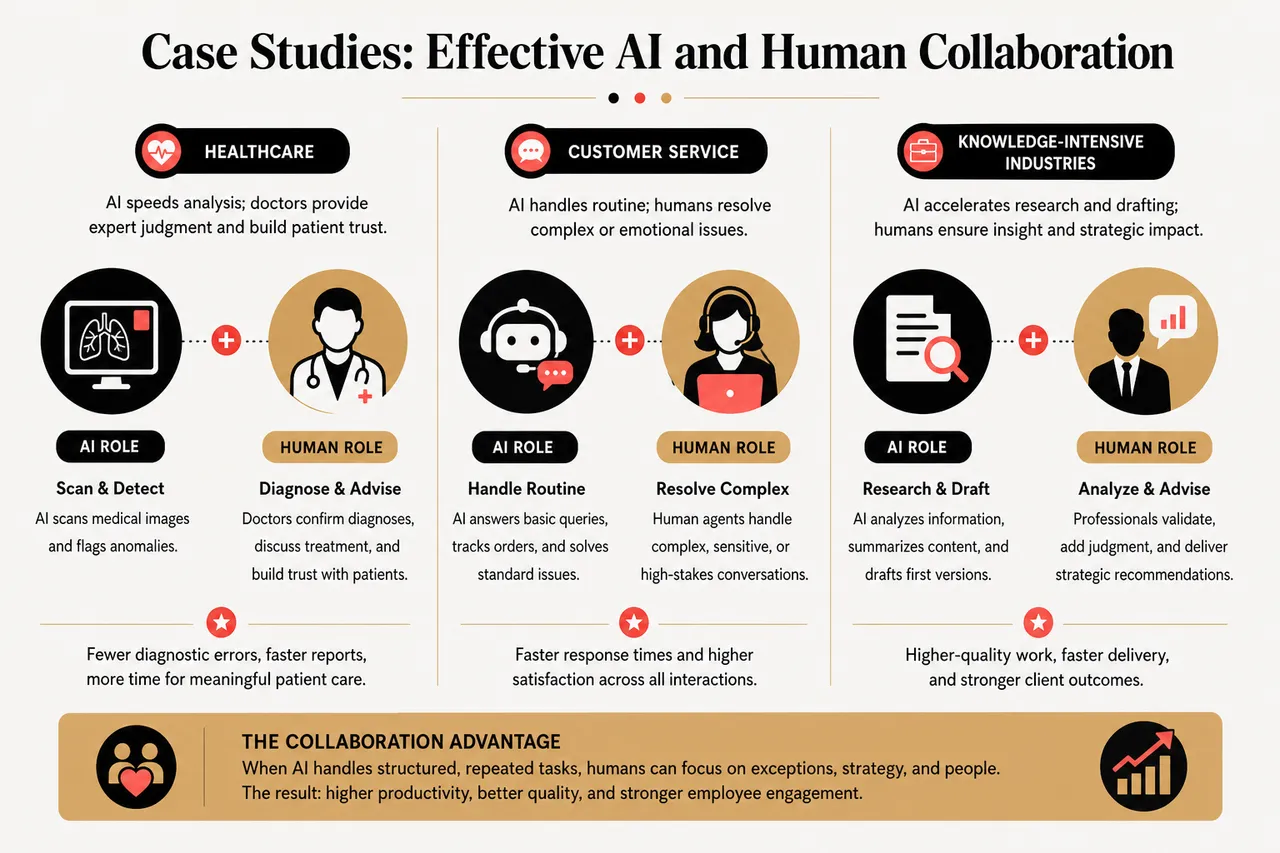
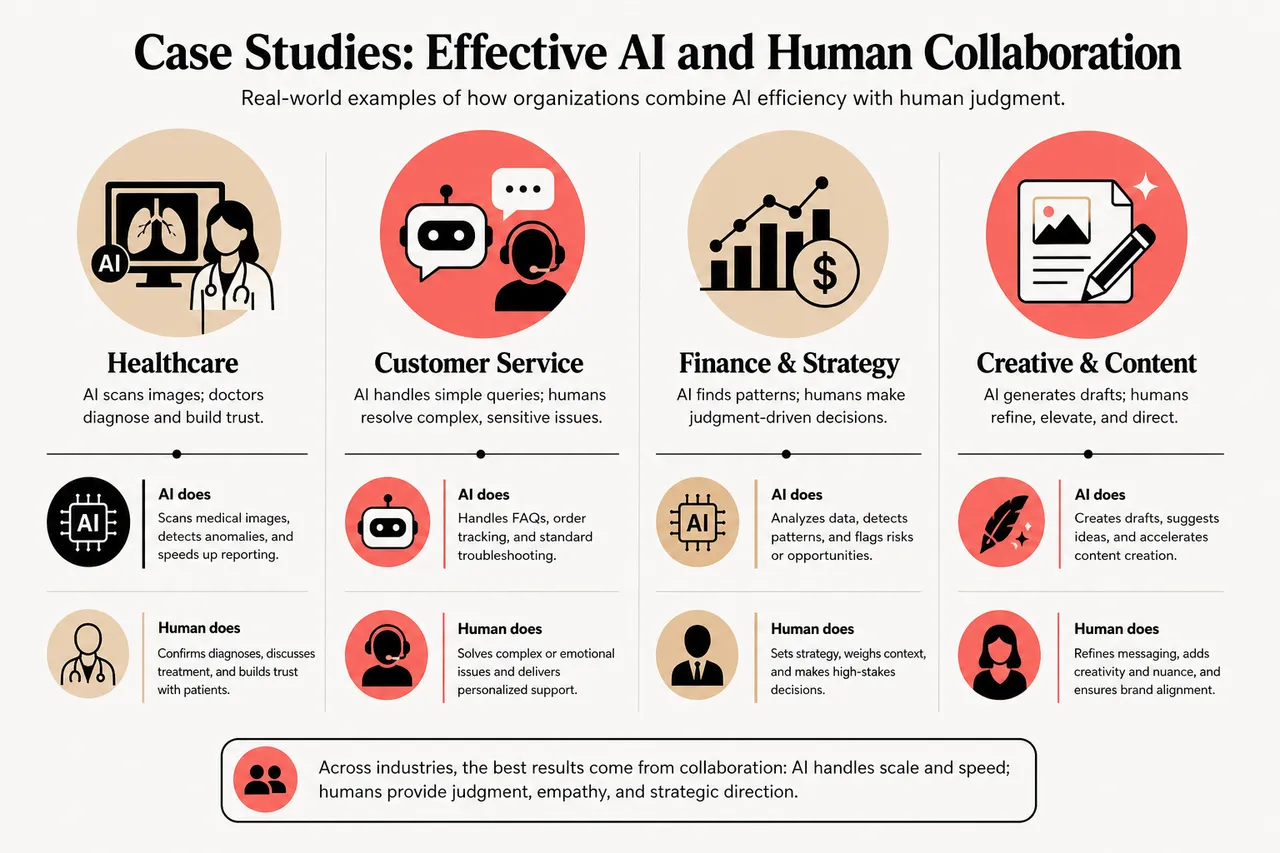
The most forward-looking organizations treat AI as a collaborator, not a competitor. They design workflows in which machines handle structured, repeated tasks and humans focus on exceptions, strategy, and interpersonal work. This approach tends to produce higher productivity, better quality, and stronger employee engagement than automation attempts that aim to remove humans entirely.
- Healthcare: AI systems scan medical images and spot anomalies, but doctors confirm diagnoses, discuss treatment options, and build trust with patients. In some hospital networks, AI-assisted radiology has reduced diagnostic errors and sped up report turnaround times, while clinicians use the extra time for deeper conversations with patients. ChatGPT 247 can support similar workflows by helping clinicians generate patient-friendly explanations, translate discharge instructions, or summarize clinical guidelines.
- Customer service: AI chatbots handle basic queries, order tracking, and standard troubleshooting, freeing human agents to focus on complex or emotionally charged issues. Companies that implement this tiered approach often see response times fall and satisfaction scores rise, because customers receive quick answers for simple questions and more thorough support for difficult situations. ChatGPT 247 enables businesses to build these virtual agents quickly, integrate them with FAQs, and keep knowledge bases up to date.
- Knowledge-intensive industries: In consulting, legal services, and professional training, AI assists with research, drafting, and scenario modeling, while human experts craft final recommendations and deliver interactive sessions. Firms report that junior staff can take on more complex assignments earlier when supported by AI, which changes the structure of teams and career paths. Human mentors shift from supervising routine work to coaching judgment, ethical reasoning, and client communication.
These examples highlight that success with AI depends as much on organizational design and training as on technology itself. Clear task boundaries, ongoing upskilling, and open communication about how AI is used help employees feel empowered rather than threatened. Workers who regularly practice new AI tools and reflect on how they change their work are often first in line for emerging roles.
As AI adoption accelerates, many companies are creating new jobs instead of cutting headcount Generally. Roles devoted to AI governance, data quality, workflow design, and human-AI collaboration are appearing across sectors. Individuals who are willing to learn these skills and help shape AI practices within their organizations often find new opportunities that did not exist only a few years ago.
AI in Healthcare: Augmenting Human Expertise
In healthcare, AI supports faster and more accurate diagnoses, triage, and resource allocation, but clinicians remain central to care. Human professionals contextualize AI findings, weigh risks, and provide the empathy and reassurance that patients depend on when facing difficult decisions.
AI in Customer Service: Enhancing Efficiency
In customer service, automated chatbots manage routine interactions and gather information, enabling human agents to focus on solving complex issues and building long-term relationships. This division of labor improves both efficiency and customer experience, especially when AI and human teams share context through integrated platforms like ChatGPT 247.
Adapting to the Future: Strategies for Individuals and Businesses
Standing still is not an option in 2026. Whether you are steering a company or planning your next career move, adapting to the evolving balance between AI automation and human work requires deliberate learning and experimentation. The most resilient organizations treat AI integration and talent development as a single strategy rather than two separate initiatives.
- Upskilling and reskilling: To stay ahead, workers need both technical capabilities and human strengths. On the technical side, this includes data literacy, familiarity with AI platforms, and basic prompt engineering. On the human side, it involves creativity, leadership, and communication. Micro-credentials, modular online programs, and practice with tools like ChatGPT 247 make it possible to build these skills incrementally. Effective upskilling plans start with mapping current roles to future tasks, identifying gaps, and giving people time and support Finally them.
- Embedding AI tools into workflows: Companies that successfully integrate AI do more than adopt isolated tools; they redesign workflows to remove friction and clarify handoffs. For example, marketing teams use AI for idea generation, testing variations of copy and images, and analyzing campaign performance, while humans make final creative decisions. Operations teams deploy AI to automate status updates and routine approvals, freeing managers to focus on coaching and complex escalations. ChatGPT 247 can serve as a central platform for these efforts, providing chatbot integration, translation, image generation, and SEO support under one roof.
- Aligning AI and talent strategies: Leaders who plan AI investments and workforce development together are better able to avoid displacement without support. This means identifying high-exposure roles, communicating how tasks will change, and offering training paths into newly created positions. Multi-generational learning teams, where experienced staff and new hires explore AI together, help knowledge spread and reduce fear.
Digital literacy has become a baseline expectation for nearly every job. Individuals who embrace new technologies, experiment with AI tools, and refine their workflows accordingly often progress faster in their careers. Organizations that cultivate curiosity, reward learning, and provide time for experimentation tend to outperform those that treat AI purely as a cost-cutting tool.
Upskilling and Reskilling for the AI Era
Pairing technical proficiency with creative problem-solving is a powerful combination. Workers should look for opportunities to master AI tools, data interpretation, and automation design, while also strengthening the uniquely human capabilities that drive innovation and trust.
- Structured learning pathways: Effective programs break learning into manageable modules, such as basic AI concepts, tool-specific training, and applied projects in the learner’s domain. ChatGPT 247 can support these pathways by providing interactive practice, feedback on prompts, and examples of AI-assisted workflows tailored to different industries.
- On-the-job experimentation: Encouraging employees to run small experiments with AI in their daily tasks helps convert training into real value. For instance, a sales team might use ChatGPT 247 to draft personalized follow-up emails, then compare engagement rates with traditional approaches. These experiments build confidence and uncover best practices.
- Continuous skill tracking: As requirements evolve, organizations benefit from regularly assessing skills and updating development plans. HR teams can monitor who is using AI tools effectively and identify potential mentors or early adopters to help others.
Leveraging AI Tools for Business Growth
By integrating AI solutions such as ChatGPT 247, businesses can reduce busywork, reach new markets, and improve customer experiences without dramatically increasing headcount. Thoughtful deployment turns automation into a growth engine rather than a blunt cost-reduction instrument.
- AI chatbot integration: Embedding AI chatbots across websites, apps, and messaging channels allows companies to respond to common questions instantly, collect leads, and triage support requests. Human agents handle complex issues that the bot escalates, while ChatGPT 247 ensures that responses remain consistent with brand voice and up-to-date information.
- Image generation tools: Visual content is central to modern marketing, but design resources are often limited. AI-powered image generation reduces bottlenecks by producing drafts and variations quickly, which designers can refine rather than create from scratch. This accelerates campaign cycles and makes it easier to test multiple concepts with audiences.
- Automated translation services: Companies seeking global reach can use AI translation to localize content at scale, from product descriptions to support materials. Human reviewers then adjust tone and cultural nuances. ChatGPT 247 supports this workflow by combining translation with style controls and glossary management, ensuring that localized content stays coherent.
- SEO optimization assistance: AI can analyze search trends, suggest keywords, and propose content structures that improve visibility. Marketing teams use these insights to plan editorial calendars and optimize pages, while human writers refine messaging for quality and authenticity.
- FAQ automation: Many support interactions revolve around a predictable set of questions. AI-driven FAQ systems handle these instantly, freeing support staff to focus on unusual or high-stakes cases. ChatGPT 247 makes it straightforward to build and update these knowledge bases as products and policies evolve.
Ethical and Societal Considerations
The spread of AI across workplaces brings significant responsibilities along with its benefits. If deployed without care, automation can exacerbate inequality, embed bias into decisions, and reduce workers’ sense of agency. With deliberate design and oversight, however, AI can support safer workplaces, fairer access to services, and more inclusive growth.
- Addressing workforce inequality: As new AI-driven roles appear, there is a real risk that only those with existing advantages gain access to training and advancement. Ensuring that reskilling programs reach workers across regions, income levels, and demographics is essential. Public-private partnerships, subsidized training, and community-based initiatives can help broaden participation. Platforms like ChatGPT 247 can be part of this solution when they are made accessible and supported by clear learning resources.
- Ensuring ethical AI deployment: Organizations need transparent guidelines and regular audits to minimize bias, privacy risks, and unintended consequences. This includes documenting how models are trained, what data they use, and how outcomes are monitored. Involving diverse stakeholders in design and testing processes helps surface concerns early and build trust with employees and customers.
It is tempting to assume that algorithms are neutral or automatically fair, but they can reflect and amplify the biases in their training data or design assumptions. Ongoing vigilance, clear accountability, and accessible explanations of how AI systems function are really important to maintaining legitimacy and avoiding harmful side effects.
Addressing Workforce Inequality
AI has the capacity either to narrow opportunity gaps or widen them. Inclusive access to quality education, digital infrastructure, and reskilling programs helps ensure that workers in different regions and backgrounds can benefit from the new jobs that AI supports rather than being left behind.
Ensuring Ethical AI Deployment
Leading organizations treat ethics as a core dimension of AI strategy. They conduct impact assessments, engage external reviewers, and communicate openly with employees and customers about how AI is used, what safeguards exist, and how concerns can be raised.
- Enhance customer engagement and streamline responses by integrating AI Chatbot Integration across your platforms, ensuring quick support for common questions and smooth handoffs to human agents when complexity arises.
- Create eye-catching visuals quickly and reduce design bottlenecks using Image Generation Tools, allowing creative teams to spend more time on concept development and brand storytelling.
- Reach international audiences more easily with Automated Translation Services that localize content in seconds, then refine those translations with human review for cultural nuance.
- Boost your website’s reach and attract more visitors through SEO Optimization Assistance, pairing AI-driven keyword insights with human-crafted content that aligns with your brand.
- Reduce repetitive work and deliver instant answers with FAQ Automation for customer support, while support staff focus on solving non-standard, high-value problems.
Where AI Automation Ends and Human Judgment Begins
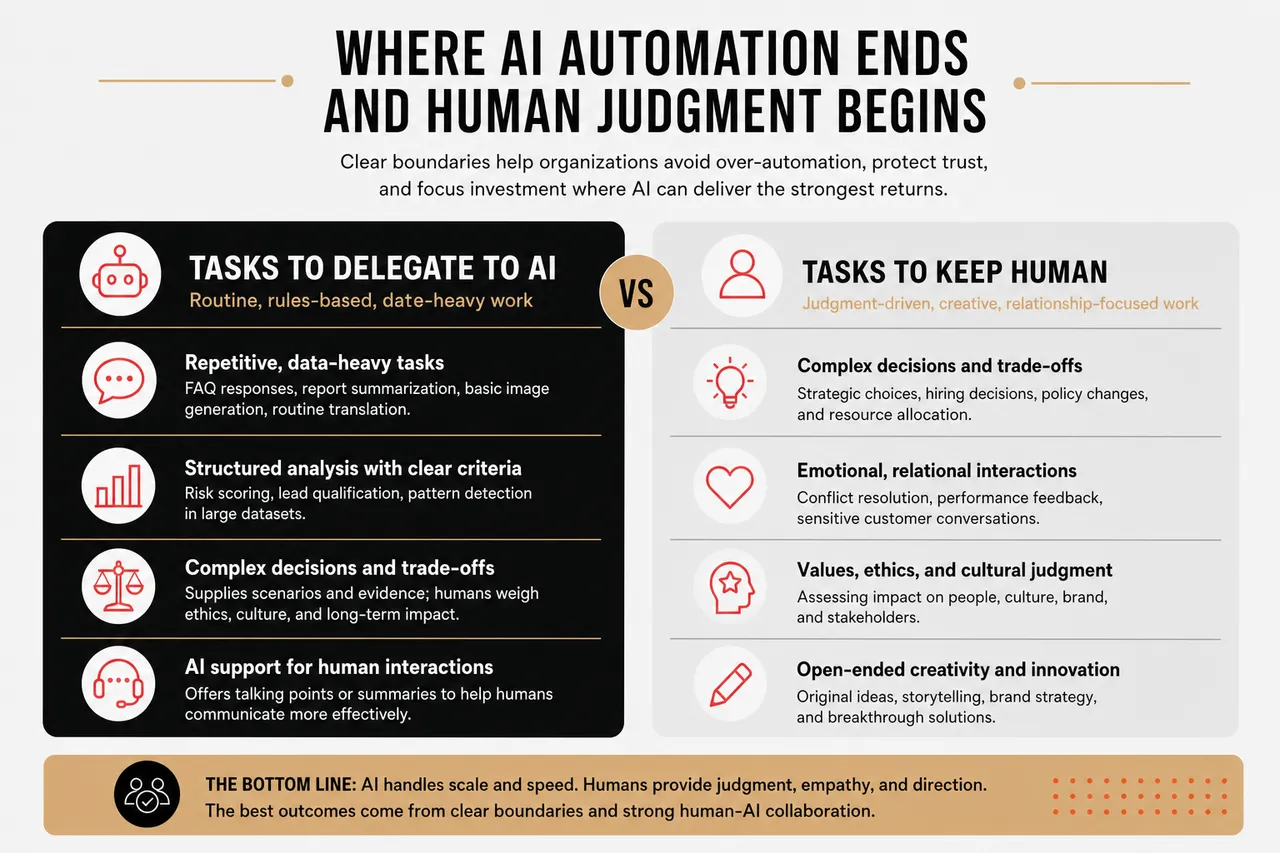
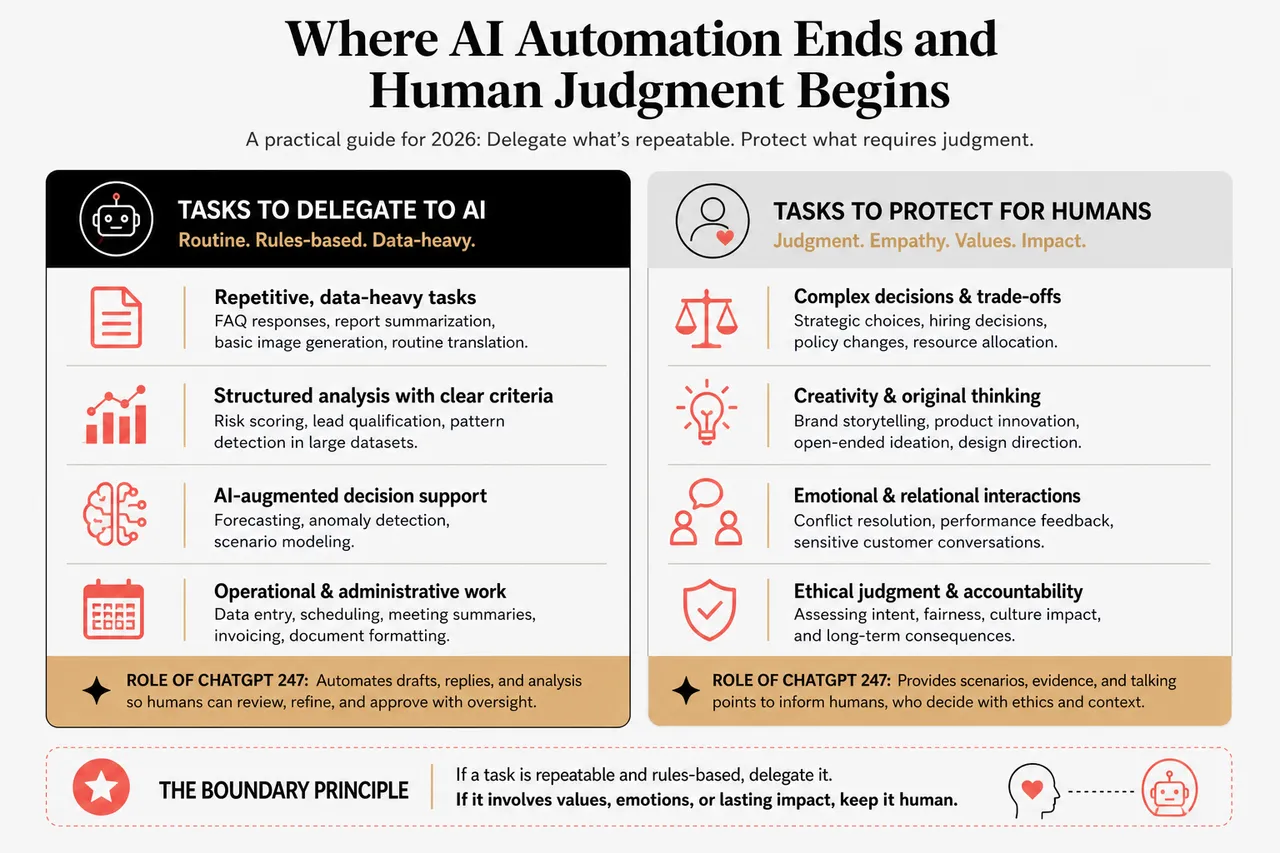
One of the most practical questions for 2026 is not whether AI will be used, but where to draw the line between automation and human responsibility. Clear boundaries help organizations avoid over-automation, protect trust, and focus investment where AI can deliver the strongest returns.
Tasks To Delegate vs Tasks To Protect
At a task level, it is helpful to distinguish between activities that are repeatable and rules-based, versus those that involve values, emotions, or open-ended creativity. The following table summarizes typical examples and how platforms like ChatGPT 247 can support delegation decisions.
| Task Type | Best Handled By | Examples | Role of ChatGPT 247 |
|---|---|---|---|
| Repetitive, data-heavy tasks | AI systems with human oversight | FAQ responses, report summarization, basic image generation, routine translation | Automates content drafts, chatbot replies, and translations; humans review and approve outputs. |
| Structured analysis with clear criteria | AI plus domain experts | Risk scoring, lead qualification, pattern detection in large datasets | Provides initial scoring and insights that experts validate and refine for decisions. |
| Complex decisions and trade-offs | Human leaders supported by AI | Strategic choices, hiring decisions, policy changes | Supplies scenarios and evidence; humans weigh ethics, culture, and long-term impact. |
| Emotional, relational interactions | Humans with AI support tools | Conflict resolution, performance feedback, sensitive customer conversations | Offers talking points or summaries, while humans deliver empathy and tailored responses. |
| Open-ended creative work | Human creators using AI as a muse | Brand storytelling, product vision, educational program design | Generates ideas and variations that human creators curate into cohesive narratives. |
This distinction helps teams decide where to implement full automation, where to use AI for augmentation, and where to keep humans firmly in control. ChatGPT 247 is particularly useful in augmentation scenarios, where the goal is to increase speed and breadth of exploration without replacing human judgment.
Key Data Points Shaping the Future of Jobs
Recent research provides several indicators of how AI is likely to influence work over the coming years. Integrating these figures into planning makes it easier to anticipate shifts and design proactive responses.
- 50-55% of jobs reshaped: Analysts estimate that in some major economies, around half of all jobs could be materially reshaped by AI within two to three years. In practice, this means workers will keep job titles but see daily tasks and expectations change as automation and augmentation become standard.
- 39% of core skills changing: Employers expect that almost two-fifths of workers’ core skills will need updating by 2030. Skills related to AI, data, cybersecurity, and technological literacy are rising fastest, reinforcing the need for ongoing education and flexible career paths.
- Net job creation despite displacement: Global projections suggest that tens of millions of roles could be displaced by AI while an even larger number of new positions emerge. Jobs focusing on AI development, ethics, data management, and infrastructure, as well as human-centered services, are expected to grow.
- Premiums for AI skills: Workers with advanced AI proficiency are already earning significantly more than peers in similar roles without these capabilities. This wage gap reflects the growing importance of AI fluency as a competitive advantage.
- Hundreds of millions of jobs exposed: Estimates indicate that hundreds of millions of jobs worldwide contain tasks that could be automated by AI. Exposure does not guarantee elimination; it signals that tasks within these roles will likely be redistributed between humans and machines.
For individuals and organizations using ChatGPT 247, these data points underscore the importance of treating AI skills as part of core professional development rather than a niche specialization. Learning to collaborate with AI is increasingly central to career resilience and business performance.
Frequently Asked Questions About AI Automation and Human Work
Which types of jobs are safest from AI automation?
Jobs that rely heavily on interpersonal interaction, complex judgment, and physical dexterity in unstructured environments tend to be less exposed to full automation. Roles such as senior leadership, therapeutic professions, skilled trades, and creative direction are more likely to be augmented than replaced, though they still benefit from AI tools that handle supporting tasks.
How can I tell if my role is likely to change because of AI?
If your work involves repetitive information processing, standardized documentation, or routine customer interactions, it is likely that AI will assume part of your task load. Rather than viewing this as a threat, consider how you can shift toward higher-level responsibilities such as oversight, design, relationship management, or strategy, using tools like ChatGPT 247 to handle routine elements.
What should businesses do first when integrating AI like ChatGPT 247?
A practical first step is to map current workflows and identify bottlenecks or repetitive tasks that consume time without adding much value. From there, pilot AI solutions in one or two areas, collect feedback from employees and customers, and refine processes before scaling. Clear communication about goals, guardrails, and training opportunities helps build trust as automation expands.
AI automation vs human work future of jobs is not about choosing sides; it is about designing smart partnerships. When you play to the strengths of both, you create a workplace that is adaptable, creative, and ready for change. Whether you are a business owner or an individual planning your next move, the most important step is to keep learning, stay curious, and look for ways to combine what AI does best with the uniquely human skills only you can bring. Tools like ChatGPT 247 are most powerful when they amplify human judgment and imagination, helping you build a career and a company that thrive in the years ahead.