
You’ve spent hours feeding prompts into AI, only to watch your brand’s personality vanish into a sea of bland, generic copy. The promise of faster content creation feels hollow when every output reads like it was written by the same robotic committee. Here’s the truth: AI doesn’t erase your voice, it amplifies it, but only if you know how to train it properly.
ChatGPT 247 helps businesses master this balance, offering practical AI tools that adapt to your tone, style, and messaging standards instead of replacing them. This guide walks you through a proven framework for generating authentic, on-brand content at scale while keeping the human element that makes your audience actually care.
The Rise of Artificial Intelligence in Content Creation
Artificial intelligence content creation means using smart platforms and tools that can write, design, analyze, or even translate content for you. These systems combine machine learning with natural language processing and, increasingly, generative vision models to produce written, visual, and audio assets in minutes, not days. In practice, that includes everything from long-form articles and email sequences to images, videos, and slide decks tailored to specific audiences and channels.
In 2026, it is no longer experimental. Industry surveys show that more than 60 percent of marketing leaders now rely on AI to support at least one stage of their content lifecycle, from ideation to optimization. At the same time, around 70 percent of consumers say that personalization influences their brand loyalty, which forces teams to deliver relevant content at a scale that is impossible without automation. In this environment, artificial intelligence content creation has shifted from a nice-to-have to a foundational capability.
- AI content tools as a competitiveness driver. Research on enterprise marketing indicates that AI-assisted workflows can increase content output by 2 to 3 times while keeping headcount steady, allowing smaller teams to compete with larger rivals. For a lean marketing team using ChatGPT 247, that can mean publishing three in-depth guides per week instead of one without sacrificing depth or quality.
- Human-guided creativity as the differentiator. The same studies warn that performance gains plateau or even reverse when teams treat AI as a fully autonomous writer. Brands that invest in prompt frameworks, editorial standards, and human review see higher engagement and lower unsubscribe or bounce rates, proving that AI performs best as a guided assistant rather than a replacement.
- From one-size-fits-all to audience-aware content. Modern AI systems can ingest audience research, customer segments, and behavioral data to shape tone and angle. When you connect tools like ChatGPT 247 to your analytics stack, you can brief the model on real audience insights, making outputs feel far closer to what a seasoned strategist would propose.
Think of AI as your creative operations engine. It does not diminish human creativity; it clears the repetitive workload so strategists, writers, and designers can focus on narrative, insight, and craft. When you train a system like ChatGPT 247 on your best content, it becomes a channel for amplifying your brand’s distinct character across every touchpoint.
What Is Artificial Intelligence Content Creation?
At its core, artificial intelligence content creation is the practice of using AI models to assist with or automate the production of digital content. Platforms such as ChatGPT 247, ChatGPT, Jasper.ai, and Copy.ai can draft blog posts, suggest social captions, summarize research, create images or short videos, and even propose slide layouts based on a simple brief. They do this by analyzing vast corpora of text and media, learning how language and visuals are structured, then predicting what should come next in a way that fits your instructions.
Modern solutions go a step further by allowing you to configure brand rules directly inside the tool. In ChatGPT 247, for example, you can store tone guidelines, key phrases, and messaging pillars as a reusable profile. When you prompt the system to write a product page, it automatically applies those standards, which reduces the risk of off-brand wording and keeps your team from rewriting every sentence from scratch.
Why AI Content Creation Matters in 2026
Content demand has outpaced human-only production capacity. Global digital ad spend and social media usage continue to climb, and brands are expected to show up across search, video, email, social feeds, and owned platforms with relevant, localized messaging. Studies of high-growth companies show that those with advanced content operations often publish several pieces of net-new, long-form content per week, plus daily micro-content for social channels.
Without AI, meeting that demand typically requires large, expensive teams. With AI, organizations can automate high-volume, low-risk tasks such as drafting outlines, generating subject line variations, repurposing a webinar into multiple formats, or creating first-pass translations. This frees humans to spend their time on strategy, original research, creative direction, and stakeholder collaboration, which are the real levers for differentiation.
- Scaling personalization. Industry data suggests that brands using AI-powered personalization can see lifts in engagement and conversion ranging from 10 to 30 percent compared to generic messaging. By using ChatGPT 247 to tailor tone, examples, and offers to specific segments, teams can deliver that level of relevance at scale.
- Shortening production cycles. Case studies from enterprise marketing teams report reductions of 40 to 60 percent in time-to-publish when AI is embedded throughout the workflow. For a product launch, that can mean going live with localized landing pages and email sequences in days rather than weeks.
- Supporting multilingual growth. AI translation and localization tools now reach quality levels sufficient for first drafts in dozens of languages. When combined with human reviewers familiar with local culture, this allows brands to test new markets faster and with lower upfront cost.
Transforming Content Workflows with AI: Practical Applications and Case Studies
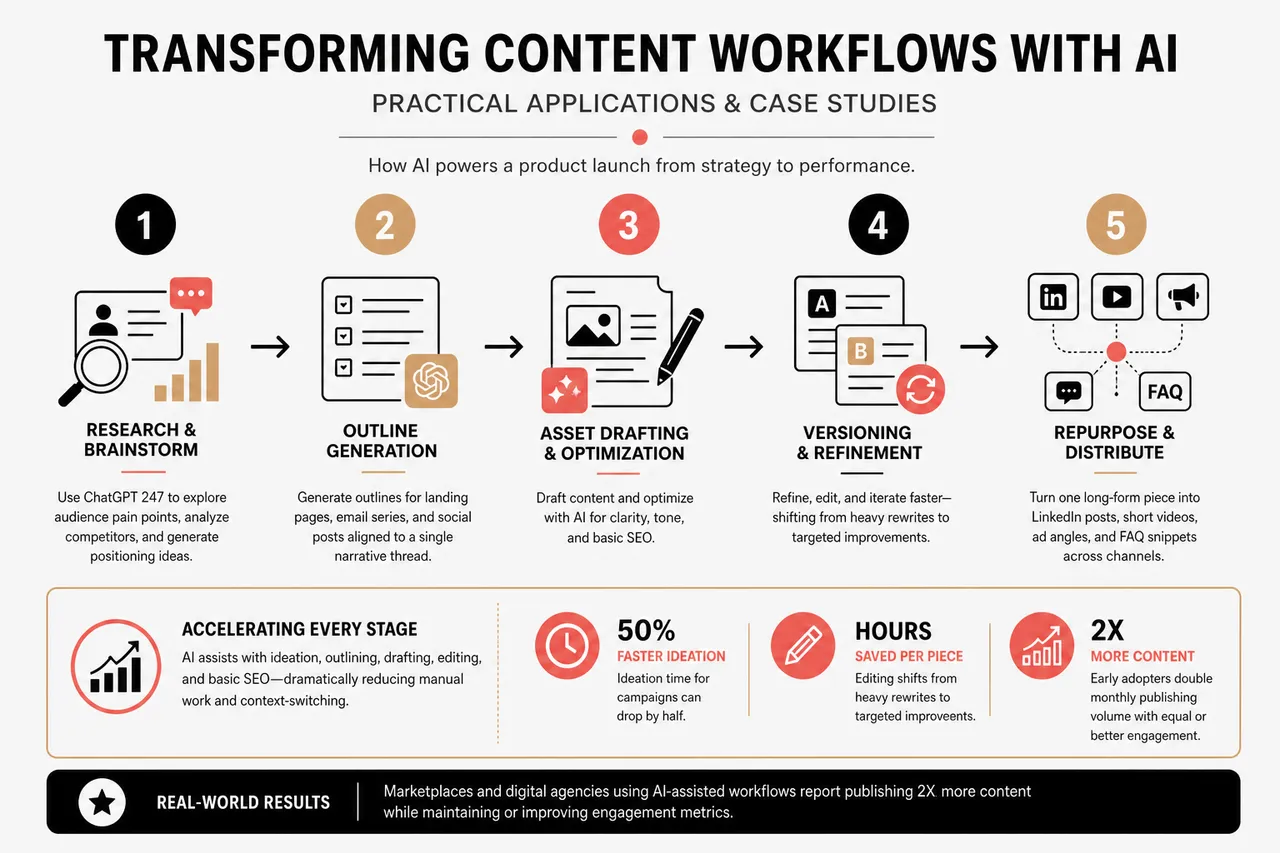
AI is reshaping the entire content lifecycle, from research to performance analysis. Consider a typical product launch campaign. Instead of brainstorming from a blank slate, a strategist can use ChatGPT 247 to explore audience pain points, analyze competitor messaging, and generate positioning ideas. From there, the tool can produce outlines for a landing page, email series, and social posts that align to a single narrative thread, giving your team concrete material to refine rather than a blank page.
Once the core assets are drafted, AI can support versioning and repurposing. A single long-form article can be turned into multiple LinkedIn posts, short-form videos, ad angles, and FAQ snippets, all within the same environment. This dramatically reduces context-switching and manual rewriting, which is often where content pipelines slow down.
- Accelerating every stage of production. Platforms like Jasper.ai and ChatGPT 247 can assist with ideation, outlining, drafting, editing, and even basic SEO optimization. Studies of AI-assisted teams show that ideation time for campaigns can drop by half, while editing shifts from heavy rewrites to targeted improvements, saving hours per piece.
- Real-world gains from early adopters. Organizations documented in recent industry reports, including marketplaces and digital agencies, report that AI-assisted workflows allowed them to double their monthly publishing volume while maintaining or improving engagement metrics. They attribute this to steady output, faster experimentation, and more time to focus on creative angles rather than drafting boilerplate copy.
- ChatGPT 247 as a workflow hub. ChatGPT 247 can serve as the central brain for your content operations by connecting prompts, brand guidelines, and reusable templates in one place. Your team can create standardized workflows for blog posts, video scripts, or landing pages, ensuring that every new project starts with a proven structure that AI helps fill in.
Even when AI automates a large share of the heavy lifting, human editors remain central. They are the ones who validate claims, adjust tone to match nuanced audience expectations, and ensure each piece supports larger business goals. When AI and human expertise work in tandem, the result is a smoother process that still feels distinctly on-brand.
AI in the Content Workflow: Step-by-Step Integration
- Identify your bottlenecks with data. Instead of guessing where AI might help, analyze your recent projects to see where tasks routinely slip timelines. If drafting long-form content is the main issue, pilot ChatGPT 247 to generate structured first drafts. If review cycles drag on, use AI for initial editing passes so human editors can focus on high-level messaging and nuance.
- Design AI-assisted templates for repeatable formats. For recurring assets such as newsletters, release notes, or product descriptions, build templates inside ChatGPT 247 that include section prompts, tone instructions, and length guidelines. This ensures that every iteration starts from the same high-quality foundation while leaving room for human customization.
- Train the system with your best work. Upload high-performing content or detailed examples into your AI workspace so the model learns what “good” looks like for your brand. Over time, you can refine these reference sets to reflect new campaigns, updated positioning, or emerging customer language.
- Institutionalize human review loops. Establish clear review stages where editors assess AI output against brand guidelines, legal requirements, and factual accuracy. Many teams adopt a two-step process: AI produces a strong draft, an editor revises heavily, then a subject-matter expert performs a final check on claims and nuance.
Case Studies: Brands Leveraging AI for Content Creation
Professional services marketplaces have documented how they use AI tools to support freelance writers with research summaries and structured outlines. This allows freelancers to focus on analysis and storytelling, cutting the time from brief to submission while increasing consistency across a rotating pool of contributors. In-house teams at digital agencies report similar results when using tools like Copy.ai for social campaign variations, enabling them to A/B test more angles without overwhelming copywriters.
ChatGPT 247 is frequently used as a centralized copilot across these scenarios. A marketing manager might create a campaign brief in ChatGPT 247, generate initial assets for multiple channels, and then assign those drafts to designers and writers for enhancement. Over several iterations, the platform learns from the approved versions, making future campaigns smoother and more aligned with evolving brand standards.
Maintaining Brand Voice and Authenticity with AI
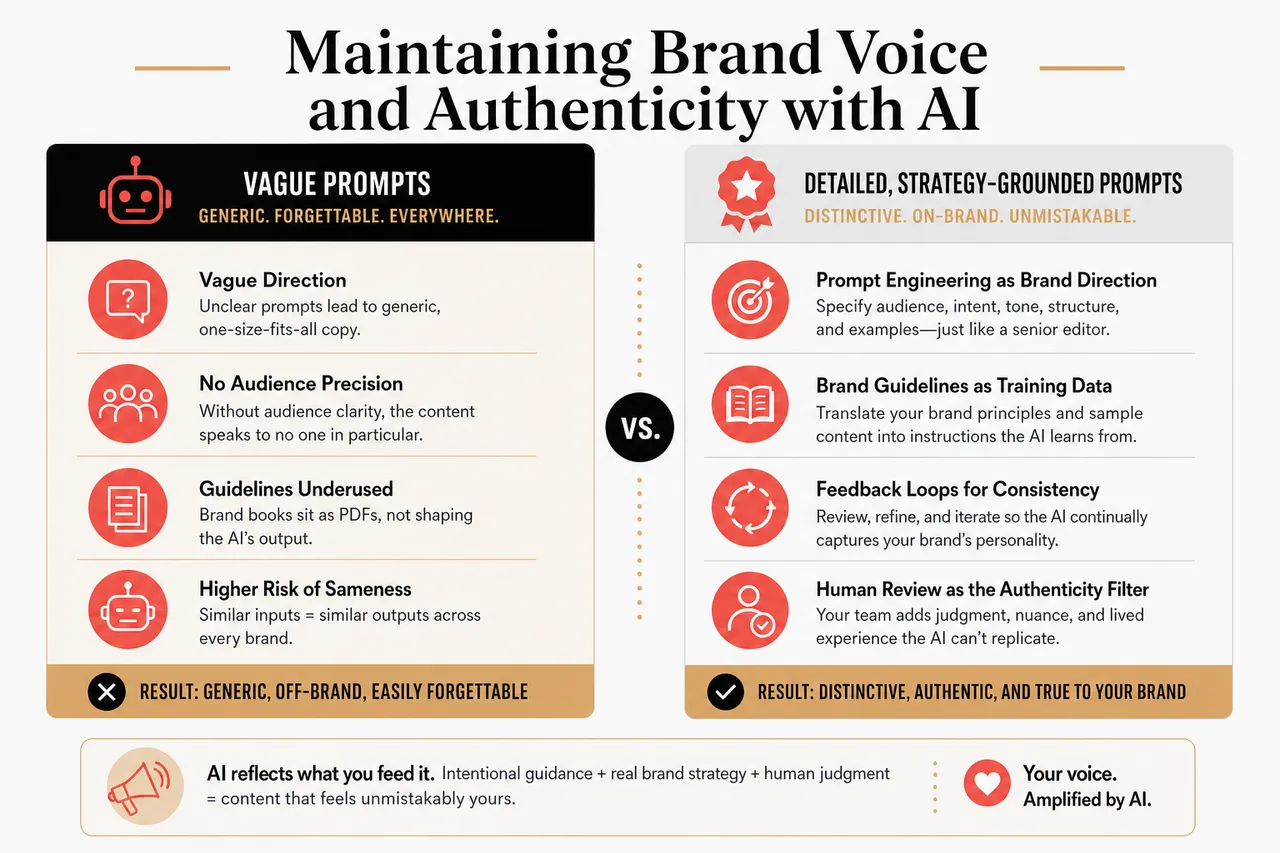
Among content leaders, the most common concern is sameness: if everyone uses similar models, will every brand sound identical? The answer depends on how intentionally you configure your tools. AI reflects whatever you feed it, which means that vague prompts result in generic copy, while detailed guidance grounded in real brand strategy produces content that feels distinctive and familiar to your audience.
Maintaining that distinctiveness requires more than a single style guide document. It involves operationalizing your voice through prompts, examples, and feedback loops so the AI can recognize and reproduce your brand’s personality consistently. ChatGPT 247 is designed with this in mind, allowing you to store and apply brand profiles that shape everything from sentence rhythm to preferred metaphors.
- Prompt engineering as brand direction. Detailed prompts act as creative direction for the model. When you specify audience, intent, tone, structure, and examples, you give the AI constraints that mirror what a senior editor would provide to a junior writer. This drastically reduces the risk of robotic or off-tone content.
- Brand guidelines as training data, not just PDFs. Instead of letting your brand book sit unused, translate its principles into concrete instructions and sample paragraphs within ChatGPT 247. Over time, you can evolve these assets as your positioning changes, ensuring that new campaigns automatically reflect the latest messaging.
- Human review as the authenticity filter. Even with strong prompts, some outputs will miss nuance or context. By treating AI drafts as starting points and requiring human sign-off, you preserve the emotional intelligence and lived experience that audiences recognize as genuine.
Actionable Tips for Preserving Brand Voice
- Create a living brand voice system inside your AI tool. Instead of a static PDF, build a structured voice profile in ChatGPT 247 that includes tone descriptors, sample phrases to use or avoid, and examples of approved content. Update this profile quarterly based on performance data and new strategic priorities so the AI remains aligned with where your brand is going, not just where it has been.
- Anchor every prompt in audience and intent. Before generating content, explicitly state who the piece is for and what you want them to think or do afterward. For example, asking ChatGPT 247 to write for “time-poor B2B marketing directors looking for measurable ROI” will produce very different copy than a prompt aimed at “curious early-stage founders exploring AI for the first time.”
- Use feedback to fine-tune future outputs. When editors revise AI-generated drafts, capture common changes and feed those patterns back into your prompt templates. Over time, this reduces repetitive edits and helps the model internalize your preferences, leading to stronger first drafts.
- Close the loop with performance metrics. Track how AI-assisted content performs compared with fully human-generated pieces across metrics like click-through rate, time on page, and conversion rate. If AI drafts consistently outperform in some formats but underperform in others, adjust where and how you apply automation.
Overcoming Challenges: Avoiding Generic Messaging
- Be precise and opinionated in your prompts. Generic prompts produce generic results. Encourage your team to include your brand’s stances, personality traits, and unique value propositions in their instructions. For example, telling ChatGPT 247 to “explain AI content creation from the perspective of a pragmatic operator who dislikes hype” will result in a noticeably different tone than a neutral explanation.
- Schedule regular brand voice calibration sessions. Every few weeks, have your content team review a batch of AI-generated examples together. Identify what sounds on-brand, what does not, and update your voice profile and prompt templates accordingly. This keeps the system in sync with subtle shifts in your brand language.
- Pair AI with editors who know your audience deeply. Editors who understand customer pain points, objections, and jargon can quickly spot when content feels off, even if it technically follows guidelines. Empower them to push AI outputs further, adding stories, analogies, and references drawn from real customer interactions.
With this level of intentionality, AI can become a powerful amplifier of your brand voice. Instead of eroding authenticity, tools like ChatGPT 247 can help you express it more often and more consistently, even as your content volume grows.
Top AI Content Creation Tools and Platforms in 2026
The AI landscape is crowded, but tools tend to cluster around specific strengths: conversational drafting, long-form marketing content, social copy, automation, or analytics. Selecting the right platform is less about picking the “best” model and more about aligning capabilities with your workflow, channels, and internal skills. ChatGPT 247 positions itself as a flexible hub that connects these strengths with your brand intelligence and day-to-day operations.
- Match tools to your primary content types. If most of your output is blog content and case studies, prioritize platforms that excel at long-form structure and research support. If social media volume is your bottleneck, choose tools with strong short-form copy and scheduling integrations. ChatGPT 247 can orchestrate multiple tools behind the scenes so your team experiences a unified interface.
- Evaluate integration and collaboration features. The real productivity gains come when AI fits seamlessly into your existing stack. Look for options that connect to project management, CMS, and analytics tools so content moves smoothly from ideation to publication and measurement. Collaborative features such as shared workspaces and version histories also help teams coordinate around AI outputs.
- Consider governance and customization. Enterprise teams increasingly require controls over data handling, access permissions, and brand configuration. Solutions that allow you to create role-based access, enforce approval workflows, and centralize brand profiles reduce risk as AI usage scales.
Feature Comparison: ChatGPT, Jasper.ai, Copy.ai, and ContentBot
| Platform | Primary Strengths | Best Use Cases | ChatGPT 247 Role |
|---|---|---|---|
| ChatGPT | Conversational content, ideation, and flexible drafting across formats. Excels at answering questions, explaining concepts, and co-writing with users. | FAQ content, knowledge base articles, initial drafts for blogs and emails, and interactive chat experiences embedded into sites or support flows. | Acts as a core engine inside ChatGPT 247 for dialogue-driven creation and on-demand brainstorming guided by your brand profile. |
| Jasper.ai | Marketing-focused long-form content with built-in templates for campaigns, landing pages, and SEO-optimized articles. | Scaling editorial calendars, generating campaign copy at volume, and supporting teams focused on search or performance marketing. | ChatGPT 247 can route specific long-form briefs to Jasper-style workflows, then pull drafts back into a central review and optimization environment. |
| Copy.ai | High-velocity short-form copy generation with many templates for ads, social posts, and quick ideas. | Producing headline variations, social snippets, and paid media copy that requires frequent testing and iteration. | Functions as a rapid ideation layer within ChatGPT 247 for campaigns where you need many creative angles in a short timeframe. |
| ContentBot | Workflow automation, triggers, and content flows that can generate and distribute pieces based on predefined rules. | Ongoing content programs like newsletters, recurring updates, and transactional messaging that benefit from consistent structure. | ChatGPT 247 can integrate with automation engines to trigger AI-assisted content creation when specific events occur, such as product updates or seasonal campaigns. |
Selecting the Right AI Tool for Your Business
- Start from your strategy, not the feature list. Clarify your primary content goals for the next 12 months, such as improving organic search visibility, supporting sales enablement, or expanding into new regions. Then evaluate whether a platform like ChatGPT 247, with its emphasis on brand voice and flexible workflows, can act as a central layer that coordinates specialized tools underneath.
- Prototype with real use cases. Instead of testing with hypothetical prompts, run a pilot using a live campaign or recurring content series. Measure time saved, quality of first drafts, and performance of published assets. This gives you evidence to decide whether to standardize on a given stack or adjust your tool mix.
- Prioritize adaptability and governance. As AI capabilities and regulations evolve, you will need a platform that can incorporate new models, comply with emerging guidelines, and reflect updated brand standards. ChatGPT 247 is designed to evolve with this landscape by allowing you to refresh prompts, workflows, and integrations without rebuilding your entire system.
Ethical Considerations and Quality Assurance in AI Content Creation
As AI-generated content becomes harder to distinguish from human-created work, ethical considerations and quality controls move from optional to essential. Regulators are paying closer attention to how automated systems influence public discourse, while customers increasingly expect transparency about how information is produced. Getting ahead of these expectations protects both your reputation and your search visibility.
Quality and ethics go hand in hand. Misleading claims, uncredited sources, or hidden automation can erode trust even if your content performs well in the short term. To avoid these pitfalls, leading organizations are codifying AI usage policies that specify when and how tools like ChatGPT 247 may be used, who must review outputs, and how to disclose AI involvement where appropriate.
- Multi-layered quality checks. Effective teams combine AI-enabled proofreading with human editorial oversight and manual fact-checking for high-stakes content. Automated tools can catch grammar issues and potential plagiarism, while human experts verify that statistics are current, context is accurate, and claims are supported by credible sources.
- Transparent AI usage policies. Some brands choose to highlight their use of AI as part of their innovation story, while others simply ensure that AI is not misrepresented as a human expert. Either way, having a written policy that clarifies acceptable use, disclosure standards, and escalation procedures helps teams act consistently.
- Compliance with evolving regulations. Responsible AI content practices include respecting intellectual property, avoiding deceptive deepfakes, and honoring data privacy rules. Platforms like ChatGPT 247 can support compliance by limiting what data is stored, providing audit trails of content generation, and allowing administrators to set guardrails on usage.
Best Practices for Quality and Originality
- Combine AI detection with human judgment. Tools that estimate whether content is AI-generated can be helpful for internal audits, but they are not foolproof. Use them as one signal among many, and rely on editorial judgment to ensure that pieces feel human-centered and aligned with your brand’s expertise.
- Verify statistics with reputable sources. When AI suggests data points, require writers or editors to confirm them against government databases, recognized research organizations, or peer-reviewed studies. This preserves accuracy and reduces the risk of perpetuating outdated or incorrect information.
- Encourage original insight and synthesis. Make it clear that AI should not be used to simply rephrase existing articles. Instead, ask ChatGPT 247 to help with structure, examples, or counterarguments, while humans contribute proprietary data, unique perspectives, and real-world anecdotes that the model does not possess.
The Role of Human Editors in AI Content Workflows
- Curators of brand meaning. Editors are responsible for ensuring that AI-assisted content reflects not only correct information but also the deeper story of your brand: what you stand for, how you see the world, and why customers should trust you. They decide when an AI draft is good enough and when it needs substantial reworking or even a complete rewrite.
- Guardians of nuance and sensitivity. AI can struggle with delicate topics, cultural nuances, and emerging issues. Human editors provide the empathy and contextual awareness needed to navigate these areas responsibly, adjusting or discarding AI outputs when they risk misunderstanding or offense.
With clear standards, rigorous review, and transparent communication, AI becomes a force multiplier for high-quality content rather than a shortcut that undermines trust. ChatGPT 247 can support this by embedding quality checkpoints directly into your workflows, so ethical considerations are part of the process, not an afterthought.
Measuring AI Content Performance and Optimizing Your Strategy
Once AI is embedded in your content operations, the next challenge is understanding its impact. Leaders do not just ask whether AI saves time; they examine how AI-assisted content performs against key metrics and adjust their strategy accordingly. This requires a measurement framework that can distinguish between AI-heavy, AI-light, and fully human content, then track their respective outcomes.
Key Metrics for Evaluating AI-Assisted Content
- Efficiency and throughput. Track how long it takes to move from brief to publish before and after adopting AI. Many teams observe 30 to 50 percent reductions in cycle time for routine formats, which translates into more experiments and a greater share of work focused on high-impact initiatives.
- Engagement and conversion. Monitor metrics like click-through rate, time on page, scroll depth, and form fills for AI-assisted content compared with historical baselines. If performance is equal or better while production time drops, you have evidence that AI is adding value without diluting quality.
- Brand consistency and sentiment. Use qualitative feedback from sales teams, customer success, or user surveys to gauge whether content still feels “on brand.” If stakeholders begin to flag tone mismatches or confusing messaging, treat this as a signal to refine your brand prompts and editorial oversight within ChatGPT 247.
Using Data to Refine AI Workflows
- Segment performance by creation mode. Tag each asset based on whether it was drafted primarily by AI, heavily edited by humans, or written manually. Over time, patterns will emerge, revealing which formats and topics are best suited to AI assistance and which require more human craftsmanship.
- Feed top performers back into the system. When a particular AI-assisted campaign outperforms expectations, add those assets to your training examples in ChatGPT 247. This helps the platform learn which angles, stories, and structures resonate most strongly with your audience.
- Iterate prompt templates based on outcomes. If content generated from certain templates underperforms, treat that as a prompt design issue rather than a model limitation. Revise instructions to emphasize clarity, originality, or stronger calls to action, and test again.
| Metric | What It Measures | How AI Influences It | Optimization Approach with ChatGPT 247 |
|---|---|---|---|
| Production Time | Hours or days from brief to publish for a given asset. | AI can significantly reduce drafting and repurposing time, especially for repeatable formats. | Automate first drafts and repurposing flows in ChatGPT 247, then monitor cycle-time reductions per asset type. |
| Engagement Rate | Clicks, time on page, comments, or shares relative to impressions. | AI enables rapid testing of angles and formats, improving odds of finding high-performing variants. | Generate multiple versions of headlines and hooks, publish A/B tests, then standardize on winning patterns. |
| Brand Consistency | Subjective assessment of how closely content matches brand voice and messaging. | Centralized brand profiles reduce variation between pieces and contributors. | Maintain brand voice guidelines inside ChatGPT 247 and require their use in all AI prompts. |
| Content Volume | Number of quality assets produced per month. | AI increases volume without linear increases in headcount, within the limits of editorial capacity. | Use AI to handle high-volume formats while reserving human-only efforts for flagship content. |
Frequently Asked Questions About AI Content Creation and Brand Voice
How much of my content can safely be AI-generated without hurting my brand?
There is no universal percentage, but a practical approach is to use AI for 60 to 80 percent of the drafting work on lower-risk formats, while keeping final accountability and key creative decisions in human hands. For flagship pieces such as major reports, leadership articles, or high-stakes campaigns, treat AI primarily as a research and structuring assistant rather than the main writer.
Will using AI-generated content harm my search rankings?
Search engines focus on relevance, originality, and usefulness rather than the exact method of creation. AI-generated content that is derivative, thin, or misleading can harm rankings and reputation, while well-edited, audience-focused content created with AI assistance can perform strongly. Combining ChatGPT 247 with human expertise, original insights, and solid SEO practices is the safest path.
How do I explain our use of AI to customers and stakeholders?
A clear, simple message works best: position AI as a tool your team uses to work more efficiently while emphasizing that humans remain responsible for quality, accuracy, and final decisions. You might say that you use platforms like ChatGPT 247 to draft and refine content, but your experts review everything before it is published to ensure it reflects your brand values and their professional judgment.
What skills should my team develop to work effectively with AI?
Key skills include prompt design, critical evaluation of AI outputs, understanding of your brand’s strategic narrative, and basic familiarity with data-driven optimization. Training your team to use ChatGPT 247 not just as a text generator, but as a collaborative partner for brainstorming, structuring, and refining ideas, will unlock far more value than simply handing them a new tool.
The Future of AI in Content Creation
Artificial intelligence content creation is no longer just about faster drafting; it is evolving into a broader orchestration layer that connects audience insight, brand strategy, and creative execution. Emerging tools can already generate multimodal experiences, turning a single strategic idea into aligned text, visuals, and presentations in one workflow. For brands willing to invest in governance and training, this opens the door to more ambitious, story-driven campaigns produced at a pace that would have been unrealistic a few years ago.
- From assistance to co-creation. Future systems will not only follow prompts but help shape them, suggesting narratives, formats, and channels based on real-time performance data and audience behavior. ChatGPT 247 is designed to move in this direction by tying creative workflows to your strategic goals and analytics signals.
- Deeper personalization at scale. Advances in AI-driven segmentation and content assembly will make it possible to deliver highly tailored experiences to thousands of micro-audiences without handcrafted copy for each one. The brands that thrive will be those that combine this technical capability with a strong, coherent narrative that keeps all those variations anchored in a recognizable voice.
- Higher expectations for responsibility and transparency. As AI-generated media becomes more sophisticated, customers, regulators, and partners will demand clear standards for disclosure, data use, and accuracy. Organizations that build robust AI content practices now, with platforms like ChatGPT 247 at the center, will be better positioned to adapt as expectations and rules continue to evolve.
For teams exploring artificial intelligence content creation in 2026, the opportunity is twofold: to dramatically increase the reach and relevance of your content, and to strengthen the core of your brand by articulating your voice more clearly than ever. When you combine well-trained AI tools with sharp strategy and thoughtful human oversight, you do not just keep up with the content race; you set a new standard for what meaningful, consistent communication can look like at scale.