

Artificial intelligence isn’t magic, and it’s not science fiction anymore. It’s the technology behind your smartphone’s autocorrect, Netflix recommendations, and yes, tools like ChatGPT that can draft emails or brainstorm ideas in seconds. But beyond the hype, most people still don’t understand how AI actually works or why it matters to them. This guide strips away the jargon and walks you through the core concepts in plain language.
Whether you’re exploring AI solutions for your business or just curious about the tools reshaping everyday life, you’ll leave with clarity, not confusion. No buzzwords. Just the truth.
Introduction to Artificial AI: Why the Term Matters in 2026
In 2026, the phrase “artificial AI” appears frequently in headlines, product launches, and marketing campaigns. This popularity reflects a surge in public curiosity about artificial intelligence, fueled by major announcements from influential figures such as Elon Musk and the swift integration of AI systems into daily routines. Despite the excitement, the term “artificial AI” is essentially a redundancy, simply repeating the “artificial” in artificial intelligence. Its rise is tied more to branding and emphasis than to any new technological breakthrough.
Why Is ‘Artificial AI’ Trending Now?
There’s no shortage of headlines highlighting “artificial AI,” and it’s easy to see why. Media outlets use the phrase to grab attention, while companies rely on it to separate their products from the crowd. For example, you’ll see “artificial AI” plastered across new chatbot launches or advanced driver assistance announcements, especially when they’re backed by big names like Elon Musk. The more it’s repeated, the more it feels like a cutting-edge breakthrough, even though it is really just familiar AI in a new marketing wrapper.
Common Misconceptions About Artificial AI
It is easy to assume that “artificial AI” points to a brand-new wave of smart technology. In reality, it is just a catchy way to talk about the same artificial intelligence that has been making headlines for years. The term works as a marketing hook to emphasize the “artificial” element, but it does not mark a leap forward in capability. Being aware of this helps set realistic expectations and makes it easier to spot what is truly new versus what is just rebranded.
- “Artificial AI” sounds fresh, but it does not describe a new kind of intelligence. It simply repeats the word “artificial,” which is already part of the phrase “artificial intelligence,” so it does not add any technical meaning even when it is used in product pitches or press releases.
- Getting comfortable with the language helps you make better decisions when choosing AI solutions. When you understand that “artificial AI” is just branding, you are more likely to compare features such as accuracy, cost, data privacy, and integrations instead of being swayed by hype-heavy names.
- Clear terminology helps you communicate effectively inside your team and with vendors. If everyone shares the same basic understanding of what AI, machine learning, and automation mean, it is easier to evaluate tools, draft requirements, and avoid misunderstandings in contracts or project plans.
Understanding Artificial Intelligence: Definitions and Key Concepts
If you want to make sense of artificial ai, it helps to start with the basics. Whether you are a business owner trying to streamline operations or someone just curious about the tech running behind the scenes, knowing the key terms and concepts gives you an edge.
What Is Artificial Intelligence?
Artificial intelligence is about building computer systems that can handle tasks we usually associate with human smarts. Think of simple things like your phone reading your voice commands, or more complex jobs like a bank’s fraud detection system spotting unusual activity across millions of transactions in real time. Streaming platforms use artificial ai to suggest your next favorite show by learning from what similar viewers watched, while apps like ChatGPT and platforms such as ChatGPT 247 draft emails or help you brainstorm ideas in seconds. These are not just science projects, they are tools you interact with every day across your phone, browser, and workplace software.
AI vs. Machine Learning: What Is the Difference?
Artificial ai is the big picture, it covers any tech that tries to imitate human thinking. Machine learning is a part of that picture, focused on teaching computers to learn from data instead of relying only on fixed rules. Instead of being programmed for every scenario, machine learning algorithms get better as they see more examples. For instance, an email spam filter improves over time by analyzing the messages you mark as spam and the ones you open, gradually adjusting what it blocks. The more it “sees,” the smarter it gets, and modern platforms like ChatGPT 247 rely on that same principle as they adjust responses to the kinds of prompts users send most often.
Types of AI: Narrow, General, and Superintelligent
- Narrow AI: This is where almost all artificial ai lives today. These systems are highly specialized, such as chatbots that answer customer service questions, image generators that create new photos for your marketing campaigns, or recommendation engines that suggest products based on your browsing history. They do one job really well, sometimes at massive scale, but they cannot switch between tasks the way people can, so your image generator will not suddenly become a financial advisor.
- General AI: Sometimes called “strong AI,” this would be software that can tackle any problem a human can, from reasoning about legal contracts to understanding humor and emotions. As of 2026, this is still theoretical, no machine matches humans across the board, even if some large language models appear impressively capable in limited tests.
- Superintelligent AI: This is the topic of movies and research papers, AI that is smarter than any human in essentially every domain. We are nowhere near this yet in real products, but it sparks debate about long term safety, governance, and how society should prepare if systems ever reach that level.
- Artificial ai is about computers doing things we would usually need people for. From classifying images to writing code snippets, these systems automate parts of knowledge work, which is why they are so attractive to both individuals and businesses looking to save time.
- Machine learning is one way for AI to get smarter, by learning from data instead of relying on fixed rules. When you upload more examples or connect a tool to live data, it can adapt to trends, new behaviors, or previously unseen scenarios in ways traditional software struggles to match.
- When you see “artificial AI,” remember it is just another name for AI, not a new category. What matters is whether a tool uses proven methods like supervised learning, reinforcement learning, or large language models, not whether it adopts the latest buzzword in its marketing copy.
How Big Is AI in 2026? Market Size, Growth, and Adoption
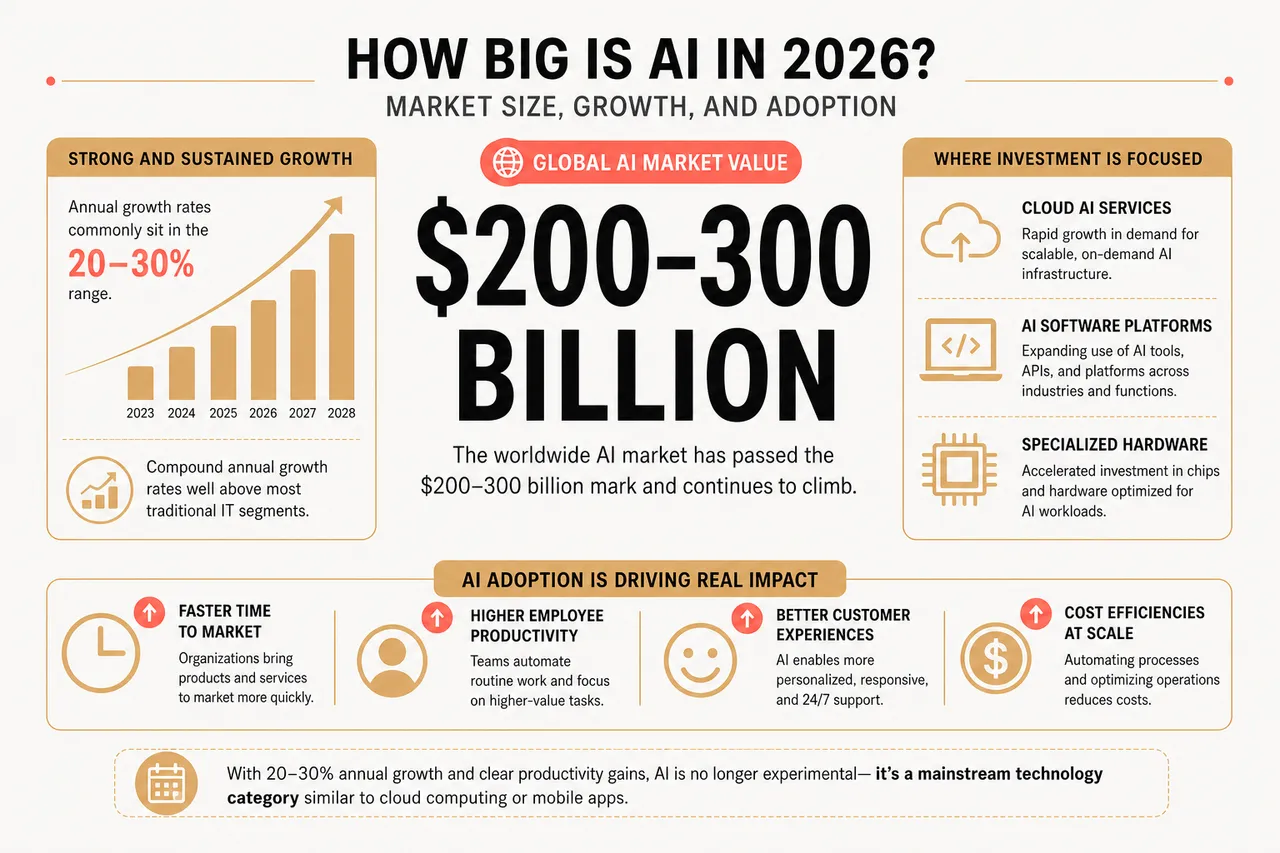
Understanding the scale of artificial ai in 2026 helps put the buzz in context. Behind the headlines, AI has become a major economic force and a standard part of how organizations operate, from small businesses to governments.
Key Numbers That Show AI’s Impact
- Global AI market value is already in the hundreds of billions of dollars. Recent industry reports from firms such as McKinsey, PwC, and Statista estimate that the worldwide AI market has passed the 200 to 300 billion dollar mark and continues to climb, as spending on cloud AI services, AI software platforms, and specialized hardware accelerates. For a business owner, this signals that AI is no longer experimental, it is a mainstream technology category similar to cloud computing or mobile apps.
- Annual growth rates commonly sit in the 20 to 30 percent range. Multiple market studies project compound annual growth rates well above most traditional IT segments, meaning the AI tools you test this year will likely be more capable, more integrated, and potentially cheaper per unit of value in just a few years. Planning with this growth in mind encourages flexible strategies, such as choosing platforms like ChatGPT 247 that update capabilities over time instead of static, one off tools.
- Productivity gains from AI are already visible at the organizational level. Surveys by global consultancies and government agencies report that firms adopting AI at scale see measurable improvements in metrics such as time to market, customer satisfaction, and cost per ticket in support centers. For example, many companies report double digit reductions in average handling time when they add AI chatbots to first line support, which shows up directly in staffing and training budgets.
- Adoption rates are especially high among digital native and knowledge intensive sectors. Technology, financial services, and professional services companies are often the first movers, with a majority reporting that they use AI in at least one core business function, such as marketing personalization, risk scoring, or document summarization. As platforms like ChatGPT 247 lower the technical barrier, these use cases spread to smaller firms and non technical teams.
- Individual users are embracing AI assistants in their daily lives. Consumer surveys indicate that a large share of internet users have tried generative AI tools, and a growing subset uses them weekly or daily for tasks like drafting messages, translating content, or summarizing long documents. This behavioral shift means your customers, partners, and employees increasingly expect AI enhanced experiences rather than purely manual ones.
Real-World Applications of Artificial AI: From ChatGPT 247 to Everyday Life
Artificial ai is no longer just a buzzword, it is part of everyday routines, at work and at home. In 2026, people from all walks of life use AI powered tools, often without even realizing it. Let us look at some real scenarios where artificial ai is making a difference right now and how platforms like ChatGPT 247 fit into this landscape.
AI Chatbots: Enhancing Customer Engagement
Think about running an online store and waking up to dozens of customer questions in your inbox. With AI chatbot integration, platforms like ChatGPT 247 can answer FAQs, schedule appointments, and even process orders around the clock. These bots do not just save time, they let your team focus on bigger challenges, while customers get instant answers across web chat, email, or social channels. For example, a boutique retailer can rely on AI chatbots to handle sizing queries and shipping updates while using the conversation history inside ChatGPT 247 to identify common pain points and refine product descriptions.
Image Generation and Creative Tools
Need a fresh logo, product mockup, or ad banner? AI powered image generation tools make it simple to move from idea to visual content in minutes. Marketers and small business owners use these tools to create eye catching visuals without waiting on a designer, testing different concepts quickly before committing budget to a full campaign. In practice, a team might sketch a campaign concept in ChatGPT 247, generate multiple image variations, and then ask the system to suggest matching headlines and calls to action, turning one idea into a complete asset set in a single workflow.
Automated Translation and Localization
Going global once meant hiring translators and spending weeks on content localization, but automated translation services powered by artificial ai now handle websites, emails, and product manuals almost instantly. For a tech startup expanding into Europe and Asia, this means reaching new customers fast without the initial language barrier. Beyond speed, these tools support consistent terminology across channels, and platforms such as ChatGPT 247 can help teams adapt tone and examples to local audiences, which is critical for marketing and customer success materials.
SEO Optimization Assistance
Standing out online is tough, especially with search algorithms evolving constantly. Artificial ai steps in with SEO optimization tools that analyze keywords, monitor competitors, and suggest updates to boost your rankings in ways that would be tedious to do manually. Even a one person business can get actionable recommendations such as which blog topics to prioritize, how long articles should be, or how to structure product pages, without hiring an expensive agency. ChatGPT 247 can act as a strategic assistant here, helping you research topic clusters, draft outlines, and refine metadata so that content is both helpful to readers and aligned with how search engines understand intent.
- Artificial ai drives chatbots, creative image tools, translation services, and SEO helpers in a unified way. These capabilities often share common building blocks such as language models and vector search, which is why platforms like ChatGPT 247 can expose multiple features through a single interface while still feeling tailored to each task.
- Platforms like ChatGPT 247 make these technologies user friendly, so you do not need a tech background to benefit. Instead of wiring together multiple APIs or hiring data scientists, you work through a conversational interface, templates, and integrations with tools you already use, such as email, office suites, or help desk systems.
- Real benefits show up in time saved, fewer errors, and more consistent customer experiences. By automating repetitive tasks with AI and keeping humans focused on exceptions and high value decisions, teams can handle higher volumes of work without burning out their staff or sacrificing quality.
Artificial AI vs. General AI: Clarifying the Buzzwords
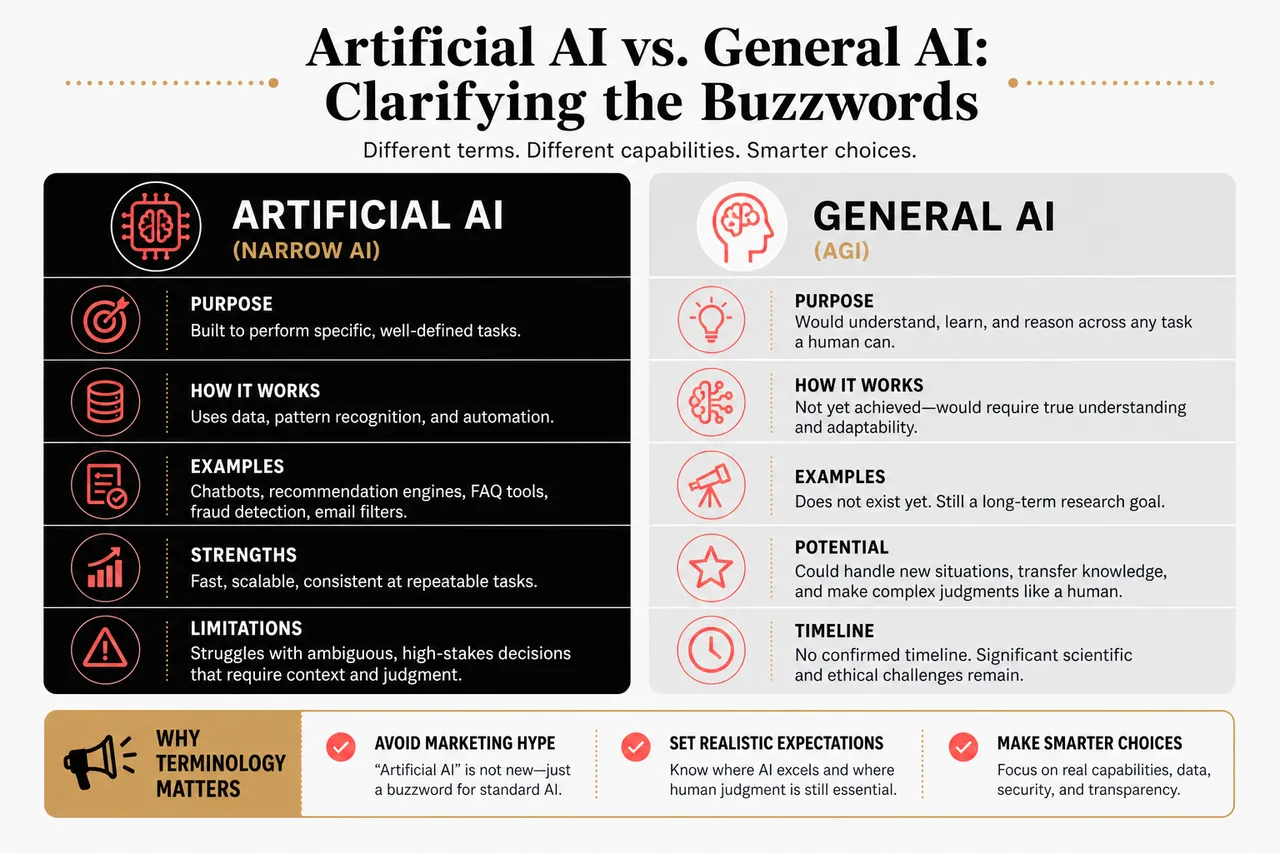
Clear language is key to making smart choices about artificial ai. When terms get tossed around loosely, it is easy to get caught up in the hype or misunderstand what is actually possible.
Why Terminology Matters in AI
Knowing the difference between “artificial intelligence,” “AI,” and “machine learning” helps you cut through marketing spin and focus on what is real. For example, reading about “artificial AI” in a product description might sound impressive, but it is really just standard AI with a new label. Being aware of these nuances helps you avoid overpaying for features you do not need or expecting miracles from tools that are designed for simpler, well defined tasks.
Setting Realistic Expectations
Artificial ai can do amazing things, but it is not magic. Most systems rely on data, pattern recognition, and automation, which means they excel at clearly defined, repeatable tasks and struggle with ambiguous, high stakes decisions that require context and judgment. For instance, an FAQ automation tool powered by ChatGPT 247 can handle most customer questions instantly, but if a customer asks about an unusual legal situation or a rare technical issue, it might still need a human touch. Knowing where AI shines and where it is limited helps you plan smarter escalation paths and avoid disappointment.
- “Artificial AI” is not a new technology, just a buzzword. If a vendor leans heavily on that phrase without explaining underlying methods, training data, or security practices, that is a sign to ask more questions before committing budget or sensitive information.
- Understanding the terms sets the stage for real, achievable results with AI. When teams distinguish between automation, analytics, and generative models, they can map each tool to the right business problem, from summarizing documents to predicting demand or detecting anomalies.
- Grounded expectations protect both trust and return on investment. By treating AI as a powerful assistant instead of an all knowing oracle, organizations are more likely to see steady productivity gains rather than experiencing costly failures or reputational damage from overreliance.
Data, Privacy, and Trust: What Powers Artificial AI Behind the Scenes
Every impressive AI demo hides an important reality, these systems are only as good as the data, infrastructure, and safeguards behind them. Understanding these foundations helps you choose tools that are not only powerful but also responsible.
Why Data Quality Matters More Than Algorithms
Modern AI models are impressive, but their performance in real settings depends heavily on the data they are trained and tuned on. Clean, diverse, and representative data helps systems avoid obvious errors and reduces the risk of biased outputs that could frustrate or harm users. When you connect your own data to a platform like ChatGPT 247, such as knowledge bases or policy documents, curating and updating those sources regularly is just as important as the choice of model.
Privacy, Security, and Regulatory Expectations
As AI adoption has grown, regulators have increased their focus on privacy, security, and transparency. Many regions now expect organizations to explain how automated systems use personal data, allow users to opt out where appropriate, and protect information with strong technical controls. When assessing tools like ChatGPT 247, it pays to ask how customer data is stored, whether it is used to train general models, and what options exist for keeping sensitive information confined to your own environment.
Human Oversight and Responsible Use
Even when AI performs well on average, it can still be wrong or inappropriate in specific cases, especially in sensitive domains such as health, finance, or legal advice. Responsible use means keeping humans in the loop for high impact decisions, documenting how AI assists those decisions, and setting clear policies about what AI is allowed to generate. Platforms like ChatGPT 247 can support this by offering configurable guardrails, access controls, and logging so that teams can audit how the system is used over time.
Glossary of Essential AI Terms for Beginners
Getting familiar with artificial ai means learning the language. Here are some key terms you will encounter, explained in plain English and connected to how tools like ChatGPT 247 work.
- Artificial Intelligence (AI): When machines are built to do things that typically require human intelligence, such as recognizing patterns, understanding language, or making decisions. In practice, this ranges from email filters that catch spam to conversational systems like ChatGPT 247 that can answer questions and generate text.
- Machine Learning: A type of AI that improves its skills by analyzing data, without needing new instructions for every task. For example, a recommendation system in an online store learns which products people tend to buy together and uses that experience to suggest items to future shoppers.
- Chatbot: An AI powered program that chats with users, usually to answer questions or help with customer support, onboarding, or simple transactions. ChatGPT 247 offers chatbot style experiences that can be embedded in websites or internal tools so people can get help through natural conversation.
- Neural Network: A computer system inspired by how the human brain works, built from layers of simple mathematical units that work together to spot patterns in complex data. Large language models, which power tools like ChatGPT 247, are a specific kind of neural network trained on vast collections of text.
- Natural Language Processing (NLP): Techniques that help computers understand and create human language, like speech or text. NLP allows systems to interpret your questions, extract key details from documents, and respond in ways that feel fluent and context aware.
- Algorithm: A clear set of rules or steps that tell a computer how to solve a problem or complete a task. In AI, algorithms define how models learn from data and how they make predictions, such as whether a transaction looks fraudulent or which answer best matches a question.
- Data Training: Feeding lots of examples to an AI system so it can learn and get better at its job, similar to how people improve with practice. When you fine tune or customize an AI model using your company’s documents inside ChatGPT 247, you are engaging in a form of data training tailored to your needs.
- Model: The virtual “blueprint” an AI uses to make predictions or decisions based on what it has learned from data. Once trained, a model can be reused across many interactions, such as answering thousands of user queries per day without needing to relearn from scratch.
Making Artificial AI Work for You in 2026
Artificial ai is no longer just a futuristic idea, it is a practical tool shaping the way we work, create, and connect in 2026. While trendy phrases like “artificial AI” might crowd the conversation, what really matters are the real world benefits and the everyday ways this technology simplifies life. By understanding key concepts and focusing on features that genuinely add value, such as AI chatbot integration, automated translations, image generation, SEO optimization, and FAQ automation, you can unlock powerful improvements in productivity and reach.
If you are ready to see what artificial ai can do firsthand, platforms like ChatGPT 247 offer an approachable starting point, packed with resources and tools for every level. You can begin with a single use case, such as automating common support questions, then gradually expand into content creation, research assistance, or multilingual outreach as your confidence grows. The world of artificial ai is growing fast, and there has never been a better time to get involved on your own terms and at your own pace, with a platform designed to help you experiment safely and learn as you go.