

Generative AI stopped being futuristic the moment it started writing your emails, designing your slides, and answering customer questions at 3 a. m. By 2026, it’s woven into daily work for millions, yet most people still treat it like a novelty rather than a strategic tool. The gap between experimenting and extracting real value comes down to understanding what these AI technologies can actually do, where they fall short, and how to deploy them without courting unnecessary risk.
ChatGPT 247 helps individuals and businesses cut through the hype by offering hands-on access to AI tools like ChatGPT, paired with practical guidance for real-world applications. This guide walks you through the most impactful uses, the hidden pitfalls, and the emerging opportunities shaping AI solutions today.
Introduction to Generative Artificial Intelligence
Generative artificial intelligence (GenAI) in 2026 represents a mature and widely adopted technology, fundamentally altering how organizations and individuals create, interact, and make decisions. Unlike earlier AI systems focused on analysis or prediction, GenAI produces new, original content ranging from text and images to audio and video by leveraging advanced machine learning models.
- Generative capabilities at scale: GenAI refers to systems capable of generating content that did not exist before, using vast amounts of training data to learn patterns and associations. In practice, this means drafting documents, composing music, designing products, or writing code in seconds, at a scale that would be impossible for human teams alone.
- Acceleration since 2020: Since 2020, the pace of GenAI innovation has accelerated dramatically, culminating in its integration into mainstream applications across industries by 2026. Industry estimates suggest the core GenAI software market was around 16 to 22 billion dollars in 2025 and is projected to grow to roughly 69 to 143 billion dollars by the mid-2030s, illustrating how quickly organizations are committing real budget to these tools.
The journey began with early neural networks and evolved rapidly with key breakthroughs such as transformers and large language models (LLMs). Today’s generative models, like ChatGPT, Gemini, and image systems such as DALL-E or Firefly, are central to content creation, automation, and problem-solving in business and everyday life. Contrary to a common misconception, generative AI is not limited to generating text. Its capabilities now span image synthesis, audio composition, video production, code generation, and even the design of new molecules in scientific research.
Evolution of Generative AI
It is easy to forget how quickly generative artificial intelligence has evolved. Early neural networks acted as the foundation, but the real shift happened when transformer models arrived and made it possible to keep track of long-range context in language and images. Suddenly, AI could summarize documents, reason across multiple paragraphs, and generate coherent stories or designs instead of short, disconnected snippets.
The public launch of conversational tools like ChatGPT in 2022 brought GenAI into mainstream awareness, while subsequent multimodal systems made it normal to talk to a single model about text, images, audio, and video in one place. By 2026, tools such as ChatGPT, Gemini, and other assistants are able to resolve about a third of customer service cases end to end, generate nearly half of the code that some developers write with tools like AI coding assistants, and support creative professionals in everything from storyboarding to sound design.
How Generative AI Works: Models and Technologies
At the heart of generative artificial intelligence are powerful neural networks and immense datasets. The two main drivers behind recent advances are transformers and large language models. Together, they enable AI to process and create content that feels surprisingly human while still being grounded in pattern recognition rather than true understanding.
- Transformers as the core architecture: Transformers are designed to handle complex sequences such as paragraphs of text, series of images, or even frames of video, allowing models to attend to relevant parts of the input and maintain context. This architecture powers text models like GPT class systems and multimodal models that can look at an image, understand it, and respond in language, making interactions feel coherent and context aware.
- Large language and multimodal models: LLMs from providers like OpenAI and Google are trained on huge datasets, learning how words, images, sounds, and increasingly sensor data connect. When you give them a prompt, they generate content by sampling from these learned patterns, making outputs feel relevant, stylistically aligned, and increasingly grounded in up to date information when connected to tools such as search or proprietary databases.
- From unimodal to unified models: Earlier AI systems handled text, images, audio, and video in separate models, which limited their ability to reason across formats. The newest generation of multimodal models uses a single architecture to process different media types together, making it possible, for example, to analyze a product photo, read accompanying instructions, and generate a support script or marketing copy in a single flow.
Here is a real-life scenario: If you ask ChatGPT inside ChatGPT 247 to write a customer service reply, it quickly crafts a message by drawing on patterns from millions of prior examples, while following your brand tone and any guidelines you provide. Or, when a designer needs a new logo or storyboard, an image model can produce several original concepts in seconds based on a short creative brief. This flexibility is what makes generative AI so appealing for businesses and individuals alike.
It is also worth noting that, regardless of how creative the outputs may seem, generative AI does not think or understand like a human. Every answer or image it creates is based on learned statistical patterns. There is no intention or independent thought behind the scenes, which is why outputs can still be confidently wrong or misaligned with your goals if you do not steer and review them carefully.
Key Technologies: Transformers and LLMs
Transformers changed the game by allowing AI to keep track of context across long stretches of text or complex images, enabling tasks such as document level summarization, conversational memory, and cross page reasoning in spreadsheets or code bases. That is why tools like GPT style models and Gemini can handle everything from in depth research reports to dense product specifications and still respond with coherent answers.
By 2026, nearly every major generative AI platform is built on some variant of transformer architectures, including specialized versions for code, biology, and scientific reasoning. These models increasingly support tool use, meaning they can call search, databases, calculators, or other software services as part of answering a question or completing a workflow. ChatGPT 247 leverages exactly this pattern to connect conversational interfaces with practical tools for content creation, analysis, and automation.
Training and Content Generation
Training a generative model is like giving the AI a massive crash course across languages, cultures, and domains. It studies a mix of books, articles, code repositories, images, videos, audio, and synthetic data, learning the underlying structure of language and media. Once trained, the model can generate new content by predicting the next word, pixel, or token over and over, guided by probabilistic patterns it has internalized.
This process is increasingly refined with techniques such as reinforcement learning from human feedback, retrieval augmented generation that consults external knowledge sources, and safety filters that steer outputs away from harmful content. The result is that AI can now help marketers brainstorm campaigns, assist lawyers in drafting first pass contracts, support doctors with structured summaries of clinical notes, and even outline research reports or software architectures. In ChatGPT 247, these capabilities are surfaced through templates and workflows so non technical users can benefit without needing to understand the math behind the models.
Current and Emerging Applications of Generative AI (2026)
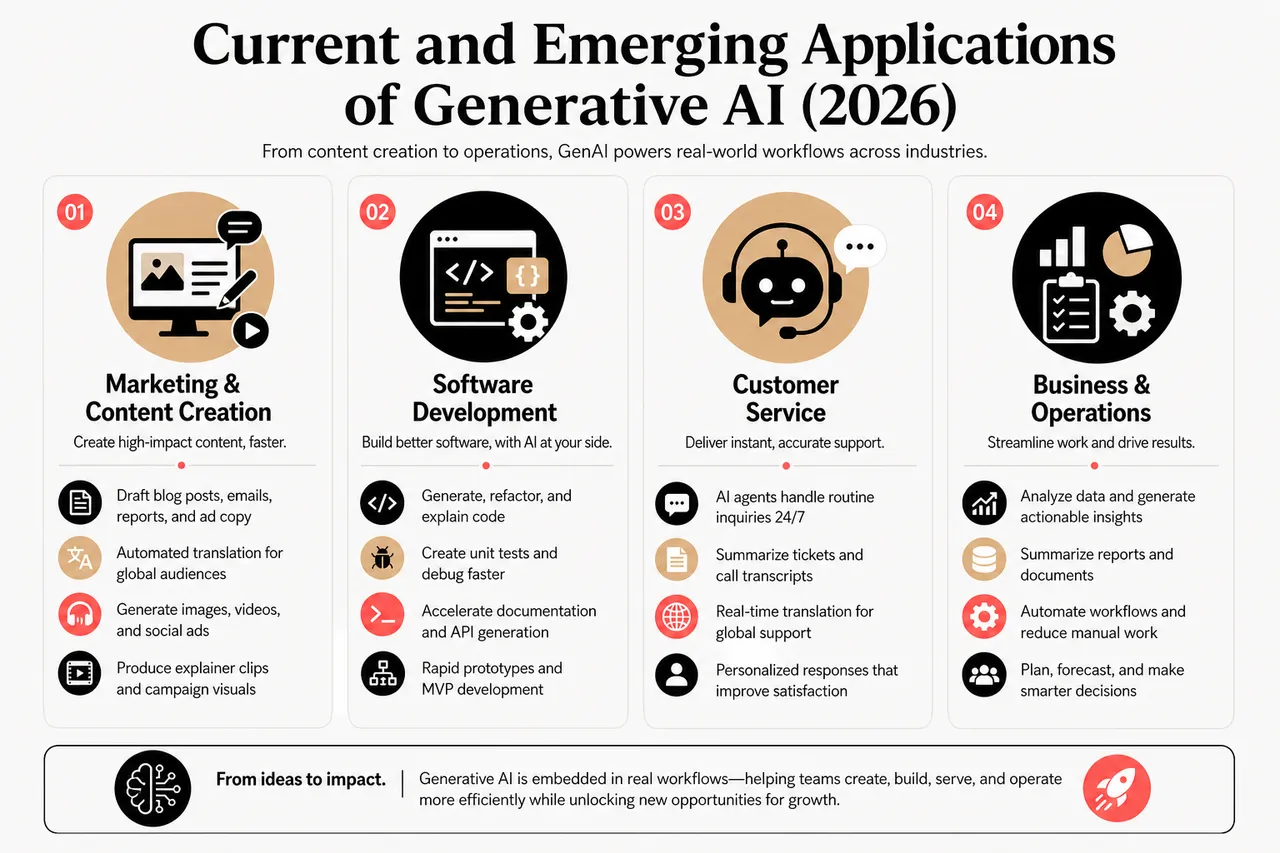
Generative artificial intelligence is no longer just about typing prompts and reading replies; it sits underneath whole workflows in marketing, software development, customer service, and operations. Organizations are moving from one off experiments to sustained deployment inside products and internal tools, and platforms like ChatGPT 247 are designed to manage that transition.
- Text and language generation: Tools like ChatGPT make it easy to draft blog posts, outreach emails, reports, or customer responses in a fraction of the time. For example, AI can prepare a first draft knowledge base article from call transcripts, which human agents then refine instead of starting from scratch. Integrated automated translation services reduce friction when serving global audiences, giving even small companies access to enterprise level localization workflows.
- Image, audio, and video generation: Marketers use image and video models to create campaign visuals, social ads, and explainer clips tuned to specific audiences. Content creators, podcasters, and game studios rely on AI to generate background music, sound effects, and scene variations rapidly, testing multiple creative directions without heavy upfront production costs. This workflow allows rapid prototyping so that teams can validate ideas before committing budget to large scale production.
- Business and industry use cases:
- AI chatbot integration: AI agents embedded in websites, apps, and messaging platforms handle routine requests, troubleshoot common issues, and escalate complex cases to humans. Some enterprises report that AI now resolves around 30 percent of incoming customer service tickets, improving response times while freeing agents to focus on high value interactions.
- Design and branding acceleration: Image generation tools produce visual assets, product mockups, and presentation templates that used to require external agencies or lengthy internal design cycles. Teams can iterate in real time with stakeholders, using AI as a shared canvas inside platforms like ChatGPT 247 to converge on a concept faster.
- Localization and global reach: Automated translation services do more than direct language conversion; they can adapt tone, idioms, and examples for local markets. This enables smaller brands to enter new regions, testing localized campaigns at low cost and scaling up where they see traction.
- SEO and content operations: Generative AI helps identify relevant keywords and questions, generate article outlines, and draft FAQ content aligned with user intent. Teams that integrate GenAI into their content pipelines report significant gains in output volume and consistency, with human editors focusing on strategy, originality, and compliance.
- Sector specific applications: In healthcare, generative AI summarizes patient encounters, structures medical histories, and supports clinicians with draft documentation that can reduce administrative time. In finance, models generate market commentary, scenario analyses, and draft compliance reports, while human experts verify and refine judgments. Retailers use GenAI powered recommendation and design tools to personalize product suggestions and simulate merchandising layouts before implementing them in stores or apps.
One of the biggest shifts in 2026 is how accessible generative artificial intelligence has become. Cloud based offerings and embedded AI features in productivity tools now reach hundreds of millions of users without them explicitly signing up for AI products. Freelancers and small businesses use platforms like ChatGPT 247 as an inexpensive back office for drafting, design, translation, and research support, while larger enterprises integrate APIs directly into their internal systems.
Text and Language Generation
Customer support teams increasingly rely on ChatGPT style assistants to propose draft responses, which agents then edit in line with policy. This reduces handle time and improves consistency, while still keeping humans in control for sensitive topics. Automated translation and summarization make it easier to route cases across regions and roles, ensuring the right specialist sees the right information at the right time.
Image, Audio, and Video Generation
Designers and marketers appreciate being able to create on brand visual and audio content on demand. Instead of waiting days for revised assets, they can generate multiple variations in minutes, test them across channels, and double down on what performs. In entertainment and media, AI assisted video editing and sound design are becoming standard, blending human creativity with automated routine tasks such as cutting scenes, adjusting audio levels, and generating alternative versions for different platforms.
Business and Industry Use Cases
Beyond content, generative AI helps businesses analyze unstructured data such as call transcripts, survey responses, and research reports. Executives can request concise summaries or scenario analyses and receive structured outputs that support decision making without reading through hundreds of pages. ChatGPT 247 can be configured to act as an internal analyst that works over your knowledge base, documents, and data, turning fragmented information into clear, actionable narratives.
Risks, Ethical Considerations, and Challenges
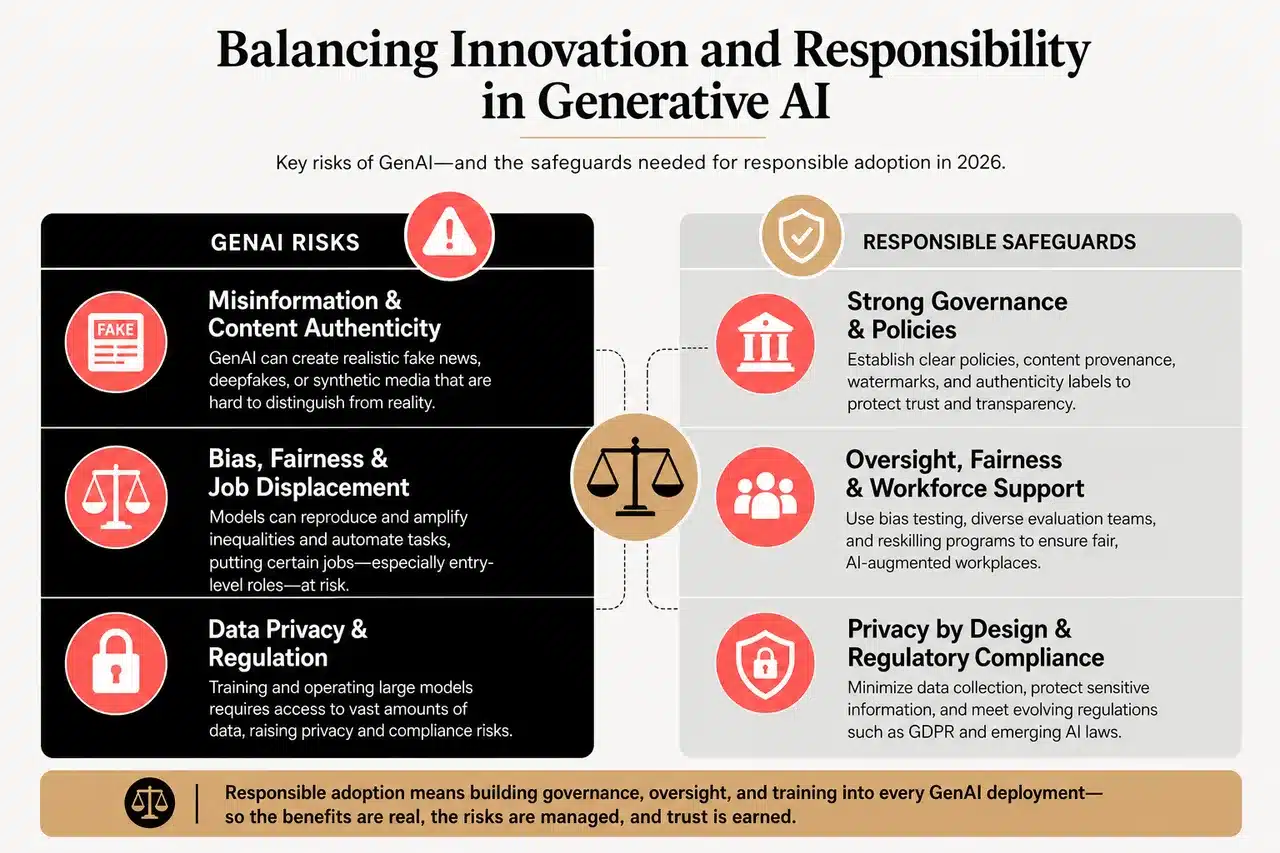
With all the promise of generative AI, it is essential to keep a clear view of its risks. These systems can amplify misinformation, encode bias, or expose sensitive data if used carelessly. Responsible adoption in 2026 means building governance, oversight, and training into the way you deploy tools like ChatGPT 247, not just switching them on and assuming everything will work out by itself.
- Misinformation and content authenticity: GenAI can easily produce realistic fake news, deepfake videos, or synthetic images that are hard for non experts to distinguish from reality. This creates serious challenges for media, education, and politics, where trust and verification are core. As a result, content provenance mechanisms, invisible watermarks, and authenticity labels are moving from experimental features to standard expectations on major platforms.
- Bias, fairness, and job displacement: Because AI models learn from historical data, they can reproduce and even amplify existing inequalities in hiring, lending, law enforcement, or content ranking. At the same time, the automation of routine content and support tasks raises concerns about the future of certain jobs, especially entry level roles that traditionally serve as training grounds. Organizations are responding by combining bias testing, diverse evaluation teams, and reskilling programs that prepare workers for more complex, AI augmented roles.
- Data privacy and regulation: Training and operating large models requires access to vast amounts of data, some of which may be sensitive. Around the world, AI specific regulation is maturing: the European AI Act, evolving executive actions in the United States, and model labeling mandates in China each push providers to strengthen transparency and control. Businesses using GenAI must keep track of where their data goes, how it is processed, and what opt out mechanisms exist, especially in regulated sectors.
Even the most advanced generative models can hallucinate, producing statements that sound confident but are factually wrong. That is why human review remains essential for any high-stakes application in domains such as healthcare, law, finance, or safety critical engineering. Treat AI as a powerful assistant that drafts and analyzes at speed, while humans provide judgment, context, and accountability.
Misinformation and Content Authenticity
As generative AI blurs the line between real and synthetic content, organizations are adopting verification tools, signed content standards, and internal policies that require proof of origin for critical media. Education and media literacy programs also matter, helping people recognize when images, videos, or texts may have been AI generated and teaching them how to cross check claims before sharing them.
Bias, Fairness, and Job Displacement
Researchers and practitioners are actively developing methods to detect and reduce harmful bias in training data and model outputs, such as counterfactual evaluation and fairness constraints. At the same time, companies and governments are investing in training programs that help workers learn how to use tools like ChatGPT 247 to augment their roles instead of being displaced outright, turning repetitive tasks into opportunities for higher level work.
Data Privacy and Regulation
With stricter AI and data rules emerging globally, organizations are required to document data sources, manage consent, and explain how models interact with personal or proprietary information. Privacy preserving techniques such as data minimization, anonymization, and on device processing where possible are increasingly integrated into enterprise deployments of GenAI, and platforms like ChatGPT 247 offer configuration options that keep sensitive data within defined boundaries.
Opportunities and Future Trends in Generative AI
Generative artificial intelligence is still in the early stages of adoption relative to its potential. Businesses are finding ways to automate routine work, deliver hyper-personalized experiences, and open up new revenue streams that would have been impractical without AI. Individuals are using GenAI for learning, creative expression, side projects, and even wellness, often via conversational interfaces that feel more approachable than traditional software menus.
- Business productivity and new services: Companies use AI chatbot integration to handle support, sales qualification, and internal help desks, improving employee experience as well as customer satisfaction. Some organizations have launched entirely new AI powered services, such as personalized research briefings or automated compliance monitoring, which would have required large teams before. ChatGPT 247 is often deployed as the front door to these services, blending natural language queries with automated workflows.
- Empowered individuals and small teams: Individuals have access to image and video generation tools that make design tasks achievable without formal training, while translation and summarization break down language and information barriers. This enables creators to build global audiences, founders to test product ideas quickly, and professionals to stay on top of complex domains using AI as a personal research assistant.
- New business models and ecosystems: AI powered creative agencies, prompt engineering consultancies, on demand content studios, and personalized tutoring platforms are emerging as sustainable businesses. Many of these rely on core models provided by big labs but differentiate through domain expertise, curated data, and user experience. Platforms like ChatGPT 247 support this ecosystem by providing stable, easy to integrate interfaces and usage based pricing that scales with demand.
Looking forward, we are likely to see even closer collaboration between humans and AI, with generative tools acting as creative partners rather than simple assistants. As interfaces become more natural, models more transparent, and governance more robust, trust in generative artificial intelligence will grow, enabling broader use in education, healthcare, the sciences, and civic life.
Business and Individual Opportunities
Companies that integrate generative AI into core processes, rather than treating it as a side experiment, are already reporting faster product launches, more personalized marketing, and improved decision support. On a personal level, people are using AI to draft business plans, create portfolios, learn new skills, and even co write books, turning ambitious projects into manageable sequences of AI assisted steps.
Predictions for the Future of Generative AI
Over the next few years, expect models to become more context aware, better at using tools and data sources, and more capable of explaining their reasoning in human friendly ways. Autonomous and multi agent systems that can plan, coordinate, and execute complex workflows will move from early pilots to everyday utilities, and the cost of running AI will continue to fall, making it viable to embed generative capabilities in many more products and devices.
New Frontiers: Agentic AI, Governance, and Skills for the GenAI Era
As generative AI matures, the conversation is shifting from isolated features to systems that can act, adapt, and cooperate. At the same time, organizations are realizing that successful adoption is as much about governance and skills as it is about raw model performance, and platforms like ChatGPT 247 are increasingly evaluated on how well they support these broader needs.
From Chatbots to Agentic Workflows
A key emerging trend is the rise of agentic AI: systems that can set sub-goals, call tools, and coordinate with other agents to complete multi step tasks with minimal supervision. Instead of just answering questions, these agents can book meetings, run analyses, draft documents, and update records across systems, effectively becoming digital teammates. Analysts expect that within a few years, a significant share of enterprise software will include such agentic capabilities, and ChatGPT 247 is already experimenting with orchestrated workflows that chain multiple AI actions together.
Enterprise Governance and Responsible AI Operations
With GenAI embedded across departments, organizations need clear guardrails that cover model access, data protection, monitoring, and incident response. This has given rise to AI governance frameworks, internal review boards, and standardized approval processes for new AI use cases. ChatGPT 247 can be deployed with role based access control, logging, and custom policies, helping companies enforce consistent standards while still allowing teams to innovate.
Skills, Culture, and the AI-Augmented Workforce
Technical infrastructure alone is not enough; employees need practical skills to use GenAI effectively and safely. Forward looking organizations are rolling out training programs on prompt design, critical evaluation of AI outputs, and domain specific best practices, often using tools like ChatGPT 247 as the hands on learning environment. Teams that embrace an experimental mindset, sharing prompt recipes and success stories, typically move faster up the adoption curve than those that treat AI as a top down mandate.
| Dimension | Traditional Automation | Generative & Agentic AI (2026) |
|---|---|---|
| Typical tasks | Rule based, repetitive processes such as form filling or fixed workflows that seldom change. | Open ended tasks like drafting content, exploring designs, answering complex questions, and coordinating multi step projects. |
| Configuration effort | High upfront effort to map every rule, adjust scripts, and maintain brittle logic over time. | Lower upfront effort by using natural language prompts, with ongoing optimization through examples, templates, and feedback. |
| Adaptability | Struggles with new edge cases and requires manual updates when processes change or exceptions appear. | Adapts more flexibly to new inputs, and can leverage external tools and data sources to handle novel scenarios. |
| Role of humans | Humans design and supervise workflows but are often removed from day to day execution. | Humans act as editors, decision makers, and domain experts, guiding AI outputs and focusing on judgment heavy work. |
| Fit with ChatGPT 247 | Limited, typically handled by traditional RPA or workflow engines. | Strong fit, as ChatGPT 247 can orchestrate conversational interfaces, content generation, and tool calls in a single environment. |
Next Steps and Getting Started
Generative artificial intelligence is reshaping how we work, create, and connect in 2026. By exploring its capabilities and understanding both the opportunities and challenges, you can harness AI’s potential to make your workflows smarter and your ideas bigger. Whether you are running a business, managing a team, or pursuing your own creative projects, now is the ideal moment to experiment with platforms like ChatGPT 247. Start with one or two targeted use cases, track the impact, and scale from there, letting generative AI become a reliable partner in your day to day work rather than a distant curiosity.
Frequently Asked Questions about Generative AI in 2026
Is generative AI only useful for large enterprises?
No. While large enterprises often have the budget to build custom solutions, most generative AI value today comes from accessible cloud tools that individuals, freelancers, and small businesses can use on demand. ChatGPT 247, for example, is designed so that a solo creator and a global company can both benefit, just at different scales.
Will generative AI replace my job?
Generative AI is more likely to change how your job is performed than to eliminate it entirely, especially in knowledge and creative work. Roles that embrace AI as a co-pilot, focusing on judgment, strategy, and human connection, are already seeing increased impact and productivity, while purely repetitive tasks are the most at risk of automation.
How can I make sure GenAI tools are used responsibly in my organization?
Responsible use starts with clear guidelines, training, and simple guardrails rather than complex technical controls alone. Define where AI can and cannot be used, require human review for high risk outputs, log interactions for auditing, and choose platforms like ChatGPT 247 that support configurable policies, data controls, and transparent documentation of how models are used.