
Generative AI has moved from research labs to boardrooms, design studios, and content pipelines faster than most technologies in recent memory. If you’re exploring AI solutions, you’ve likely encountered ChatGPT, but it’s just one example of a much broader landscape. ChatGPT 247 helps individuals and businesses navigate this evolving space by spotlighting the tools and AI technologies that actually deliver results.
This guide breaks down seven core generative AI model types, from transformers to diffusion models, with real-world examples that show how each one works and where it fits into your workflow.
What Are Generative AI Models?
Generative AI models are designed to create brand-new data that looks and feels like the original data they were trained on. Unlike models that simply sort or classify information, generative models learn the statistical patterns hidden inside huge datasets and use that knowledge to produce original text, images, audio, video, or even structured data like tables.
Since their early days, generative AI models have come a long way. What started as simple probabilistic techniques and rule-based programs has evolved into advanced neural networks that can generate content so realistic it is sometimes hard to distinguish from human-made work. In 2026, these models are powering everything from automated design and content generation to highly personalized marketing campaigns, software development support, and synthetic data creation for research and privacy.
The Evolution of Generative AI
The journey of generative AI began with basic algorithms and Markov chains, but real progress took off with deep learning. Breakthroughs like Generative Adversarial Networks (GANs), Variational Autoencoders (VAEs), and Transformers unlocked new possibilities, followed by diffusion models that redefined image and video quality. Today, these architectures sit at the core of large foundation models deployed at scale across cloud platforms, powering everything from photorealistic image creation to dynamic audio generation and quick-turnaround content for businesses using platforms like ChatGPT 247.
- Pattern learning at scale: Generative AI models create original content by spotting and mimicking complex patterns in existing data, often learning from billions of tokens or images. This scale allows them to generalize across topics, styles, and modalities in ways that were not feasible with earlier machine learning approaches.
- Broad domain coverage: They are useful in fields as diverse as art, product design, software engineering, language translation, customer support, and technical troubleshooting. For instance, a single large language model can generate marketing copy in multiple languages, draft code, and summarize legal documents for internal teams.
- From niche tools to infrastructure: Generative models are no longer isolated experiments but are increasingly embedded into core business systems. Companies integrate them into CRM workflows, analytics dashboards, and knowledge bases, often orchestrated through platforms like ChatGPT 247 that make discovery and deployment easier.
Many people think generative AI is only about creating images or writing text. In fact, these models are now used to generate audio, video, multimodal experiences, and even structured datasets, making them essential tools for modern businesses and creative teams alike. As a result, they are increasingly treated as a new digital workforce that augments human teams rather than a standalone app.
7 Essential Generative AI Model Types Explained
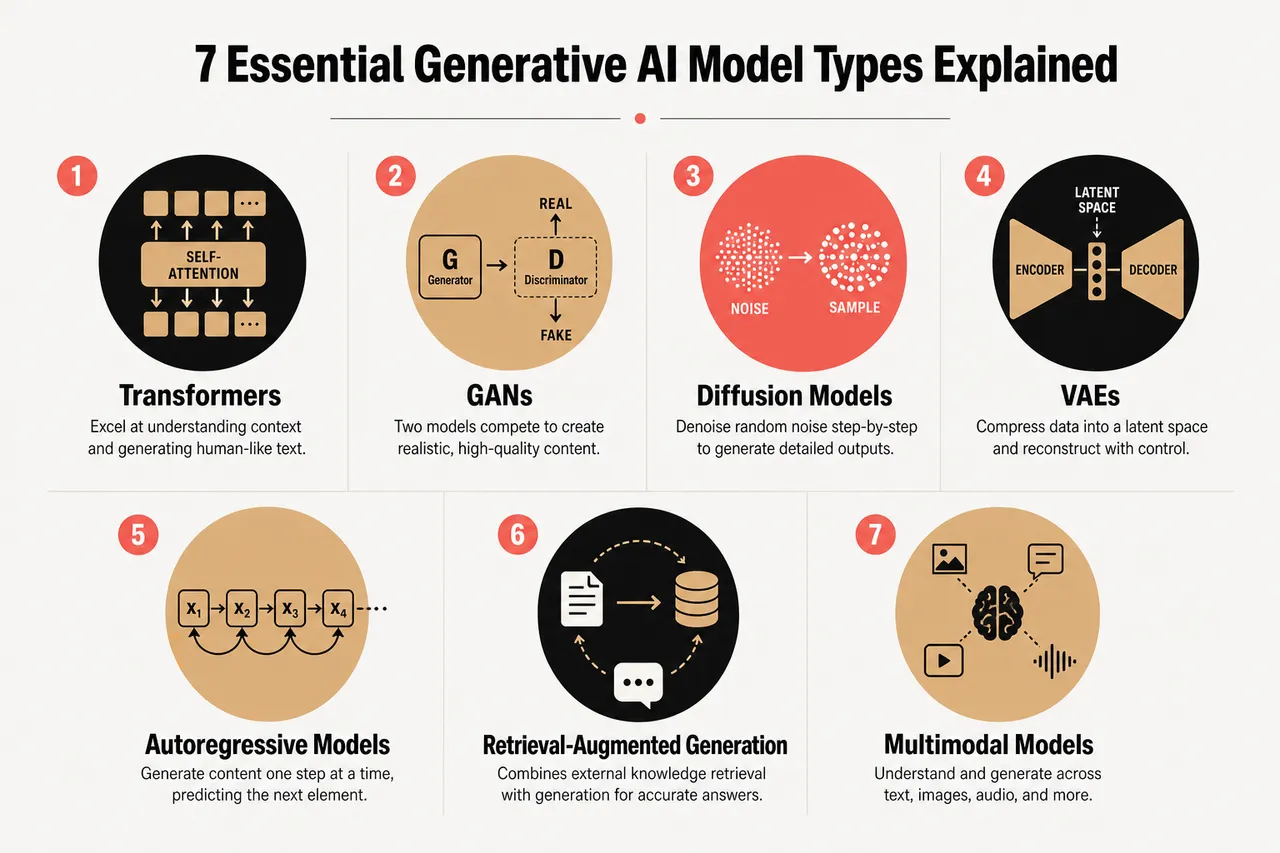
The world of generative AI is built on several key model architectures, each with its own strengths and ideal use cases. Understanding these differences will help you pick the right model for your business or project needs and evaluate tools surfaced by platforms like ChatGPT 247 with more confidence.
- Generative Adversarial Networks (GANs): GANs are built around two models: a generator that creates new data and a discriminator that tries to tell real data from fake. The competition between them drives the generator to improve, leading to incredibly realistic results, especially in image and video domains.
Example: Deepfake tools use GANs to create ultra-realistic synthetic videos, transforming how brands approach digital marketing, social media campaigns, and entertainment content. GAN-based upscaling is also used in e-commerce to sharpen low-resolution product photos and in media restoration to revive old footage. - Variational Autoencoders (VAEs): VAEs compress data into a simplified latent representation and then reconstruct it, allowing for controlled and consistent content generation. Because the latent space is smooth and continuous, users can interpolate between points to blend styles or morph between concepts.
Example: Photographers and designers use VAEs in image restoration tools to clean up grainy photos or repair damaged images with minimal effort. In industrial settings, VAEs support anomaly detection by learning what “normal” sensor readings look like and flagging unusual patterns. - Transformers: Transformers use a self-attention mechanism to process sequences of data, making them ideal for understanding and generating language and for handling multi-modal tasks that blend text and images. Many of the largest models deployed in production today, including leading large language models, are transformer-based.
Example: ChatGPT and other conversational AI platforms use transformers for fast, engaging, and context-aware responses. Integrating an AI chatbot powered by transformers through ChatGPT 247 can boost customer engagement, assist internal teams with knowledge retrieval, and automate routine conversations on your website or app. - Flow-based Models: Flow-based models, like RealNVP and Glow, learn reversible transformations between data and a simpler representation. Because they are invertible and allow exact likelihood computation, they offer precise control over generated outputs and robust uncertainty estimation.
Example: Advanced photo editing software leverages RealNVP-like architectures to create seamless, lifelike image transformations for creative professionals, such as smooth color grading or style adjustments that preserve fine details. - Diffusion Models: Diffusion models start with random noise and gradually shape it into structured content, enabling them to produce stunning, high-resolution images and increasingly realistic video and 3D assets. Their iterative denoising process often yields more diverse and faithful outputs than earlier approaches.
Example: Tools like DALL-E 3 and Stable Diffusion use diffusion models to turn simple text prompts into unique, imaginative images, making them a favorite among marketers and artists looking to enhance visual content quickly with image generation tools. In product design, teams use diffusion models to explore dozens of visual concepts before committing to a single direction. - Autoregressive Models: These models generate content step by step, using each previous step to inform the next, which makes them especially strong for tasks where sequence and context matter. They are widely used in language modeling, code generation, and some forms of audio synthesis.
Example: GPT-4-class models power content automation, long-form writing, software code suggestions, and personalized email campaigns, freeing up time for marketers and developers. Integrated into platforms like ChatGPT 247, these models help non-technical users build workflows and prompt strategies that fit their day-to-day tasks. - Energy-based Models: Energy-based models evaluate how likely different data configurations are, assigning lower energy to more probable examples. They shine in detecting unusual patterns, learning from unstructured data, and serving as components in larger hybrid systems that combine generative and discriminative capabilities.
Example: Financial institutions use deep energy-based models to spot fraudulent transactions by learning what normal patterns look like and flagging anything that stands out. In cybersecurity, similar techniques help identify anomalous network behavior that could indicate an attack.
- Model-use case fit: Each model type has its own unique benefits and trade-offs, so matching the model to your use case is really important. For example, diffusion models excel at creative exploration but may be slower to sample, while autoregressive text models can be steered in real time through prompts.
- Quality, speed, and control: Real-world examples make it easier to see how these models can deliver value in practical scenarios, but you also need to weigh factors like latency, controllability, and cost. Many organizations use a combination of model types, orchestrated through APIs and platforms like ChatGPT 247, to balance these trade-offs.
- Foundation vs specialized models: Foundation models offer broad capabilities out of the box, whereas fine-tuned or domain-specific models can outperform them on narrow tasks. A common strategy is to start with a general foundation model and then refine or constrain it with your own data and policies.
Not all generative AI models are created equal. The best fit depends on what you want to achieve, the type and volume of data you are working with, your latency and cost constraints, and the level of quality or control you need in the output. This is why platforms such as ChatGPT 247 increasingly emphasize model selection guidance alongside tool discovery.
How These Models Compare in Practice
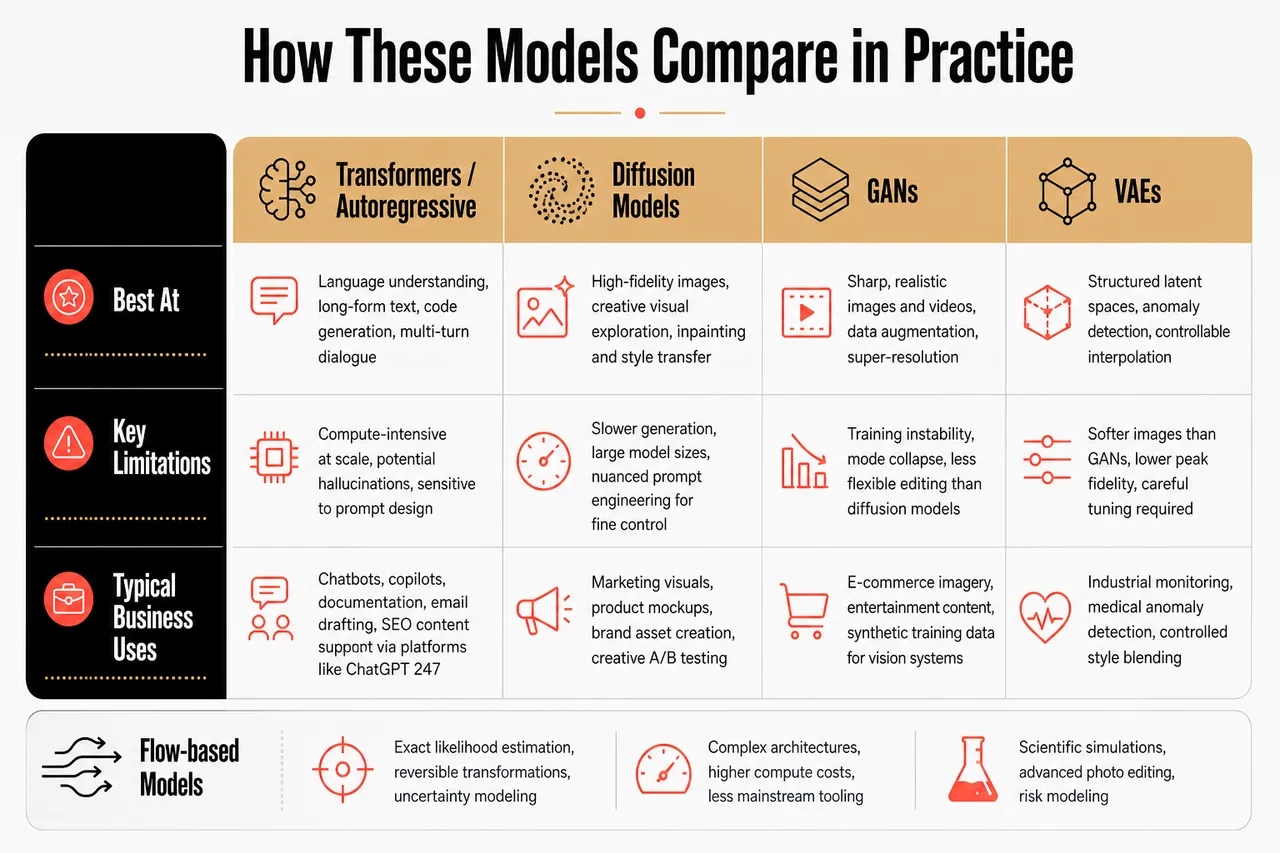
When you move from theoretical understanding to practical deployment, it helps to compare the main model families side by side in terms of strengths, limitations, and typical business use cases.
| Model Type | Best At | Key Limitations | Typical Business Uses |
|---|---|---|---|
| Transformers / Autoregressive | Language understanding, long-form text, code generation, multi-turn dialogue | Compute-intensive at scale, potential hallucinations, sensitive to prompt design | Chatbots, copilots, documentation, email drafting, SEO content support via platforms like ChatGPT 247 |
| Diffusion Models | High-fidelity images, creative visual exploration, inpainting and style transfer | Slower generation, large model sizes, nuanced prompt engineering for fine control | Marketing visuals, product mockups, brand asset creation, creative A/B testing |
| GANs | Sharp, realistic images and videos, data augmentation, super-resolution | Training instability, mode collapse, less flexible editing than diffusion models | E-commerce imagery, entertainment content, synthetic training data for vision systems |
| VAEs | Structured latent spaces, anomaly detection, controllable interpolation | Softer images than GANs, lower peak fidelity, careful tuning required | Industrial monitoring, medical anomaly detection, controlled style blending |
| Flow-based Models | Exact likelihood estimation, reversible transformations, uncertainty modeling | Complex architectures, higher compute costs, less mainstream tooling | Scientific simulations, advanced photo editing, risk modeling |
| Energy-based Models | Anomaly detection, pattern scoring, hybrid generative-discriminative setups | Training complexity, harder interpretability for non-experts | Fraud detection, cybersecurity, quality control in manufacturing |
Real-World Applications and Industry Examples
Generative AI models are changing the game across industries by automating complex content creation and opening doors to new efficiencies and creative possibilities. Recent industry reports indicate that well over half of large enterprises have piloted or deployed at least one generative AI use case, and adoption continues to grow as tools become easier to integrate through platforms like ChatGPT 247.
- Text Generation and Conversational AI: Transformers are the backbone of advanced chatbots and virtual assistants. Companies use these models to automate customer support, generate product descriptions, draft meeting summaries, and localize content for global audiences. With AI chatbot integration, businesses can engage customers around the clock, reduce response times from hours to seconds, and automate answers to common queries while routing complex issues to human agents.
- Image and Video Synthesis: GANs and diffusion models are behind many of the hyper-realistic product images you see in online catalogs, as well as tailored marketing visuals for individual customers. Image generation tools let brands create eye-catching images without the need for a full design team, saving time and resources. Video generation models are beginning to power rapid storyboard creation and short promotional clips, shrinking production cycles from weeks to days.
- Synthetic Data for Training and Privacy: VAEs and GANs help organizations create synthetic datasets that look real but protect sensitive information. This is especially valuable in sectors like healthcare and finance, where privacy is paramount but data is needed for AI training. Synthetic data also enables stress-testing of systems against rare scenarios, such as extreme market conditions or unusual device failure patterns, that are underrepresented in historical logs.
- Code and Content Automation: Autoregressive models streamline everything from generating technical documentation to writing email campaigns, reducing manual workload for engineering, sales, and marketing teams. FAQ automation is another practical use, instantly handling routine questions and freeing up human agents for more complex issues. Integrated into CI/CD pipelines, code models can also propose fixes, suggest refactors, and generate tests, accelerating development cycles.
- Search, Knowledge, and SEO Optimization: Generative models increasingly augment search and discovery systems by summarizing documents, generating answers grounded in internal knowledge bases, and helping teams draft SEO-optimized content. SEO optimization assistance powered by generative models can recommend keyword variations, rewrite meta descriptions, and produce structured FAQ sections that align with how users actually search, all orchestrated from central hubs like ChatGPT 247.
- Faster experimentation and prototyping: Generative models support rapid prototyping and help speed up AI development with diverse synthetic data and auto-generated artifacts like UI mockups, legal text drafts, or data schemas. This accelerates innovation cycles and allows teams to test more ideas with fewer resources.
- Accelerating industry-wide adoption: As these models prove their reliability and flexibility, adoption across industries is accelerating. Organizations are increasingly moving from single-use pilots to portfolio-wide deployments, with generative AI baked into customer journeys, internal tools, and analytics platforms.
- Blending human expertise with AI output: Many of the most successful deployments use a human-in-the-loop approach, where subject-matter experts review, refine, and approve AI-generated outputs. This hybrid setup allows companies to benefit from AI speed and scale while maintaining quality and accountability.
Generative AI is not just for creatives. It is making waves in highly technical areas like real-time translation, fraud detection, supply chain optimization, and medical research. In healthcare, for example, generative models help design new drug candidates and summarize complex clinical trial reports. For businesses looking to boost online visibility, SEO optimization assistance powered by generative models can help improve rankings and attract more visitors, especially when combined with ongoing experimentation supported by platforms like ChatGPT 247.
Adoption Metrics, Market Growth, and Business Impact
Beyond technical capabilities, organizations increasingly want to understand how generative AI affects real business outcomes and how widely it has been adopted across industries. Recent studies and market analyses provide a clearer picture of the current landscape and trajectory.
Market Size and Growth Momentum
Industry research over the last 12 to 18 months shows that the global generative AI market has rapidly grown into a multi‑billion‑dollar segment, with annual growth rates often estimated well above traditional enterprise software categories. For many CIOs, generative AI has moved from a speculative investment to a top‑three strategic priority, especially in sectors with heavy knowledge work like professional services, media, and financial services.
Enterprise Adoption and Use Case Spread
Surveys of large enterprises indicate that a strong majority have already launched generative AI pilots, and a significant share report deploying these systems into production for at least one function such as customer support, marketing, or software development. Interestingly, many organizations report that once the first use case proves successful, additional departments quickly follow, leading to organization‑wide adoption that platforms like ChatGPT 247 are designed to support and orchestrate.
Productivity Gains and Cost Savings
Reports from consulting firms and early adopters frequently highlight measurable productivity gains from generative AI, such as reducing time spent on drafting emails, documentation, or code by substantial margins. While exact numbers vary by task and organization, it is common to see teams reclaim many hours per week per employee, which can be reinvested into higher‑value strategic work like customer research or product innovation.
User Demographics and Skill Profiles
Usage data from public generative AI tools and enterprise rollouts suggests that both technical and non‑technical users are embracing these systems, though their needs differ. Developers often focus on code generation, debugging, and documentation, while business users rely on generative AI for writing, analysis, and ideation. Platforms like ChatGPT 247 cater to this diversity by offering curated toolsets and learning resources tailored to different user roles and skill levels.
Risk Awareness and Governance Investment
Alongside enthusiasm, there is growing awareness of risks related to data privacy, intellectual property, and model bias. Many enterprises are now investing in AI governance frameworks, model monitoring, and privacy‑preserving techniques such as synthetic data generation. A notable trend is the emergence of cross‑functional AI steering committees that work with platforms like ChatGPT 247 to standardize tool selection, policy enforcement, and measurement of business impact.
Challenges, Misconceptions, and Ethical Considerations
Even with all the progress, generative AI models introduce technical and ethical challenges that require thoughtful management. These concerns span data quality, fairness, transparency, regulatory compliance, and long‑term societal impact.
- Addressing Data Bias and Fairness: Because generative models learn from existing data, they can pick up and amplify hidden biases related to gender, race, geography, or socioeconomic status. In 2026, researchers are focused on building fairer datasets, developing transparent evaluation methods, and finding ways to reduce bias in outputs through techniques such as debiasing, reinforcement learning from human feedback, and careful prompt design.
- Preventing Misuse and Ensuring Transparency: Powerful generative AI can be misused, for example to create misleading media, impersonate individuals, or generate convincing misinformation. Clear internal review processes, explainable AI techniques, content watermarking, and strong monitoring are essential for building trust and accountability. Many organizations now require disclosure when content has been AI‑generated, particularly in customer‑facing communications.
- Data Privacy, Security, and IP: Training and using generative models raises questions about how data is collected, stored, and reused. Enterprises need to ensure that sensitive data, trade secrets, and copyrighted materials are handled responsibly, with mechanisms like data anonymization, access control, and synthetic data generation. Platforms like ChatGPT 247 increasingly highlight tools that support stronger data governance features as a decision criterion.
- Ethical deployment and trust: Ethical deployment is essential to build long-term trust with users and society. This includes clear user communication, opt-out mechanisms where appropriate, and meaningful human oversight. Transparent policies on data usage and model behavior help customers understand where AI fits into your service.
- Technical and operational hurdles: Technical hurdles include ensuring your data is high-quality, your models are explainable, and your systems can scale in real-world production. Operationally, organizations need to address skills gaps, update processes, and adapt performance metrics to account for AI-augmented workflows.
- Regulatory alignment and emerging standards: As regulators around the world release guidance and regulations related to AI, organizations must ensure their generative AI deployments comply with evolving legal requirements. This often involves collaboration between legal, compliance, IT, and business teams, supported by centralized platforms like ChatGPT 247 that provide visibility into tools, models, and usage.
It is a mistake to assume that generative AI is automatically unbiased or safe. Regular oversight, strong governance, and ongoing user education are really important to get the most benefit from these tools while minimizing risks. Ethical considerations are no longer just the domain of researchers; they are now a core part of enterprise AI strategy.
Operationalizing Generative AI: From Experiment to Production
Deploying generative models in production environments requires more than choosing an architecture. Organizations must also think about infrastructure, monitoring, governance, and change management to ensure sustained value.
Model Lifecycle and MLOps for Generative AI
Modern teams treat generative models as living systems that need to be monitored, evaluated, and periodically updated. This includes tracking performance metrics, monitoring for drift in user behavior or data distributions, and managing versioning as new model checkpoints are released. Many organizations extend their existing MLOps practices to accommodate generative workloads, often incorporating tools surfaced by ChatGPT 247 into their pipelines.
Prompt Engineering and Guardrails
Because many generative systems are controlled through prompts rather than traditional configuration, prompt engineering has become a mainstream skill. Teams design and test prompts, templates, and system messages to steer model behavior, while also implementing guardrails such as content filters and policy-based post-processing. Platforms like ChatGPT 247 increasingly provide prompt libraries and best-practice playbooks to help organizations ramp up faster.
Human-in-the-Loop Review Processes
In high-stakes or regulated contexts, human reviewers remain essential. Organizations often design workflows where AI drafts content, recommendations, or analyses, and humans review, edit, or approve the outputs before they reach end users. This approach leverages AI speed while ensuring that domain experts retain final accountability.
Measuring ROI and Business Outcomes
To move beyond experimentation, teams need clear metrics that tie generative AI to business outcomes such as reduced handling time, increased conversion rates, or improved customer satisfaction. Dashboards that combine usage analytics, quality scores, and financial metrics help leaders decide where to scale or refine deployments. ChatGPT 247 can support this effort by helping teams benchmark tools and architectures against industry norms.
Future Trends and Resources for Continued Learning
The pace of innovation in generative AI is only accelerating. Foundation models and multi-modal architectures are now enabling machines to generate content that combines text, images, audio, and video, creating seamless cross-domain applications and highly personalized user experiences. As these capabilities mature, they are likely to reshape not just individual tasks, but entire workflows and customer journeys.
- Continuous evolution of model families: New model variants and hybrid architectures are emerging that combine strengths of transformers, diffusion models, and retrieval systems. These hybrids aim to reduce hallucinations, improve grounding in verified data, and make models more efficient to run at scale.
- Domain-specialized foundation models: While general-purpose models remain important, many organizations are investing in domain-specific models tailored to sectors like healthcare, law, or financial services. These models can provide higher accuracy and better alignment with industry regulations and terminology.
- Ecosystem growth and tool standardization: The surrounding ecosystem of orchestration tools, evaluation frameworks, and safety layers is maturing rapidly. Platforms like ChatGPT 247 help make sense of this ecosystem by curating tools, surfacing emerging best practices, and providing educational content.
Foundation Models and Multi-modal AI
Foundation models, trained on massive and diverse datasets, are raising the bar in everything from healthcare diagnostics to creative design and robotics. In 2026, businesses are increasingly leveraging these models to create integrated solutions such as visual reports that include interactive summaries, conversational analytics dashboards, or personalized product recommendations paired with dynamic images and chat-based explanations. Multi-modal models also make it easier to build assistants that understand screenshots, documents, and voice instructions in a single interface.
Recommended Resources and Tools
- ChatGPT 247: Access curated tool recommendations, in-depth guides, and practical tips to help you navigate the generative AI landscape for your business. The platform highlights key details like model type, typical use cases, and governance features so you can make informed choices.
- OpenAI and similar research hubs: Explore the latest research papers, model announcements, and safety frameworks from leading AI labs. These resources help technical teams understand new capabilities, limitations, and evaluation techniques as they emerge.
- Image and media generation tools: Platforms like DALL-E 3, Stable Diffusion interfaces, and emerging video generators offer a hands-on way to experiment with creative AI for marketing, design, or prototyping. Many integrate directly with productivity suites, design tools, or content management systems.
- Evaluation and governance toolkits: A growing set of open-source and commercial tools help teams evaluate bias, toxicity, and factuality, as well as manage access control and audit trails. Integrating these into your workflows from day one makes scaling safer and more predictable.
With generative AI advancing so quickly, keeping your knowledge current is more important than ever. Staying informed helps you make smarter decisions, avoid common pitfalls, and ensure your AI projects are responsible and effective. Treat learning as an ongoing process rather than a one-time effort.
Frequently Asked Questions About Generative AI Models
How do generative AI models differ from traditional machine learning models?
Traditional machine learning models are often discriminative: they classify, rank, or predict outcomes based on input data, such as detecting spam or forecasting demand. Generative models, by contrast, learn the underlying distribution of the data so they can create new examples that resemble the training set, such as writing an email draft or generating a product image. Many modern systems combine both approaches, using discriminative components for retrieval or filtering and generative models for creation.
Do I need a lot of proprietary data to benefit from generative AI?
You can gain value from generative AI even without large proprietary datasets by using pre-trained foundation models accessible through APIs or platforms like ChatGPT 247. These models already encode broad knowledge and can perform many tasks with simple prompts. Over time, you can layer in your own data for fine-tuning, retrieval-augmented generation, or custom guardrails to make the system more tailored to your organization.
How can small and medium businesses adopt generative AI without large teams?
Small and medium businesses can start with ready-made tools and integrations that focus on specific outcomes such as customer support automation, content creation, or SEO optimization. Platforms like ChatGPT 247 lower the barrier to entry by curating tools, providing best-practice templates, and offering guidance on implementation without requiring in-house AI experts. Starting with a contained, high-impact use case and expanding gradually is often the most effective path.
What skills are most important for working effectively with generative AI?
Beyond technical roles like machine learning engineering, skills such as prompt design, data literacy, domain expertise, and critical thinking are increasingly important. Team members need to understand how to formulate effective prompts, interpret AI outputs, check for errors or bias, and integrate AI-generated content into existing workflows. Many organizations are investing in internal training programs and external resources surfaced by ChatGPT 247 to build these capabilities.
How do I choose between different tools built on similar model types?
When multiple tools rely on comparable underlying model types, factors such as data governance, integration options, pricing, latency, domain specialization, and vendor support become key differentiators. Evaluating tools side by side, ideally using trial periods and proof-of-concept projects, helps you understand which solution aligns best with your needs. ChatGPT 247 can streamline this process by aggregating information and highlighting trade-offs in a consistent format.
- Generative AI as a new capability layer: Generative AI models are the engine behind modern AI innovation across every industry, enabling systems to create content, not just analyze it. This shifts how teams think about automation, creativity, and collaboration between humans and machines.
- Importance of model understanding and selection: Choosing the right model or tool for your needs makes all the difference in project success, influencing quality, speed, cost, and risk profile. A basic understanding of model types and architectures helps you ask better questions and push vendors for clarity.
- Responsible deployment as a strategic advantage: Responsible, ethical deployment is essential for building trust and achieving sustainable results. Organizations that invest early in governance, transparency, and user education often find it easier to scale generative AI across the business and to maintain stakeholder confidence over time.
Generative AI models have taken artificial intelligence from something theoretical to a practical force for creativity, automation, and problem-solving. By understanding the main types of generative AI models and how they are being used in the real world, you can unlock powerful new opportunities, whether you are building smarter chatbots, automating design, or scaling your business globally. As generative AI continues to grow in 2026, staying curious, learning from reputable sources, and keeping ethics at the forefront will help you make the most of this transformative technology. This is an ideal moment to explore, experiment, and bring your next big idea to life using the latest generative AI tools, guided by platforms like ChatGPT 247 that help you navigate the expanding ecosystem.