
Grok AI is shaking up how people interact with artificial intelligence, bringing a fresh blend of real-time data access and conversational wit that sets it apart from the crowd. If you’ve been exploring AI tools like ChatGPT through platforms such as ChatGPT 247, you already know how transformative these technologies can be for everyday tasks and business workflows.
But Grok takes a different approach, one that’s worth understanding if you’re serious about choosing the right AI solution for your needs. This guide breaks down exactly what Grok is, how its underlying technology works, and who will benefit most from using it, so you can make an informed decision without the marketing fluff.
Introduction to Grok AI
Grok AI, developed by xAI, Elon Musk’s AI company founded in 2023, is positioned as a frontier-class conversational system built to answer questions using both pre-trained knowledge and what the world is saying right now. First unveiled in late 2023 and iterated rapidly through Grok 3 and Grok 4.3, it moved from a simple X-integrated chatbot into a broader information assistant with dedicated research modes and multimodal capabilities.
- Origin and philosophy: The name Grok comes from classic science fiction, meaning to understand something completely and intuitively. That concept underpins xAI’s mission statement for Grok: helping people « understand the universe » by combining deep reasoning with live data instead of serving static, risk-averse responses.
- Real-time, opinionated assistance: Unlike heavily filtered systems, Grok is explicitly designed to be more direct, occasionally irreverent, and willing to commit to a position. Its fun mode and lighter content filtering make it suitable when users want candid competitive analysis, sharp critique, or sentiment reading around sensitive topics rather than generic boilerplate.
- Integration with X and beyond: The first versions of Grok were tightly integrated into X, using the platform both as a data source and as a delivery channel. As the platform matured, Grok became available through grok.com, dedicated mobile apps, and specialized workspaces such as SEO writing environments, while still retaining privileged access to the X firehose.
One misconception is that Grok AI simply replicates the capabilities of other chatbots. In reality, Grok’s design centers on live X data, deeper research modes, and less constrained commentary, giving it a specific niche in trend monitoring, public conversation analysis, and fast-moving topics where yesterday’s summary is already outdated.
The Origins of Grok AI
Grok AI emerged from xAI’s desire to build systems that prioritize truth-seeking and reasoning over cautious, generic output. Early versions were trained with input from researchers who had previously worked at OpenAI and DeepMind, but the distinguishing choice was tight integration with X’s data streams. Rather than waiting for journalists, analysts, or bloggers to interpret events, Grok is designed to tap directly into what millions of users are posting in real time and use that raw conversation as part of its context.
This decision means Grok is not just « another chatbot » sitting on top of a large language model. It is essentially a live lens on public discourse, capable of surfacing sentiment and arguments that have not yet reached traditional news or search results. For users of platforms like ChatGPT 247, this creates an interesting contrast: ChatGPT and similar tools excel at synthesis of established information, while Grok specializes in the unstructured flow of what is happening right now.
Why Grok AI Is Gaining Attention in 2026
By 2026, Grok’s appeal rests on three pillars: speed of iteration, unique data access, and specialized research tooling. Grok 3 introduced Websearch and DeepSearch modes that turned the chatbot into a research companion, and subsequent releases like Grok 4.3 pushed its general capabilities into the same benchmark class as leading models such as GPT-5.5 and Claude while retaining its X-centric strengths.
Businesses have noticed that for questions where the answer evolves hourly, Grok’s feed from X is often ahead of what major search engines can index. Educators and analysts appreciate that it can assemble context around live events, product launches, and policy changes while they are still unfolding. Creators see its personality-driven replies and image tooling as a way to produce content that feels more like a collaborator than a cautious assistant.
How Grok AI Works: Technology and Features
Under the hood, Grok combines a large language model with specialized search and data pipelines. It works not only as a chatbot but as a research router, selecting between fast web lookups and deeper, slower investigations depending on the user’s request. The most visible difference for everyday users is that Grok can respond as a conversational agent, a real-time social sentiment reader, or a structured research assistant, all from the same interface.
- Model and context window: Recent Grok iterations such as Grok 3 ship with a large context window, commonly cited around 128k tokens, which allows the system to keep track of long reports, many sources, or extended chat sessions. In practice, this means you can ask Grok to synthesize long threads from X, multiple articles, and your own notes without constantly losing earlier parts of the discussion.
- Real-time X and web access: Grok maintains ambient access to the live X stream instead of only performing on-demand browsing. This lets it respond to questions like « What are people saying about the latest central bank decision? » by sampling posts as they are written, then augmenting that view with web news and historical data. For markets, politics, entertainment, and brand monitoring, this real-time layer is often several hours ahead of conventional search indexes.
- Voice and image interaction: Grok supports voice input for hands-free queries and includes image generation and, in newer builds, text-based image editing. You can ask it to produce a product mockup, tweak an uploaded graphic with a new headline or color scheme, or generate teaching visuals, all as part of the same conversation that also contains text explanation and references.
Think about a financial analyst using Grok alongside ChatGPT 247. ChatGPT might summarize last week’s earnings coverage across major outlets, while Grok reads what traders, commentators, and retail investors are posting about the stock on X right now. When those two views are combined, the analyst gets both the established narrative and the live market sentiment, which can be critical for short-term decisions.
Instead of recycling old information, Grok incorporates live signals with its pre-trained knowledge. The result feels less like querying a reference library and more like talking with a researcher who is actively monitoring conversations, pulling documents, and sketching diagrams to make the picture clear.
Real-Time Web Search and Data Access
Grok Websearch is the fast lane for information retrieval. When this mode is active, Grok scans the web in real time, indexes relevant pages, and replies with a concise view of the most credible sources it can find at that moment. It is optimized for direct questions, quick fact checks, and simple comparisons, where the priority is speed and up-to-date answers rather than exhaustive analysis.
For more demanding queries, Grok DeepSearch steps in. DeepSearch is engineered to handle complex, multi-step questions: synthesizing conflicting evidence, tracing historical context, and surfacing methodological notes where appropriate. While Websearch might list several articles on a topic, DeepSearch aims to digest them into a coherent narrative with explicit reasoning about why certain sources or interpretations are more trustworthy.
Voice and Image Generation Capabilities
Spoken interaction in Grok makes it easy to capture ideas when you cannot type, such as during meetings or commutes. You can dictate a complex research request, ask Grok to outline key trends, and then have it generate supporting slides and images in the same thread. For teachers and presenters, this increases the likelihood that a fleeting idea turns into a usable artifact rather than being forgotten.
Image generation in Grok has grown beyond simple prompt-to-picture workflows. Newer builds include text-based editing for uploaded graphics, allowing you to swap product colors, alter backgrounds, or overlay new slogans based on plain language instructions. For marketers, this means they can iterate on visual concepts quickly, then pass the best variants into more specialized design tools or collaborate with copy-focused models inside ChatGPT 247.
Integration with the X Platform and Apps
Grok remains closely tied to X, but access in 2026 is broader and more flexible than in its early releases. You can use Grok directly inside X for social listening and reply drafting, open grok.com in a browser for general-purpose research, or work from dedicated apps and workspaces focused on tasks like SEO writing or analytical reporting. Settings such as DeepSearch toggles, research modes, and workspace templates are usually available near the chat input, giving you fine-grained control over how Grok handles each request.
This ubiquity means your research, drafts, and visual assets can move between environments with minimal friction. A brand strategist might start by monitoring campaign reactions in X using Grok, refine messaging in a Grok content workspace, then test alternate copy variants using ChatGPT within ChatGPT 247 before final publication, all while keeping a continuous thread of context.
Grok AI vs. Other AI Chatbots
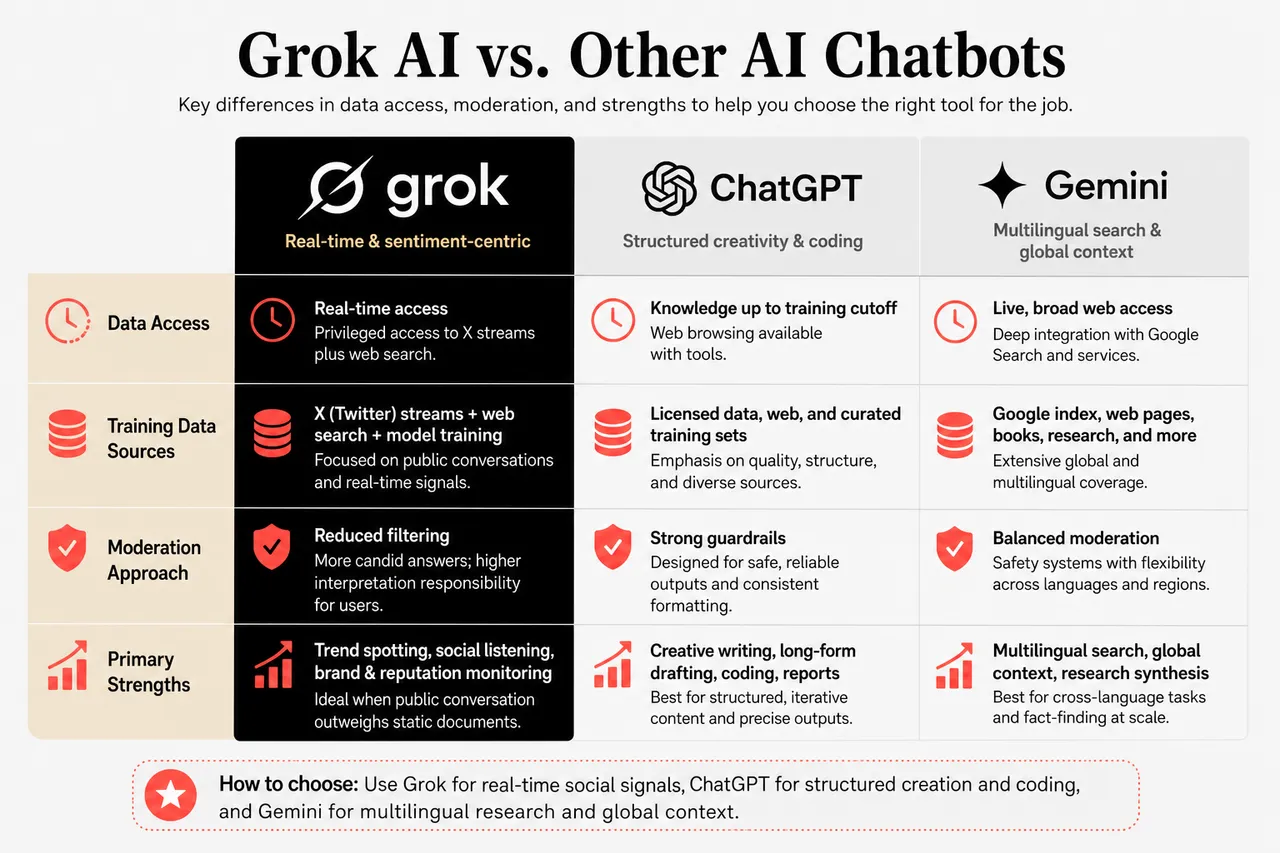
The broader AI landscape in 2026 includes several major consumer-facing models, and Grok, ChatGPT, and Gemini often anchor that comparison. Each has different training data access, moderation standards, and integration choices, which in turn shape their strengths for particular roles. For users of ChatGPT 247, understanding where Grok fits relative to ChatGPT and Gemini helps decide when to route a task to each system.
- Grok: real-time and sentiment-centric: Grok’s standout feature is privileged access to X streams and its ability to blend that data with web search and deep reasoning. It is particularly strong for trend spotting, social listening, brand and reputation monitoring, and any scenario where public conversation is more informative than static documents. Its reduced content filtering also means more candid answers, albeit with a slightly higher burden on the user to interpret and contextualize those views.
- ChatGPT: structured creativity and coding: ChatGPT, as featured on platforms like ChatGPT 247, excels in creative writing, long-form drafting, and structured outputs such as reports, technical documentation, or code. Its guardrails and training focus make it the default choice when you need reliable formats, detailed explanations, or iterative refinement of text artifacts over several editing passes.
- Gemini: multilingual search and global context: Gemini’s close tie-in with broader Google infrastructure gives it strong multilingual capabilities and access to extensive global web indexes. It is particularly useful for cross-border teams, translation-heavy workflows, and scenarios where you need local context around policies, regulations, or news in multiple languages at once.
A digital marketer working on ChatGPT 247 could, for example, ask Grok to analyze real-time reaction to a new ad campaign on X, use ChatGPT to turn those insights into an optimized landing page and email sequence, and tap Gemini to ensure messaging resonates across different language markets. Each model plays to its strengths while the Generally workflow remains coherent.
It is tempting to assume that any large language model can do everything reasonably well, but once you factor in live data access, moderation levels, and ecosystem integrations, the differences become material. Choosing the right model for each step will usually yield better results than trying to push a single chatbot into every role.
Strengths and Weaknesses: Grok AI, ChatGPT, Gemini
Grok’s strength lies in its integration with X, DeepSearch capabilities, and willingness to address controversial and fast-moving topics directly. The trade-off is that it may not always be the best candidate for meticulous long-form composition or highly constrained corporate communication on its own. ChatGPT’s strength is structured reasoning and generation across many domains, but it can lag slightly on the most immediate public conversations. Gemini is a strong fit for multilingual and search-heavy scenarios yet may not have the same tight, conversational integration with any particular social platform.
Users on ChatGPT 247 can mitigate these weaknesses by combining tools. For instance, if Grok gives a blunt assessment of public sentiment that feels too raw for internal stakeholders, you can pass its takeaways into ChatGPT and ask for a diplomatic summary suitable for executive briefings. Similarly, if Gemini surfaces regulations or market data in another language, Grok can be used to check how local commentators on X are reacting to those developments in real time.
Which AI Chatbot Is Right for You?
The « best » chatbot depends on your principal use case. If your daily work involves public-facing campaigns, brand monitoring, or rapid reaction to trending topics, Grok is likely to become a primary tool. If you spend more time writing long reports, engineering solutions, or educational materials, ChatGPT might remain your default. For organizations with multinational teams or regulatory obligations across several jurisdictions, Gemini’s global reach adds important coverage.
ChatGPT 247 is useful here as a hub that exposes multiple models through one interface. You can experiment with the same prompt across Grok, ChatGPT, and other systems, then compare style, depth, and timeliness. Over time, patterns will emerge: Grok for what is happening right now, ChatGPT for how to explain or build around it, and Gemini for how it appears across borders.
| AI Tool | Core Strength | Best Use Cases | Primary Data Focus |
|---|---|---|---|
| Grok AI | Real-time X integration and DeepSearch reasoning | Trend monitoring, social listening, sentiment analysis, fast-moving topics | Live X posts plus up-to-date web data |
| ChatGPT | Structured text generation and coding support | Long-form writing, documentation, code, educational content | Pretrained knowledge with selective browsing |
| Gemini | Multilingual capabilities and global search | Translation, international research, cross-border collaboration | Global web index and language models |
Use Cases and Who Should Use Grok AI
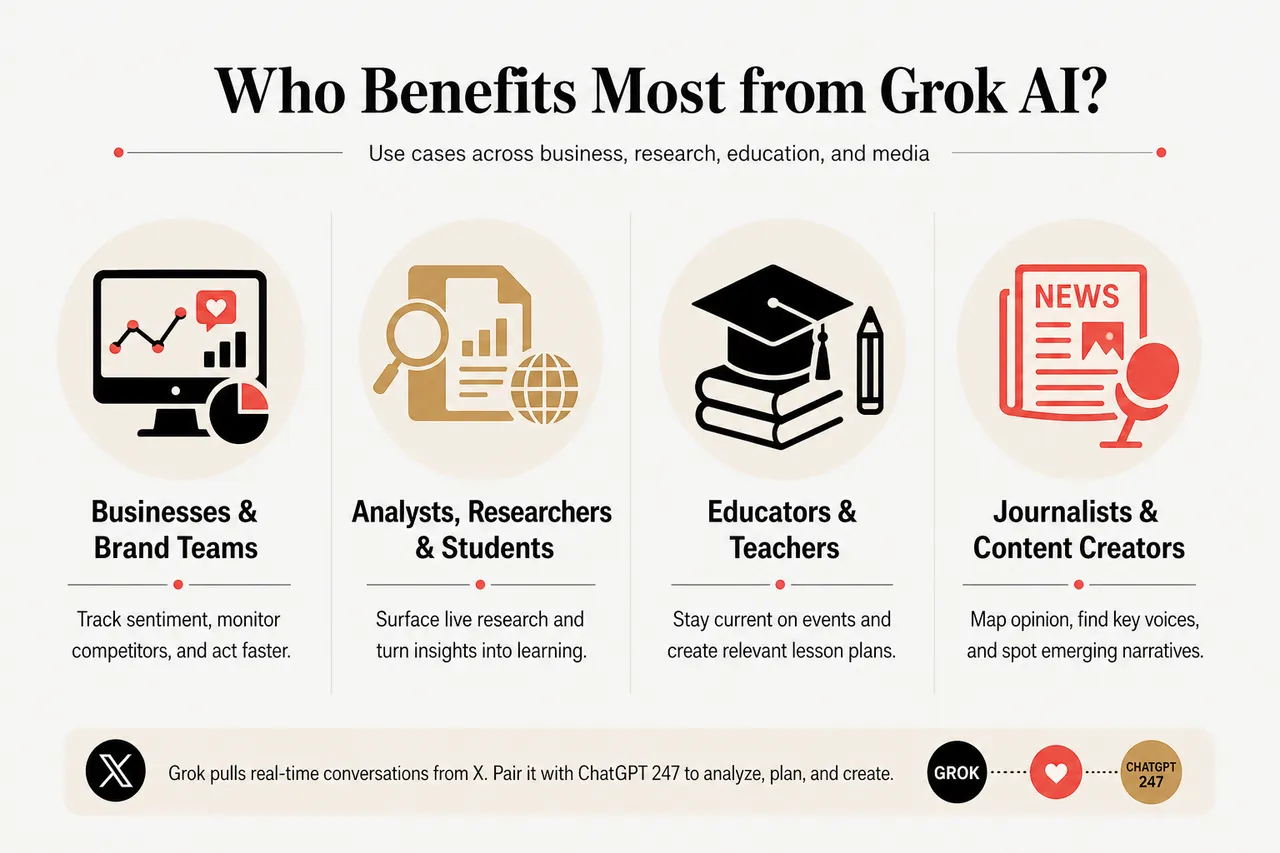
Grok’s ability to combine live data with structured reasoning makes it valuable across many fields, but some roles benefit more directly from its unique strengths. Business leaders, analysts, educators, journalists, and content creators all find different ways to incorporate Grok into their workflows, especially when they already use ChatGPT 247 as a central platform for AI experimentation.
- Businesses and brand teams: Companies can use Grok to track brand sentiment in real time, analyze how customers react to product changes, and monitor competitor moves on X. When paired with ChatGPT inside ChatGPT 247, Grok’s findings can be turned into response plans, updated FAQs, or refined marketing copy quickly. This combination supports continuous improvement loops where public feedback and internal communication evolve together.
- Educators, researchers, and students: Grok can act as a live research assistant, surfacing the latest discussions, preprints, and reactions to new findings. Students might ask Grok for how a recent policy announcement is being debated on X, then use ChatGPT to turn that debate into a structured classroom presentation. Teachers can follow the same pattern, using Grok to stay aware of current events and ChatGPT 247 to craft lesson plans that tie those events back to curriculum objectives.
- Content creators and media professionals: Journalists can use Grok to quickly map out opinion clusters around breaking news, identify key voices, and see which narratives are gaining traction. Creators can transform that map into scripts, newsletters, or visual content with the help of ChatGPT and other tools inside ChatGPT 247. Grok’s personality mode and image capabilities lend themselves well to fast-turnaround content that still reflects genuine audience sentiment.
Picture a customer support team where Grok constantly monitors X for complaints or questions about a new feature. Those insights flow into ChatGPT 247, where ChatGPT drafts refined replies and updates help center documentation. Over time, the team builds a knowledge base that is grounded not only in official specs but in how users actually talk about the product.
Grok’s interface and tooling are designed such that non-experts can start with simple questions and gradually move to more sophisticated research prompts. Features like DeepSearch toggles, guided prompts, and iterative refinement make it easier to scale from everyday curiosity to data-backed decision making.
Business Applications
Retailers, fintech firms, and service providers can apply Grok in several layers of their operations. At the top, it acts as an early warning system for brand issues or emerging trends, scanning X for shifts in sentiment. In the middle, it assists marketing and product teams by clustering feedback and surfacing recurring issues. At the bottom, it feeds into customer support scripts, internal knowledge bases, and training materials once combined with structured drafting tools like ChatGPT on ChatGPT 247.
For example, a marketing agency can ask Grok’s DeepSearch mode to compile a detailed report on how consumers are reacting to a client’s product launch, complete with statistics on positive versus negative posts, emerging memes, and key influencers. That report can then be summarized into an executive briefing or translated into new campaign assets using other models via ChatGPT 247.
Education and Learning
In education, Grok supports both formal and informal learning. Teachers can query it for how different communities are discussing topics like climate policy or technological change, then bring those perspectives into classroom debates. Students can use Grok to gather contemporary viewpoints, while ChatGPT helps them structure essays or presentations that compare those viewpoints to foundational theory. ChatGPT 247 serves as the workspace where both Grok insights and ChatGPT outputs are stored, organized, and reused across courses.
Grok also helps keep study materials fresh. Instead of relying solely on static textbook examples, instructors can inject current events, social media discussions, and live case studies into their curriculum. DeepSearch ensures that extended assignments have a strong underlying evidence base, not just snapshots of opinion.
Content Creation and Productivity
For bloggers, YouTubers, and social media managers, Grok offers two key advantages: awareness and speed. Awareness comes from being able to see what audiences are posting in real time about topics, brands, and formats. Speed comes from generating both text and imagery on demand. Using ChatGPT 247, creators can pipeline these capabilities: Grok discovers which themes and hooks resonate on X, ChatGPT drafts scripts or posts to match those hooks, and Grok’s image tools produce accompanying graphics.
Project managers can also benefit from Grok’s research modes when planning initiatives. By understanding how similar projects have been received publicly or what stakeholders are discussing, they can anticipate friction points earlier. Those insights can then be transformed into risk registers, communication plans, and stakeholder updates with ChatGPT inside ChatGPT 247, keeping both strategic and tactical views aligned.
Getting Started with Grok AI
Accessing Grok in 2026 is straightforward. The main entry point is the grok.com site, where you can open a chat interface after signing in, and mobile apps extend that access to phones and tablets. Within these interfaces, Grok exposes controls for Websearch, DeepSearch, and related tools in the toolbar near the message field so that you can decide how much depth you want for each query.
- Sign up and connect accounts: New users typically create an account on grok.com or through the mobile app, then optionally link their X profile for tighter integration. This connection helps Grok personalize certain experiences, such as tailoring social listening to your brand or interests. For users of ChatGPT 247, keeping credentials organized across platforms ensures data flows smoothly between Grok insights and ChatGPT outputs.
- Security and verification: Account verification and optional multi-factor authentication help protect access, especially given the potential sensitivity of research and social monitoring data. Organizations can enforce stronger policies, including role-based access, for staff who use Grok as part of their daily work. When combined with ChatGPT 247’s own security mechanisms, this creates a layered defense for AI-assisted workflows.
- Dashboard and tooltips: The main Grok dashboard presents chat, search modes, and creative tools in a single view. Tooltips and quick-start guides explain features like turning on DeepSearch, using prompt prefixes such as « Use deep search » for complex research tasks, and interpreting structured output. This onboarding helps new users progress from simple question-and-answer interactions to more sophisticated, repeatable research patterns.
Most users can begin basic conversations with Grok within minutes. As they grow more comfortable, they can explore dedicated workspaces like Grok SEO writing, which focuses on content creation with built-in search support. At that point, integrating Grok into ChatGPT 247 becomes a matter of designing workflows where Grok handles live research and sentiment while ChatGPT focuses on composition and refinement.
DeepSearch can also be activated directly via prompts such as « Use deep search: explain the latest smartphone release with detailed sources. » This pattern is useful when you want to embed research instructions in reusable prompt templates across Grok and ChatGPT 247, ensuring that complex tasks are handled consistently.
Account Setup and Login
To start, open your browser and visit grok.com or the Grok app, then follow the prompts to create an account. If you already have an X profile, single sign-on options can streamline this process, reducing account sprawl. Once logged in, you can immediately access chat, search modes, and workspace templates, and you can later link Grok workflows to processes you manage inside ChatGPT 247.
Organizations deploying Grok at scale often create shared guidelines and prompt libraries so that teams ask questions in consistent ways. Those same libraries can be mirrored in ChatGPT 247 to ensure that ChatGPT and other models receive similar inputs, making cross-model comparisons more meaningful.
Navigating Grok AI’s Main Features
Within the Grok interface, the lower portion of the screen, near the text input, usually houses controls for DeepSearch, attachment handling, and mode selection. By toggling DeepSearch, you can shift from quick answers to slower, more comprehensive reports. Structured outputs such as bullet-point summaries, tables, or source lists can be requested explicitly, which is useful when you plan to pass those results into ChatGPT 247 for further transformation.
Over time, users develop a rhythm: ask Grok for research and sentiment, skim its outputs, request a summary or executive briefing, and then use ChatGPT or other models accessed via ChatGPT 247 to adapt those briefings to different audiences. Understanding where each control lives in Grok makes that rhythm smoother and reduces friction between discovery and delivery.
Frequently Asked Questions about Grok AI
Because Grok deals with both public conversations and potentially sensitive research topics, users often have detailed questions about privacy, data handling, pricing, and support. xAI’s documentation emphasizes encryption, transparent policies, and evolving safety systems, and many organizations layer their own governance frameworks on top of those controls when integrating Grok into broader toolsets such as ChatGPT 247.
- Data protection and visibility: Communications with Grok are encrypted, and users typically have access to controls over what history is stored, for how long, and under which account. For sensitive workflows, organizations can restrict access to certain modes or deploy internal guidelines about what kinds of queries are appropriate. ChatGPT 247 can complement these controls by centralizing audit trails of prompts, responses, and downstream edits across different models.
- Privacy policies and consent: xAI’s privacy policies spell out how user data is used to improve Grok, what is kept, and what is not. While Grok draws heavily on public posts from X, it treats those as external data rather than private user content. Enterprises connecting Grok to their own data repositories generally use additional agreements and tooling, often orchestrated through platforms like ChatGPT 247, to ensure that internal information is governed appropriately.
- Pricing tiers and support channels: Grok offers different tiers, from individual access bundled with X subscriptions to more feature-rich plans that include extended context windows, priority access to DeepSearch, and business-oriented tooling. Support is delivered through documentation, tutorials, and direct assistance, particularly for enterprise clients. When Grok is part of a multi-model environment such as ChatGPT 247, organizations often coordinate support across vendors to maintain a consistent help path for users.
Users concerned about data handling can review Grok’s privacy center and their organization’s internal AI policies side by side. Doing so clarifies which activities are covered by Grok’s default safeguards and which require extra layers of governance, such as anonymization or access controls applied through ChatGPT 247 or other orchestration platforms.
Pricing decisions often hinge on how heavily you plan to use DeepSearch and large context windows. Light users may be adequately served by bundled or entry-level plans, whereas teams building regular research outputs and dashboards will want higher tiers. ChatGPT 247 can centralize access by aligning Grok subscriptions with those of other models, reducing administrative overhead.
Privacy and Data Security
Grok’s reliance on public X data does not mean it disregards user privacy. Encryption, access controls, and ongoing security updates reduce the risk of unauthorized exposure. At the same time, organizations still need to decide what kinds of internal documents, logs, or customer data, if any, should be shared with Grok versus confined to other tools. Platforms like ChatGPT 247 can act as policy enforcement layers, routing prompts based on sensitivity.
In practice, many teams treat Grok primarily as an external intelligence and sentiment tool while reserving internal decision-support queries for models that are configured within their own private environments. This balanced approach preserves Grok’s advantages without overextending its role into domains that require stricter isolation.
Pricing and Support
Grok’s pricing models reflect its dual nature as both a consumer-facing chatbot and a business research assistant. Individual users may access core Grok features via X subscriptions or direct plans, while organizations negotiate enterprise agreements that include priority DeepSearch access, onboarding support, and potentially custom integrations. These agreements often sit alongside contracts for ChatGPT 247, which might cover access to ChatGPT, Gemini, and other tools through a single pane of glass.
Support for Grok includes tutorial videos, documentation explaining features like DeepSearch toggles and prompt patterns, and direct assistance channels. Users who rely on ChatGPT 247 as their main workspace benefit when support coordination covers all connected models, ensuring that troubleshooting for prompt behavior or integration issues does not fall through the cracks between vendors.
Grok AI Adoption Trends and Data-Driven Insights
Beyond features and use cases, Grok’s impact in 2026 can be understood through emerging adoption patterns and comparative performance data. While formal market studies are still catching up to the pace of AI innovation, several trends are evident from industry analyses, platform usage reports, and enterprise pilot feedback, especially when viewed in the context of multi-model environments like ChatGPT 247.
Emerging Adoption Patterns Across Industries
Early adoption of Grok has been strongest in industries that depend heavily on public sentiment and fast-changing information, such as marketing, finance, and media. Agencies and trading desks use Grok to monitor X for signals that may not yet appear in newswires or analyst notes, then complement that view with more traditional research and modeling. Educational institutions and think tanks have begun exploring Grok for teaching media literacy and understanding the dynamics of online discourse.
As organizations mature in their AI usage, they tend to move from experimenting with Grok in isolated pilots to embedding it in repeatable workflows that also include ChatGPT 247. This shift reflects a broader trend: live conversation analysis and static knowledge synthesis are both essential, and neither alone is sufficient for robust decision-making.
Real-Time Sentiment vs. Traditional Research
One of the clearest themes in Grok usage is the growing distinction between sentiment-aware answers and document-centric answers. Grok’s DeepSearch and Websearch modes, when combined with X access, produce responses that reflect what people currently think, not just what has been written in reference materials. Traditional models accessed through ChatGPT 247 maintain strength in careful, citation-backed summaries of established knowledge.
Users who learn to interpret these differences appropriately gain a richer, more nuanced understanding of their topics. For example, a policy analyst may use Grok to see how a regulation is being received by affected communities and ChatGPT to map that reception against formal impact assessments and legal commentary. Neither view is complete without the other.
Practical FAQ Opportunities Around Grok and ChatGPT 247
As Grok and ChatGPT 247 are used together more often, certain practical questions recur. Addressing them upfront helps organizations design smoother workflows and better guardrails.
- How do I decide whether to use Grok or ChatGPT for a given task? A useful rule of thumb is to ask whether your question depends primarily on real-time sentiment or on stable, documented knowledge. If the former, Grok is usually the first stop; if the latter, ChatGPT and other models within ChatGPT 247 are more appropriate. Many tasks benefit from both perspectives, with Grok providing current signals and ChatGPT synthesizing them.
- Can Grok and ChatGPT 247 share context safely? Yes, but context sharing should be guided by data sensitivity. You can pass non-confidential insights from Grok, such as anonymized sentiment summaries or public trend descriptions, into ChatGPT 247 to develop reports or strategies. Avoid sending directly identifiable or highly sensitive internal data into Grok unless your governance framework explicitly allows it.
- What is the best way to build repeatable workflows involving Grok? Start by documenting prompt templates for common Grok tasks such as « Use deep search » analyses, social listening queries, and sentiment breakdowns. Then create corresponding templates in ChatGPT 247 that accept Grok outputs as input and produce standard deliverables like briefings, campaign plans, or FAQs. Over time, refine both sides based on user feedback and outcomes.
| Workflow Step | Preferred Tool | Primary Objective | Output Type |
|---|---|---|---|
| Live trend and sentiment discovery | Grok AI | Capture what audiences are saying now | Sentiment maps, key posts, topic clusters |
| Structured analysis and planning | ChatGPT via ChatGPT 247 | Turn signals into strategies and documents | Reports, scripts, briefs, code |
| Cross-border and multilingual checks | Gemini or other models in ChatGPT 247 | Ensure resonance and compliance across regions | Translations, localized insights |
Grok AI stands out in 2026 for its real-time insights, creative power, and flexible integrations. Whether you’re looking to streamline your business, empower your classroom, or supercharge your creative projects, Grok AI adapts to your needs with an interface that feels natural and intuitive. With so many features designed for real-world productivity, and with platforms like ChatGPT 247 making it easier to combine Grok with other leading models, more people are making Grok a central part of their AI toolkit.
Ready to see how Grok AI can transform your workflow? Explore how it pairs with tools inside ChatGPT 247, and experience firsthand how real-time AI can boost your productivity, spark new ideas, and keep you ahead of the curve in a fast-moving digital world.