
Machine learning sounds intimidating until you realize it’s just teaching computers to recognize patterns, the same way you learned to spot a familiar face in a crowd. The real challenge isn’t the complexity; it’s knowing where to begin when every resource assumes you’re either a complete novice or already fluent in Python. ChatGPT 247 has helped thousands cut through that confusion by offering guided explorations of AI technologies that meet you exactly where you are.
This guide will walk you through the essential first steps, the skills that actually matter, and a realistic learning path that won’t leave you drowning in theory before you’ve written your first line of code.
Introduction to Machine Learning: What It Is and Why It Matters in 2026
Machine learning, a subset of artificial intelligence, has become a foundational technology in 2026. At its core, machine learning enables systems to learn from data and improve their performance over time with minimal human intervention. This ability to recognize patterns and adapt is what powers many of the AI-driven tools and services integrated into daily life and business operations, from recommendation systems to fraud detection and AI assistants like ChatGPT 247.
While artificial intelligence covers a broad range of technologies, machine learning specifically refers to the development of algorithms that can automatically improve through experience. Artificial intelligence includes everything from rule-based systems to robotics, whereas machine learning focuses on teaching computers to identify trends and make predictions or decisions based on data. In practice, many modern AI systems you interact with daily are driven by machine learning models trained on large datasets.
Learning machine learning is more accessible than ever. Many people still assume that only experts with advanced degrees in mathematics or computer science can participate, but beginners can make significant progress by mastering foundational concepts, basic programming, and practical skills. In 2026, demand for machine learning expertise continues to grow as organizations across industries rely on data-driven insights for innovation, operational efficiency, and competitive advantage.
- Machine learning is a core driver of technological and economic innovation in 2026. From language models to computer vision systems, it underpins new products, smarter workflows, and entirely new business models.
- Understanding machine learning opens doors in technology, healthcare, finance, retail, manufacturing, and the public sector. Even a beginner-level grasp helps you collaborate with technical teams, automate small tasks, or prototype AI ideas using tools like ChatGPT 247.
- Beginner-friendly platforms and low-code tools are reducing the barrier to entry. You can now experiment with powerful models through APIs and visual interfaces without building everything from scratch.
Machine Learning vs. Artificial Intelligence
Artificial intelligence is the broad goal of giving machines skills that feel human, such as reasoning, problem-solving, perception, and language understanding. Machine learning is one of the most practical ways to get there, using data and algorithms to help computers learn patterns instead of relying solely on hand-crafted rules. A helpful analogy is to Think about a doctor using a rigid rulebook to diagnose patients, compared with an experienced physician who has seen thousands of cases and can spot rare conditions through pattern recognition. The rulebook resembles classic AI; the seasoned doctor mirrors how machine learning models learn from experience.
In a traditional AI system, engineers specify explicit rules: if symptom A and symptom B occur together, then suggest diagnosis C. A machine learning-based system, in contrast, analyzes thousands or millions of patient records, learns which combinations of features tend to precede specific outcomes, and then uses that knowledge to make predictions about new patients. This same shift from rules to learned patterns shows up in many domains, from email spam filters to recommendation engines and natural language interfaces like ChatGPT 247.
Why Learn Machine Learning Now?
Machine learning is everywhere in 2026. It powers small business chatbots, predicts which products customers will want next, streamlines supply chains, and helps clinicians interpret medical images more accurately and quickly. It is no longer confined to big tech companies; startups, solo developers, and even non-technical teams are leveraging pre-trained models and user-friendly platforms to build smarter solutions with limited resources.
For individuals, learning even the basics of machine learning can be a significant career advantage. Many roles that are not explicitly labeled « data scientist » or « ML engineer » now benefit from literacy in AI concepts. For businesses, understanding how to frame problems for machine learning, evaluate model outputs, and integrate AI responsibly into workflows can unlock new revenue streams and substantial cost savings. Whether your goal is to change careers, automate repetitive tasks, or explore what AI can do for your existing work, this is an ideal time to dive in, and tools like ChatGPT 247 can act as an always-available mentor along the way.
How Machine Learning Works: Key Concepts and Terminology
Before you write code or explore advanced algorithms, it helps to get comfortable with the basic vocabulary. At its heart, machine learning is about feeding data to algorithms so they can spot patterns and make predictions, similar to how you might guess the weather based on a few clues from the sky, such as cloud cover, wind, and humidity.
Core Terminology Explained
These core terms appear across tutorials, documentation, and tools like ChatGPT 247:
- Algorithm: An algorithm is a step-by-step procedure that defines how to learn from data. In machine learning, algorithms such as linear regression, decision trees, or neural networks specify how to adjust internal parameters to reduce errors over time. For beginners, you can think of an algorithm like a recipe: it tells the computer how to mix the ingredients (data) and how to tweak the process to get a better result with each attempt.
- Model: A model is the artifact you get after running an algorithm on data. It captures what the algorithm has learned about the relationship between inputs and outputs. For instance, if you train a model to recognize handwritten digits using thousands of labeled examples, that model can then classify new images it has never seen before. In practice, you save models to disk, deploy them into applications, and update them as new data arrives.
- Training Data: Training data consists of examples you feed to the algorithm so it can learn. These might be customer records, sensor readings, images, or text snippets, often accompanied by labels that indicate the correct answer. The quantity and quality of training data strongly influence how well your model performs, which is why many modern systems rely on large, carefully curated datasets.
- Features: Features are the individual pieces of information in your data that help the algorithm make decisions. In a housing price model, features might include the number of rooms, square footage, and neighborhood. In an image classification model, features could be pixel intensities or high-level patterns extracted by a neural network. Choosing and engineering good features is a key practical skill that beginners can develop quickly by experimenting with real datasets.
- Labels: In supervised learning, labels are the correct answers associated with each input example. They might be categories such as « spam » or « not spam, » a numeric value like a price, or a probability distribution over possible outcomes. Labels provide the feedback the algorithm needs to measure error and improve over time.
An intuitive way to tie these together is to picture an algorithm as a chef following a recipe, training data as the ingredients, features as the chopped and prepared components, labels as taste-test notes, and the model as the final dish you end up serving. Change the ingredients, preparation, or feedback, and you can get a very different result from the same basic cooking process.
Types of Machine Learning: Supervised, Unsupervised, and More
There are several main families of machine learning approaches, each suited to different kinds of problems:
- Supervised Learning: In supervised learning, you provide the model with input-output pairs, such as housing features alongside their sale prices. The algorithm learns a mapping from inputs to outputs by minimizing the difference between its predictions and the true labels. This approach is used for tasks like image classification, spam detection, and price prediction. For beginners, supervised learning is usually the best starting point because it is intuitive and widely supported by tutorials and tools.
- Unsupervised Learning: Unsupervised learning deals with data that has no explicit labels. The goal is to discover structure, such as groups, clusters, or low-dimensional representations. A classic example is segmenting customers into clusters with similar purchasing behavior to tailor marketing strategies. Because there is no single « correct » answer, interpreting the results often requires domain knowledge, but unsupervised methods are powerful for exploratory analysis and pattern discovery.
- Reinforcement Learning: Reinforcement learning involves an agent that learns by interacting with an environment, receiving rewards for good actions and penalties for poor ones. Over time, the agent learns a policy that maximizes cumulative reward. This paradigm underlies systems that play games at superhuman levels, control robotic arms, or optimize dynamic decision-making problems. While highly influential, reinforcement learning is more advanced than most beginner topics and is best approached after gaining experience with supervised and unsupervised learning.
- Semi-supervised and Self-supervised Learning: Many real-world datasets contain a mix of labeled and unlabeled data. Semi-supervised and self-supervised methods exploit large amounts of unlabeled data to improve performance when labeled examples are scarce or costly. Modern language models, including those used by ChatGPT 247, rely heavily on self-supervised learning, where the model learns to predict missing parts of the data using only the raw text itself.
Step-by-Step Guide: How to Start Learning Machine Learning
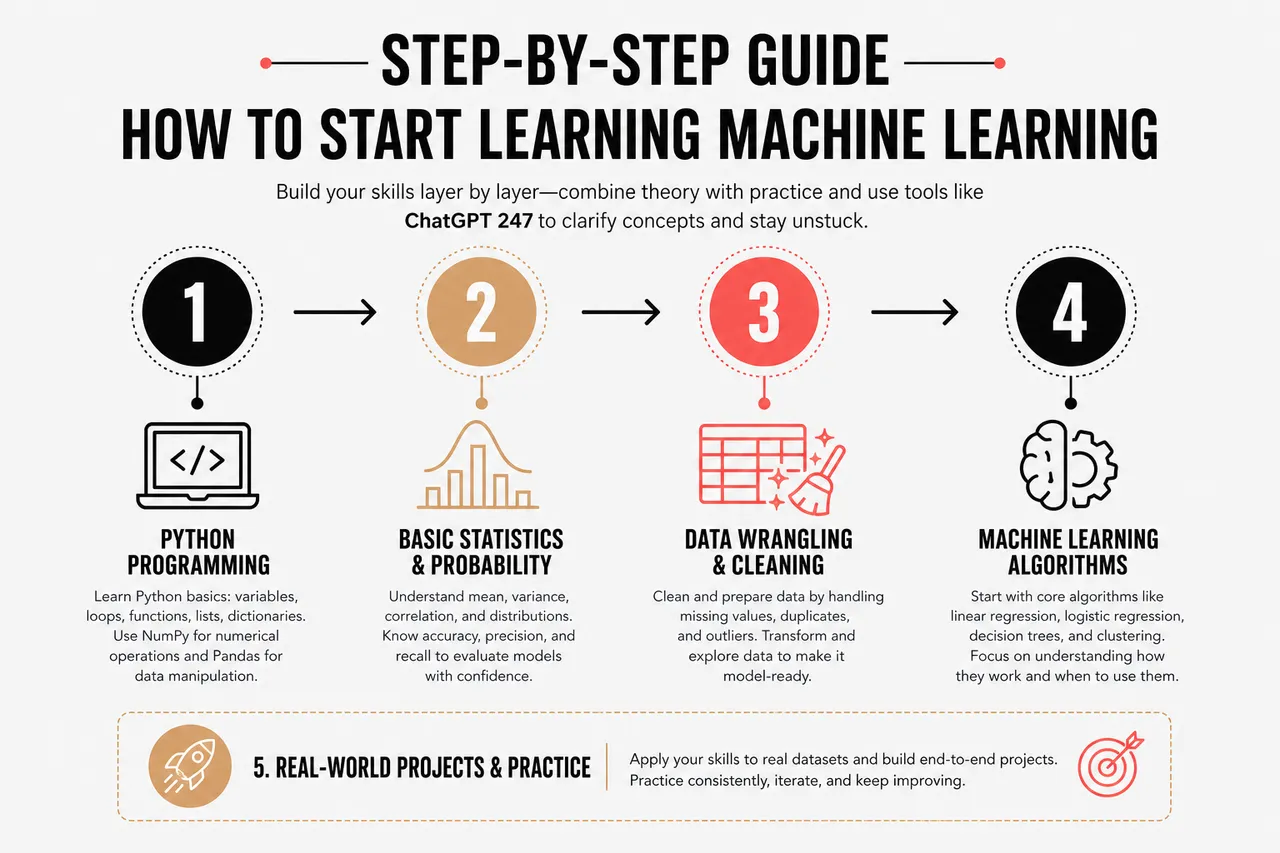
If you are starting from scratch in 2026, a clear roadmap will keep you focused and motivated. Instead of trying to learn everything at once, you can build skills layer by layer, combining theory with practice and leaning on tools like ChatGPT 247 to clarify concepts whenever you feel stuck.
Essential Skills for Beginners
- Python Programming: Python is the dominant language in machine learning thanks to its readable syntax and rich ecosystem of libraries. For beginners, the key is to become comfortable with basic concepts such as variables, loops, functions, and data structures like lists and dictionaries. Once you have that foundation, you can start working with libraries like NumPy for numerical operations and Pandas for data manipulation. ChatGPT 247 can generate code snippets, explain error messages, and suggest improvements, making the learning curve less intimidating.
- Basic Statistics and Probability: Even simple machine learning workflows rely on statistical ideas like mean, variance, correlation, and probability distributions. Understanding these concepts helps you interpret model outputs, detect data issues, and make informed decisions about model performance. For example, knowing the difference between accuracy, precision, and recall is really important when evaluating a classifier. Rather than memorizing formulas, focus on intuition and use tools and visualizations to see how changes in data affect these metrics.
- Data Wrangling and Cleaning: Much of practical machine learning involves organizing, cleaning, and transforming data. This might include handling missing values, removing duplicates, converting text into numeric form, or normalizing numerical features. Developing data hygiene habits early on will save you time and frustration later. Tools like Pandas in Python, spreadsheet software, and even low-code platforms can help you experiment quickly, and ChatGPT 247 can suggest step-by-step cleaning strategies based on a description of your dataset.
- Data Visualization: Visualization tools such as Matplotlib, Seaborn, and Plotly allow you to turn raw numbers into intuitive charts and plots. Visualizing distributions, relationships, and trends helps you understand your data before modeling and communicate your findings to others. As a beginner, practice creating a few core plot types, such as histograms, scatter plots, and line charts, and use them in every project to check your assumptions and validate model behavior.
By prioritizing these essentials, you build a toolkit you can reuse across many projects, regardless of the specific algorithm or domain. ChatGPT 247 can act as an on-demand tutor, explaining concepts at different levels of detail depending on your familiarity.
Recommended Learning Resources (2026 Edition)
- Interactive Online Courses: Platforms like Coursera, edX, and Udacity offer structured beginner-friendly courses that combine short videos, quizzes, and programming assignments. These courses often use real datasets and guide you through building simple models step by step. For many learners, following a curated curriculum reduces the overwhelm of choosing from thousands of scattered tutorials.
- Free Crash Courses and Documentation: Initiatives like Google’s Machine Learning Crash Course provide free lessons, coding exercises, and visual explanations that introduce core ideas without assuming prior expertise. Official library documentation, such as for scikit-learn or TensorFlow, has also become more beginner-friendly, with walkthroughs, examples, and notebooks you can run in the browser.
- Beginner-Friendly Books: Books such as « Hands-On Machine Learning with Scikit-Learn, Keras, and TensorFlow » take a project-based approach, starting with intuitive explanations before diving into code. Working through a book at your own pace, especially when paired with interactive notebooks, helps reinforce concepts and gives you a reference you can return to as you tackle new projects.
- AI-Powered Learning Companions: Conversational AI platforms like ChatGPT 247 can clarify definitions, propose practice problems, review your code, and explain unfamiliar error messages. Instead of getting stuck on a small detail for days, you can ask targeted questions and receive context-aware explanations, allowing you to keep moving forward with your learning.
Combining structured courses, self-paced reading, and interactive Q&A with ChatGPT 247 often yields the best results. You get the depth and rigor from curated content and the flexibility to ask questions that match your exact confusion.
Building Your First Simple Machine Learning Project
- Choose a Small, Meaningful Problem: Start with a project that feels relevant to you, such as predicting house prices, classifying handwritten digits, or analyzing a simple customer dataset from Kaggle. The goal is not to solve a world-changing problem but to experience the full lifecycle from raw data to a deployed model or at least a clear visualization. ChatGPT 247 can help you scope the project, identify suitable datasets, and break the work into manageable steps.
- Work Through an End-to-End Pipeline: Document every stage of your workflow, including loading the data, exploring its structure, cleaning and transforming features, splitting into training and test sets, training a model, and evaluating its performance. Even if your first model is a simple linear regression, going through this complete loop gives you a mental template you can reuse on more advanced projects. Annotated notebooks and comments in your code help you and others understand your reasoning later.
- Share, Reflect, and Iterate: Once your project runs from start to finish, share it on GitHub, a portfolio site, or community forums. Asking for feedback from peers can highlight blind spots, suggest enhancements, or reveal better ways to See your results. Use ChatGPT 247 to refine your project write-up, generate README files, and prepare short summaries that you can reuse in resumes or professional profiles.
Completing even one small project builds confidence and turns abstract ideas into concrete skills. Over time, you can gradually tackle more complex datasets, more sophisticated models, and eventually applications that tie into APIs and products.
Real-World Applications of Machine Learning in 2026
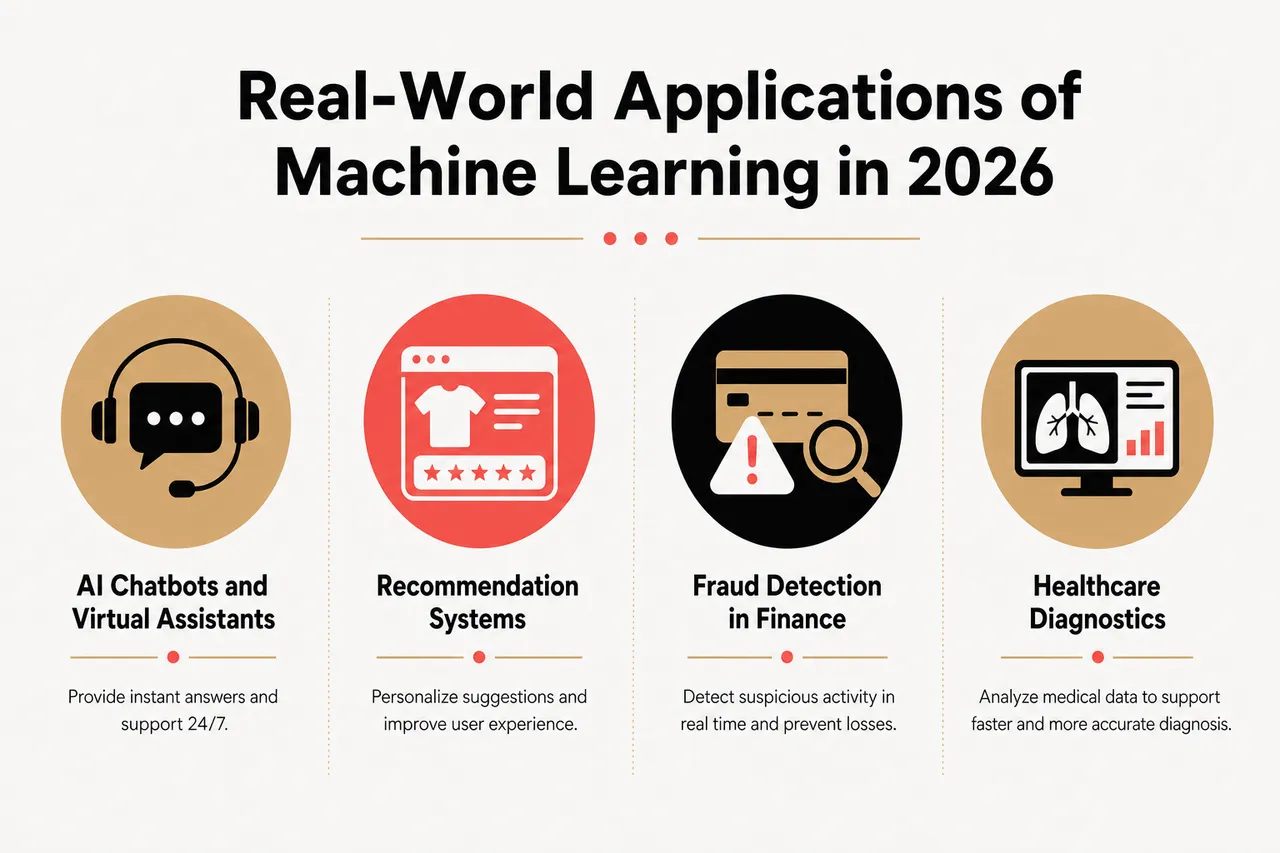
Machine learning is not just a buzzword in 2026; it is embedded in the tools you use every day, often in ways that are invisible to end users. For beginners, seeing concrete examples of machine learning at work can make abstract concepts feel far more tangible and can also spark ideas for your own projects or business use cases.
AI Chatbots and Virtual Assistants
AI chatbots, such as those powered by ChatGPT-style language models, rely heavily on machine learning to interpret user questions, maintain context across turns, and produce helpful, human-like responses. Businesses deploy these chatbots on websites, messaging platforms, and internal help desks to handle routine inquiries, freeing human staff to focus on more complex or sensitive tasks. In many support centers, integrating an AI chatbot has reduced average response times and increased customer satisfaction by providing instant answers at any time of day.
ChatGPT 247 extends this idea by acting as a multi-purpose assistant for exploring AI technologies. It can help individuals learn machine learning concepts, guide teams through designing AI-powered workflows, and even generate prototype code snippets that connect to machine learning APIs. For organizations, this means faster experimentation and a smoother path from ideas to working prototypes, all supported by conversational guidance rather than lengthy documentation alone.
Healthcare, Finance, and Beyond
- Healthcare: Hospitals and clinics use machine learning models to analyze medical images, flag unusual patterns in lab results, and predict which patients might be at risk of complications. For example, a model might review thousands of chest X-rays to identify subtle indicators of disease that are easy for humans to miss. While these systems do not replace clinicians, they act as decision-support tools that can prioritize cases and reduce diagnostic delays.
- Finance: Banks and payment processors rely on machine learning for fraud detection, credit scoring, and algorithmic trading. Fraud models monitor transaction streams in real time, spotting unusual patterns that may indicate stolen cards or account takeovers. In credit scoring, models can incorporate far more variables than traditional approaches, potentially leading to more accurate risk assessments when combined with robust governance and fairness checks.
- Retail and Logistics: Retailers use machine learning to forecast demand, personalize product recommendations, and optimize inventory across warehouses and stores. Recommendation systems analyze browsing and purchase histories to surface items customers are likely to consider next, which can significantly increase conversion rates. In logistics, route optimization models help companies reduce delivery times and fuel consumption by dynamically adjusting routes based on traffic and order patterns.
Developers and startups have also gained access to powerful pre-built AI services that used to require large research teams to create. With tools like ChatGPT 247, you can combine components such as image generation, translation, and text analysis into end-to-end solutions that once would have been out of reach for small teams.
- AI Chatbot Integration: By integrating machine learning-powered chatbots into your website or product, you can automate frequently asked questions, provide guided onboarding, and triage support tickets. This reduces the burden on human support teams while maintaining a consistent, always-on experience for users. ChatGPT 247 can help you design conversation flows, draft responses, and prototype the integration logic.
- Image Generation Tools: Generative models can create custom images, illustrations, and design variations in seconds, enabling small teams to produce high-quality visuals without a dedicated design department. These tools are especially helpful for marketing campaigns, social media content, and rapid prototyping of user interfaces.
- Automated Translation Services: Machine learning-based translation systems can localize websites, documentation, and support content into multiple languages with impressive speed. While human review remains important for high-stakes texts, automated translation dramatically lowers the barrier to entering new markets. ChatGPT 247 can assist by drafting multilingual FAQs, help center articles, or support scripts tailored to specific audiences.
- SEO Optimization Assistance: Search-optimized content plays a major role in how users discover products and services. Machine learning tools analyze search behavior, topic clusters, and content structure to suggest improvements in headings, keyword coverage, and internal linking. Combining these tools with ChatGPT 247, you can generate draft articles, refine meta descriptions, and plan content calendars that align with how users actually search.
- FAQ Automation: Many businesses face repeated questions about pricing, features, and troubleshooting. By training models on existing support tickets, documentation, or website content, you can automate answers to common queries while still allowing handoffs to human agents when needed. ChatGPT 247 can help you identify patterns in user questions and turn them into a structured FAQ that feeds directly into your AI system.
Practical Metrics and Market Signals Every Beginner Should Know
Understanding how fast machine learning is growing and where it is being adopted can help you prioritize what to learn and how to position your skills. While exact figures vary by report and region, several consistent patterns emerge across recent industry surveys and market analyses.
Growth, Adoption, and Skills Demand
- Rapid Market Expansion: Recent industry reports estimate that the broad AI and machine learning market is continuing to grow at a double-digit annual rate, reflecting ongoing investment by large enterprises, startups, and governments. For a beginner, this means that even entry-level roles and hybrid positions that combine domain expertise with basic ML literacy are likely to expand over the next few years, especially in data-rich sectors such as finance and healthcare.
- Rising Enterprise Adoption: Surveys of business leaders consistently show that a significant portion of organizations have already deployed at least one AI use case in production, with many planning to scale their efforts. This trend has created strong demand for roles that bridge technical and non-technical stakeholders, such as product managers, data-savvy analysts, and team leads who can translate business needs into machine learning projects. ChatGPT 247 can help you practice this translation by turning plain-language problem descriptions into candidate ML formulations.
- Skills Gaps and Upskilling Needs: Despite the hype around AI, many companies report that they lack sufficient in-house expertise to design, implement, and maintain machine learning systems. This skills gap is driving investments in internal training programs, bootcamps, and partnerships with learning platforms. For self-learners, this environment is favorable: demonstrating a handful of well-documented projects, familiarity with core concepts, and the ability to collaborate with tools like ChatGPT 247 can make you a compelling candidate even without a traditional ML-focused degree.
- Broadening User Demographics: As low-code platforms and conversational tools spread, the profile of people who use machine learning in their work has diversified. Educators use ML-powered tools to personalize learning, marketers analyze campaign performance with predictive models, and small business owners rely on AI assistants to draft copy, respond to inquiries, and plan inventory. This democratization means you do not need to become a full-time ML engineer to benefit; instead, you can treat ML literacy as a complementary skill alongside your primary profession.
Summary Table: Market Signals for Machine Learning Learners
| Signal | What It Means | Why It Matters for Beginners |
|---|---|---|
| Fast-growing AI / ML market | Organizations continue to increase investment in AI projects and infrastructure across industries. | Entering the field now positions you to grow with the market and specialize over time as new roles emerge. |
| Enterprise adoption across sectors | AI use cases exist in healthcare, finance, retail, manufacturing, education, and government. | You can apply ML skills in almost any domain you care about, not only in traditional tech companies. |
| Persistent skills shortages | Many organizations lack enough people who understand both the technical and business aspects of ML. | Well-documented projects and clear communication skills can stand out even at the beginner or junior level. |
| Rise of low-code and conversational tools | Platforms like ChatGPT 247 allow non-experts to experiment with AI and integrate it into workflows. | You can start creating value with ML before mastering advanced math or complex architectures. |
Responsible, Safe, and Effective Use of Machine Learning
As you move from learning concepts to building systems, it is important to think about how machine learning affects people, data, and organizations. Responsible AI is not only an ethical priority; it is also essential for building solutions that users trust and that stand up to regulatory and legal scrutiny.
Data Privacy and Security Basics
Machine learning models learn patterns from data, which often includes sensitive information such as personal details, financial records, or health data. Beginners should get in the habit of removing personally identifiable information when possible, minimizing the data they collect, and following organizational policies or regulations that apply in their region. Tools like ChatGPT 247 can help you anonymize sample datasets for practice and remind you of standard safeguards when you describe your use case.
Bias, Fairness, and Evaluation
Models trained on historical data can inadvertently learn and reinforce existing biases. For example, if past hiring decisions favored certain groups over others, a model trained on that data may reproduce the same patterns. Early on, you can practice evaluating models not only on Generally accuracy but also on their performance across different segments of your data. Asking ChatGPT 247 to explain concepts like fairness metrics and balanced datasets can help you build a vocabulary for discussing and addressing these issues.
Human-in-the-Loop Decision Making
In many real-world applications, machine learning systems should assist, not replace, human judgment. For example, a healthcare model might flag high-risk cases for review by clinicians rather than making final diagnoses. Designing workflows where humans can confirm, override, or question model outputs reduces the risk of overreliance on automated predictions. ChatGPT 247 can help you sketch out these workflows and draft documentation that makes model limitations clear to stakeholders.
Your Next Steps in Machine Learning
Learning machine learning is a journey that rewards curiosity, practice, and engagement with a community of learners and practitioners. The field moves quickly, but so do the tools and resources that help beginners keep up.
Continuing Your Learning Path
- Engage with Communities: Online spaces such as Stack Overflow, Reddit communities, and specialized Discord servers provide venues to ask questions, share projects, and learn from others’ experiences. Participating actively helps you see how others debug, design experiments, and explain their work, which is invaluable for building your own skills and professional network.
- Participate in Competitions and Challenges: Platforms like Kaggle offer structured competitions and datasets that simulate real-world problems. Even if you do not aim to win, working through challenge notebooks and reading winning solutions exposes you to best practices, clever feature engineering, and model tuning strategies. ChatGPT 247 can assist by explaining unfamiliar techniques you encounter and suggesting simpler versions you can try.
- Explore Advanced Topics Gradually: Once you are comfortable with basic supervised learning and data pipelines, you can begin exploring deep learning, natural language processing, or recommendation systems. Take these topics one at a time, pairing theoretical resources with small, focused projects. Lean on ChatGPT 247 to generate learning plans, summarize complex papers in simpler terms, and suggest practical exercises.
- Integrate ML into Your Existing Work: Look for opportunities to apply what you have learned to your current job, studies, or hobby projects. This might mean building a simple model to forecast a metric you track regularly, using AI tools to analyze feedback text, or automating parts of a reporting process. Connecting learning to real outcomes keeps you motivated and helps you build a portfolio that speaks directly to potential collaborators or employers.
Machine learning is more approachable than at any time in the past, and taking the first step now sets you on a path toward skills that can create new opportunities in almost any field. The most effective strategy is to combine structured learning, hands-on projects, and ongoing support from tools and communities.
Start with a simple course or tutorial, choose a small project that genuinely interests you, and use ChatGPT 247 as a companion to answer questions, generate examples, and refine your work. With each project you complete and each concept you clarify, you will gain confidence and insight, turning machine learning from an intimidating buzzword into a practical, creative tool you can use to shape your future in a rapidly evolving world.
Machine Learning for Beginners: Common Questions
Do I need advanced math to start learning machine learning?
You do not need advanced calculus or linear algebra to begin. Basic familiarity with statistics, probabilities, and algebra is enough to get started with practical projects, especially if you use high-level libraries and tools. Over time, as you encounter more complex models, you can gradually learn the underlying math with the help of resources and explanations from ChatGPT 247.
How long does it take to become productive with machine learning?
Many learners become productive within a few months by focusing on Python basics, simple models, and small projects that mirror real tasks. The key is consistent practice, not perfection. Completing two or three end-to-end projects, even if they are small, often matters more for your confidence and portfolio than the total number of hours spent watching lectures.
Can I use machine learning in my business without hiring a full data science team?
Yes. With modern APIs, cloud platforms, and conversational tools like ChatGPT 247, small businesses can integrate chatbots, recommendation systems, and analytics without building everything in-house. You may still want occasional consultation or review from an expert for high-stakes applications, but many common use cases can be prototyped and refined by non-specialists who are willing to learn the basics and leverage existing services.