
You’ve heard the terms thrown around in every tech conversation, but here’s the truth: most people use « AI » and « machine learning » interchangeably without understanding they’re not the same thing. This confusion isn’t just semantic it shapes how businesses choose AI solutions and whether those tools actually deliver.
If you’re exploring AI technologies or evaluating platforms like ChatGPT 247, which helps individuals and businesses navigate practical AI applications, knowing this distinction matters. This guide breaks down exactly what separates artificial intelligence from machine learning, why it affects your decisions, and how to think about AI tools with clarity instead of hype.
Artificial Intelligence and Machine Learning: What Is the Real Difference?
Artificial intelligence and machine learning are two of the most influential technologies shaping how people work, search, create, and automate in 2026. They are closely connected, but they are not interchangeable, and the difference matters when you evaluate tools, compare vendors, or decide whether a solution is truly learning from data.
What the terms actually mean
What is artificial intelligence?
Artificial intelligence refers to computer systems designed to perform tasks that normally require human intelligence, such as recognizing speech, reasoning through a problem, understanding language, or making decisions. Some AI systems are rule-based and follow instructions written by programmers, while others are adaptive and adjust their behavior based on experience or data.
In practice, that means a medical triage system that follows a decision tree is still AI, even if it never learns from new cases. A conversational assistant that adjusts its responses based on user context is also AI, but it uses more advanced methods to do so.
What is machine learning?
Machine learning is a subset of AI focused on algorithms that learn patterns from data rather than relying only on fixed rules. Instead of being explicitly programmed for every scenario, ML models improve as they process more examples, which makes them especially useful for prediction, classification, and personalization.
A fraud detection model is a strong example because it can learn from thousands of transactions and identify suspicious behavior even when fraud patterns change. That ability to adapt is what makes ML so valuable in fast-moving environments where static rules quickly become outdated.
Where deep learning fits
Deep learning is a specialized branch of machine learning that uses layered neural networks to analyze complex data. It is especially effective for images, speech, video, and natural language because it can detect subtle patterns that are difficult to hand-code.
This is the layer that powers many of the most visible modern AI tools, including large language models and image generators. In other words, AI is the broad field, machine learning is one major approach within it, and deep learning is one of the most powerful techniques inside machine learning.
| Concept | What it does | How it learns | Typical example |
|---|---|---|---|
| Artificial intelligence | Performs tasks associated with human intelligence | May use rules, logic, search, or learning | Rule-based diagnostic system |
| Machine learning | Finds patterns and makes predictions from data | Learns from examples | Fraud detection model |
| Deep learning | Handles highly complex data with neural networks | Learns through many network layers | Image recognition or ChatGPT-like systems |
How AI and machine learning overlap in real products
AI and machine learning often appear together in the same product, which is why the terms get blurred. But their roles are different: AI defines the broader system behavior, while ML is often the engine that helps the system improve with data.
Chatbots and conversational tools
Modern chatbots, including tools like ChatGPT, rely on machine learning to understand patterns in language and generate relevant responses. Broader AI logic still matters too, because the system must manage conversation flow, safety constraints, and context handling to stay useful and coherent.
This distinction matters for businesses using ChatGPT 247 because a chatbot can sound intelligent without learning in the way a business expects. If the system is not retrained, fine-tuned, or updated, it may remain useful but not truly adaptive.
Recommendations, filters, and decision support
Streaming platforms, online stores, and search engines use machine learning to personalize results and rank content. At the same time, AI rules and business policies help prevent unsafe recommendations, enforce compliance, and shape what users see first.
That combination is why one product can feel highly personalized while still being guided by static constraints. In business settings, that blend is often the difference between a helpful automation layer and a system that quietly makes poor assumptions.
What current research and adoption trends show
Recent studies and industry reports show that machine learning is no longer limited to experimental use cases. It is becoming a practical layer inside consumer apps, enterprise software, and public-sector workflows, especially where large data volumes make manual decisions slow or inconsistent.
- Generative AI adoption is broadening. According to the Stanford AI Index, many organizations now report using AI in at least one function, with generative AI becoming one of the fastest-moving adoption areas in 2026. That matters because it shows the market is shifting from curiosity to operational use.[https://hai.stanford.edu/ai-index]
- Foundation models are driving major investment. The Stanford AI Index has also tracked continued growth in private investment tied to foundation models, which helps explain why systems like ChatGPT are moving from novelty to infrastructure. For readers of ChatGPT 247, this means the tools available today are being built on rapidly improving model ecosystems.[https://hai.stanford.edu/ai-index]
- Model quality is improving across language and vision tasks. The MLPerf benchmark suite has continued to document progress in training and inference performance across leading AI systems, reflecting better speed and efficiency in real deployments. That translates into faster responses, lower latency, and more capable AI products for end users.[https://mlcommons.org/benchmarks/]
- Open-source models are reshaping access. Research and industry coverage throughout 2025 and 2026 show that open-weight models have lowered barriers for startups and teams that need customization without building from scratch. This is especially relevant for businesses comparing vendor lock-in against flexibility when choosing AI platforms.[https://www.oecd.org/en/publications/2024/ai-policy-observatory.html]
- Responsible AI is now a deployment requirement. The European Union’s AI Act creates formal obligations for certain AI uses, especially in high-risk domains, which means governance is no longer optional in regulated industries.[https://eur-lex.europa.eu/]
- Public-sector and security use cases are expanding. MIT Lincoln Laboratory notes that data-driven machine learning is helping investigators spot patterns in large online datasets, including dark web activity and illicit marketplaces. This is a reminder that ML is not just about marketing or chatbots, but also about detection and intelligence work.[https://www.ll.mit.edu/news/artificial-intelligence-helping-investigators-fight-crime-dark-web]
| Signal | Why it matters | What it means for businesses |
|---|---|---|
| Generative AI adoption | Shows AI is moving into mainstream workflows | Teams should prepare for everyday use, not isolated pilots |
| Foundation model investment | Indicates rapid innovation in core model capabilities | Platform choices may change quickly as the market evolves |
| Benchmark gains | Reflects better speed and cost efficiency | AI tools can become more practical for smaller teams |
| Regulatory growth | Raises compliance expectations | Governance and explainability need to be built in early |
Industry use cases that show the difference clearly
Finance
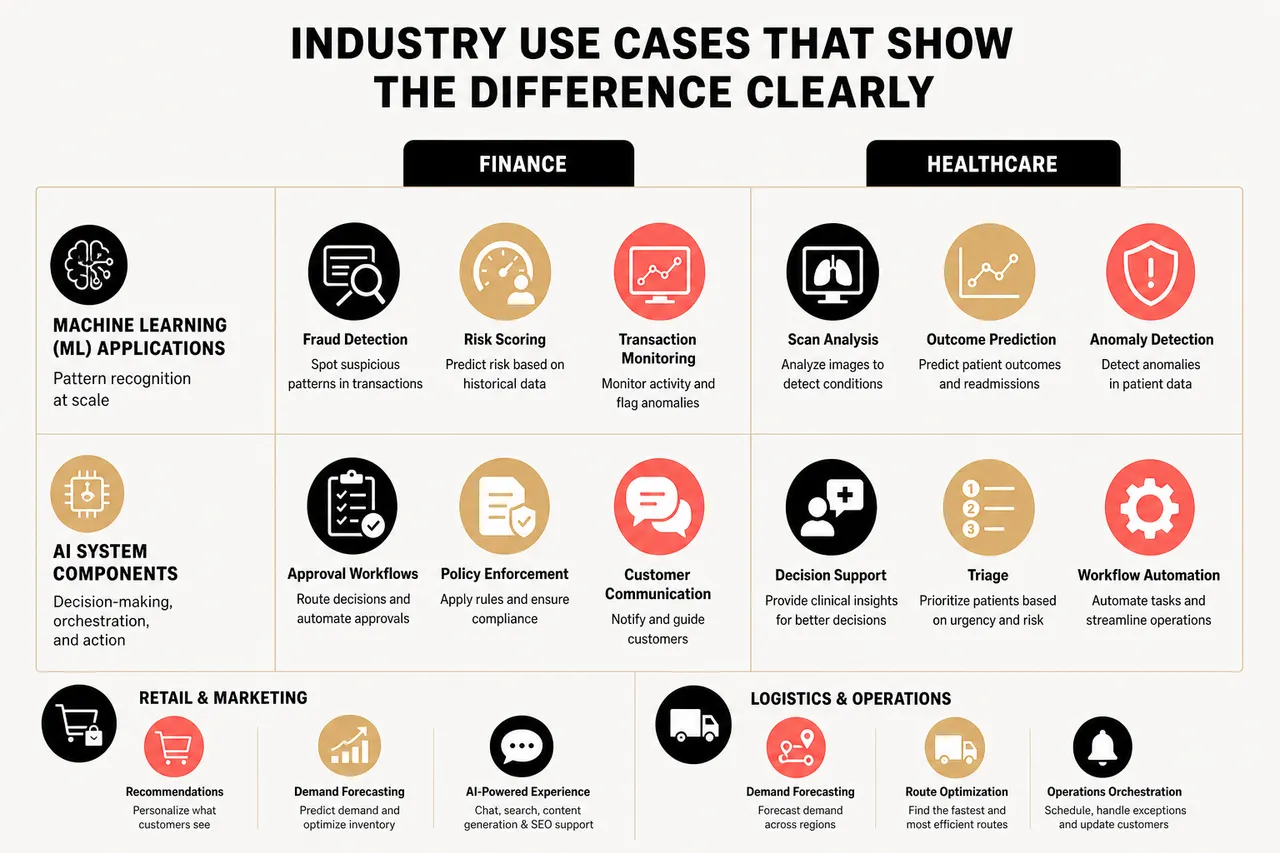
In finance, machine learning is often used for fraud detection, risk scoring, and transaction monitoring because those tasks depend on pattern recognition across large volumes of data. AI adds the larger decision framework around those predictions, such as approval workflows, policy enforcement, and customer communication.
Healthcare
Healthcare uses AI for decision support, triage, and workflow automation, while machine learning helps analyze scans, predict outcomes, and detect anomalies. Academic and medical research continues to show that deep learning is especially strong in imaging tasks because it can identify details that are easy to miss in manual review.[https://doi.org/10.1038/s41591-024-02989-5]
Retail and marketing
Retailers use ML for recommendations, demand forecasting, and dynamic pricing, while AI systems handle the broader customer experience through chat, search, and automation. In marketing, ChatGPT 247-style workflows are useful because they combine content generation, FAQ automation, and SEO support into a single practical layer.
Logistics and operations
Logistics teams use machine learning to forecast demand and optimize routes, while AI tools coordinate scheduling, exception handling, and customer updates. The value is not just speed, but resilience, since ML models can adjust as supply conditions or shipping patterns change.
The part most people miss: data, governance, and deployment trade-offs
One of the biggest unexplored differences between AI and machine learning is not technical, but operational. The best model in the world still fails if the data is poor, the workflow is unclear, or the organization cannot explain what the system is doing.
Data quality decides how useful machine learning becomes
Machine learning depends on data quality, quantity, and relevance, which means noisy or biased inputs lead to weak outputs. That is why businesses using AI through ChatGPT 247 or similar tools should care about data preparation as much as model selection, especially if the system will be used for customer-facing or regulated decisions.
Rules can outperform learning in stable environments
Not every problem needs machine learning. If the task is stable, narrow, and easily defined, a rule-based AI system can be cheaper, easier to audit, and more reliable than an ML model that needs constant retraining.
Explainability matters more as stakes rise
As AI enters healthcare, hiring, finance, and legal review, explainable systems become more important because users need to understand why a result was produced. That is one reason regulators and standards bodies keep emphasizing transparency, documentation, and human oversight.[https://eur-lex.europa.eu/]
How to choose the right approach for your project
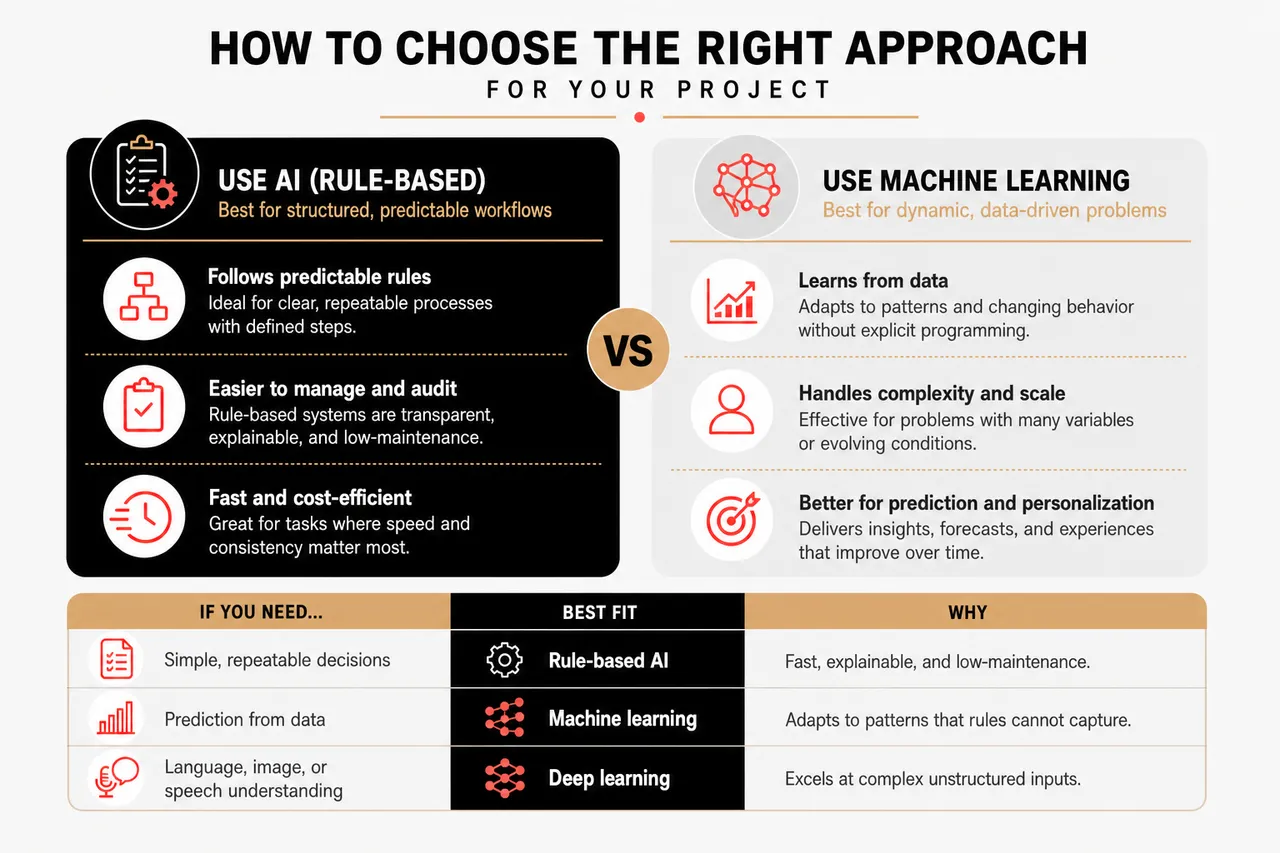
Choosing between AI, machine learning, or a hybrid setup depends on the problem you are trying to solve. The clearest path is usually the one that matches the level of uncertainty in the task, the amount of data available, and the cost of making mistakes.
Use AI when the workflow is structured
If the task follows predictable rules, such as routing support tickets or approving standard requests, a rule-based AI system may be enough. This reduces maintenance and makes the system easier to audit and control.
Use machine learning when patterns matter
If the problem involves changing behavior, personalization, or prediction from large datasets, machine learning is usually the stronger choice. That is why recommendation systems, fraud detection, and forecasting tools rely on ML rather than hardcoded logic.
Use deep learning for complex unstructured data
Deep learning is best when the input is messy or highly dimensional, such as images, voice, video, or natural language. If your organization needs conversational AI or visual recognition, deep learning is often the layer that makes the experience feel genuinely intelligent.
| If you need… | Best fit | Why |
|---|---|---|
| Simple, repeatable decisions | Rule-based AI | Fast, explainable, and low-maintenance |
| Prediction from data | Machine learning | Adapts to patterns that rules cannot capture |
| Language, image, or speech understanding | Deep learning | Excels at complex unstructured inputs |
Why this distinction matters for ChatGPT 247 users
For people exploring ChatGPT 247, the practical value of this distinction is simple: it helps you ask better questions before adopting a tool. Instead of asking whether a product is « AI, » it is more useful to ask what kind of AI it uses, what data it learns from, how often it updates, and where human oversight sits in the process.
- Better vendor evaluation. If a platform claims to be AI-powered, you can check whether it uses machine learning, retrieval, rules, or a mix of approaches. That helps you avoid paying for impressive language that does not match the product’s actual capabilities.
- Better operational planning. If you know a system is learning from data, you can plan for training, monitoring, and retraining. That is important for teams using ChatGPT 247 for customer support, SEO assistance, or FAQ automation because performance will depend on how the system is configured and maintained.
- Better risk control. If a tool affects customers, finances, or compliance workflows, you need to know whether outputs are generated from rules or learned patterns. The more consequential the task, the more important it is to understand that difference before deployment.
Common misconceptions that still cause confusion
All AI learns by itself
This is one of the most common misunderstandings. Many AI systems are static unless a developer updates them, while machine learning systems can improve only when they are trained on relevant data and monitored over time.
Machine learning is always better than rules
ML is not automatically the best choice. In low-variance tasks, rules can be faster to deploy, easier to explain, and less expensive to maintain than a model that needs regular tuning.
ChatGPT is the same thing as AI
ChatGPT is an AI application powered by machine learning and deep learning, not a synonym for the entire field of AI. That distinction matters because it helps users understand that AI includes many other methods beyond language models.
FAQs people ask before choosing an AI tool
Is every AI system machine learning?
No. Some AI systems are rule-based or logic-driven and do not learn from data at all.
Can machine learning exist without AI?
In practice, machine learning is usually treated as part of AI, because the goal is still to create intelligent behavior. The main difference is that ML achieves that behavior through data-driven learning rather than hand-coded rules.
Should small businesses start with AI or machine learning first?
Most small businesses should begin with the problem, not the technology. If the need is simple automation, a rule-based AI tool may be enough; if the need is prediction, personalization, or language generation, machine learning is often the better fit.
Getting started with clearer expectations
If you are new to the topic, the best starting point is to identify the task you want to improve and match it to the right type of system. Platforms like ChatGPT 247 can help individuals and businesses explore practical AI applications, but the results are stronger when you know whether you need rules, learning, or both.
- Understand the task first. Define whether the job is classification, prediction, conversation, or automation before comparing products. That keeps you focused on functionality rather than marketing language.
- Check the data requirement. If a system depends on machine learning, ask what data it needs, how it is trained, and how performance is monitored. This prevents unrealistic expectations and reduces deployment surprises.
- Plan for oversight. Even the best AI tools need review, especially in customer-facing or regulated environments. Human review is often the difference between convenient automation and dependable operational support.
Artificial intelligence and machine learning are closely connected, but they solve different problems and carry different trade-offs. AI is the broader field of creating intelligent systems, while machine learning is one of the main ways those systems learn from data and improve over time. Understanding that difference helps you choose better tools, ask smarter vendor questions, and make more realistic decisions about what AI can do for your team.