
Choosing the right OpenAI model can mean the difference between a project that sings and one that falls flat. With GPT-4o, DALL·E 3, and Whisper each built for different tasks, knowing which tool fits your workflow saves you time, money, and frustration. ChatGPT 247 breaks down the entire OpenAI lineup so you can match models to real-world needs, whether you’re drafting content, generating visuals, or transcribing audio.
This guide walks you through speed versus accuracy trade-offs, cost considerations, and practical use cases across text, image, and audio applications. You’ll walk away knowing exactly which model to deploy and when.
Introduction to OpenAI Models in 2026
The Evolution of OpenAI Models
OpenAI’s story started with models like GPT-2 and GPT-3, which changed how people thought about generating and understanding text. As the years rolled on, these tools have become much more than just text generators. By 2026, models like GPT-4o, GPT-5, and the GPT-5.4 family have introduced robust multimodal abilities, letting you work with text, code, images, audio, and tools in a single pipeline.
Alongside the GPT series, OpenAI has released specialized reasoning models such as the o3 and o4-mini families, designed to “think” longer before answering and deliver stronger performance on math, science, and complex visual tasks. These models power advanced copilots, data analysis assistants, and agent workflows that go beyond basic chat. At the same time, video and richer visual generation are emerging through models like Sora, which turn simple scripts or prompts into detailed video sequences that creative teams can iterate on rapidly.
One of the biggest shifts is the rise of open-weight models across the wider AI ecosystem. While OpenAI itself focuses mainly on API-delivered frontier models, users increasingly combine OpenAI APIs with open-weight models from communities like Hugging Face or initiatives like Llama 4 to build hybrid stacks. In practice, this means businesses can experiment, customize, and innovate with a mix of managed OpenAI intelligence and self-hosted models, reducing vendor lock-in and tuning their cost and privacy posture.
Why OpenAI Models Matter in 2026
OpenAI models are now the backbone of countless workflows in 2026. Online retailers use ChatGPT-style assistants powered by GPT-4o or GPT-5 to engage customers around the clock, answering questions, suggesting products, and guiding purchases in real time. Marketing teams lean on DALL·E 3 and related image tools to instantly create eye-catching visuals for campaigns, while global companies use advanced multilingual GPT models to keep communication smooth across continents.
Enterprise adoption has accelerated significantly: OpenAI reports rapid growth in ChatGPT Enterprise and frontier model usage across sectors like finance, healthcare, and manufacturing, where models power document review, compliance checks, and operational decision support. Independent analyses estimate that the broader generative AI market has surpassed 100 billion dollars in annual value by the mid-2020s, with language and multimodal models driving most of that growth. For individual creators and small businesses, platforms such as ChatGPT 247 play a really important role by making these capabilities easier to explore and integrate without needing in-house AI teams.
- Broad model spectrum for different needs: OpenAI’s lineup now includes general-purpose chat models like GPT-4o and GPT-5, high-reasoning models such as o3 and o4-mini, and creative tools like DALL·E 3 and Sora. Each serves a distinct role, from everyday drafting to deep analysis and generative media.
- Enterprise-grade deployment options: Offerings like ChatGPT Enterprise, Frontier models, and Codex-based tools are optimized for security, observability, and integration, making them suitable for regulated industries and large-scale automation projects.
- Hybrid use with open weights: Many teams combine OpenAI APIs with open-weight models to control data residency and cost. For example, they might use GPT-5.4 Thinking for strategic reasoning while running an open-weight summarizer locally for high-volume internal documents.
Types of OpenAI Models: Flagship, Reasoning, Creative, and Open-Weight Hybrids
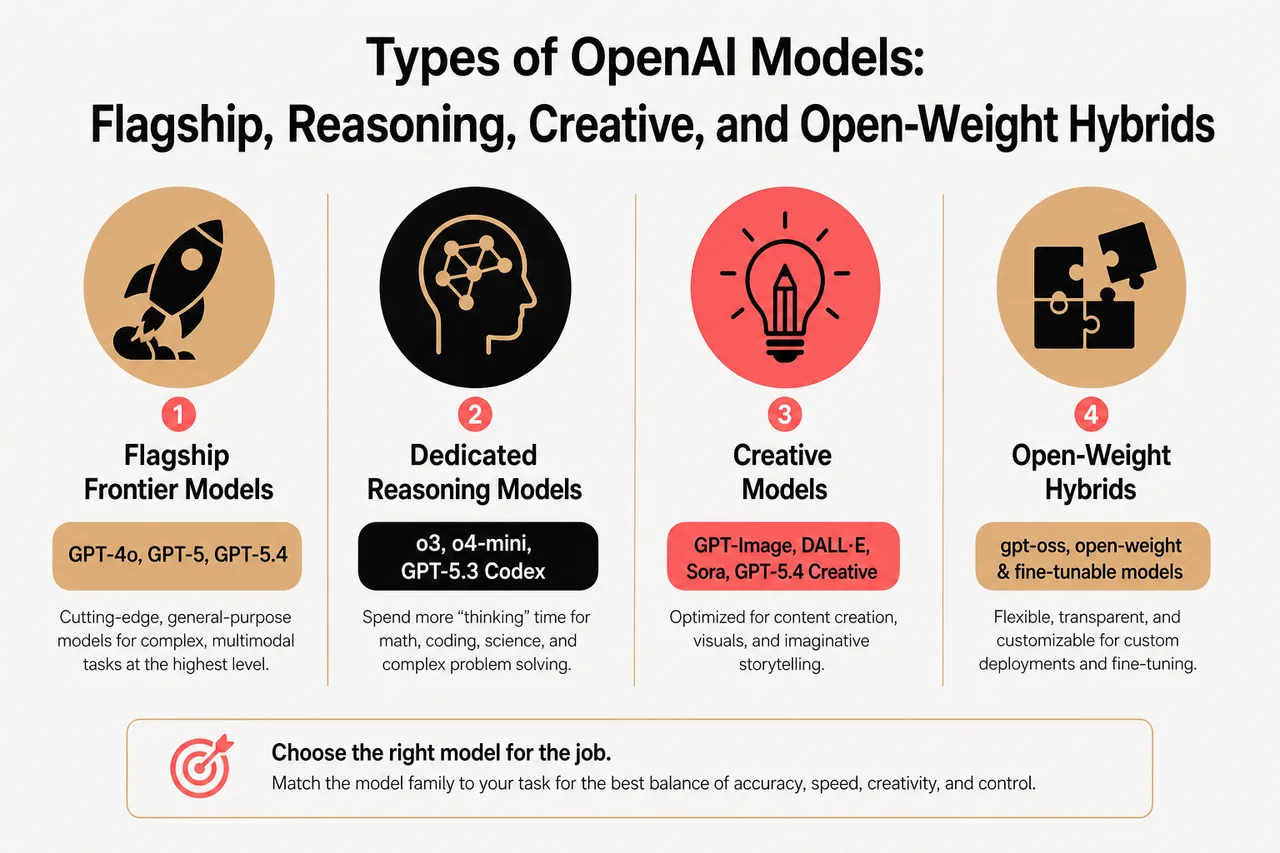
Flagship Frontier Models (GPT-4o, GPT-5, GPT-5.4)
Flagship frontier models like GPT-4o and GPT-5.4 are at the cutting edge of what OpenAI can do for general-purpose language and multimodal tasks. GPT-4o serves as a fast, capable default model in ChatGPT, handling text, images, and simple tools with strong performance and low latency. GPT-5 and GPT-5.4 add larger context windows and improved reasoning, making them better suited to long documents, complex workflows, and integrated tool use such as browsing, code execution, and data retrieval.
For example, a law firm might use GPT-5.4 Thinking to draft and refine contracts, summarize multi-hundred-page case bundles, and cross-check clauses against internal policy. Research teams can lean on GPT-5.x models to scan scientific literature, extract key findings, and generate hypotheses in a structured way. These flagship models are ideal when accuracy, depth, and reliability matter, such as in healthcare diagnostics support, financial risk analysis, or strategic business planning.
Dedicated Reasoning Models (o3, o4-mini, GPT-5.3 Codex)
Reasoning-focused models are designed to spend more computational effort “thinking” before responding, which pays off on challenging tasks like math, structured problem solving, and complex code. OpenAI’s o3 series pushes the frontier across coding, math, science, and visual perception, performing especially well when answers are not obvious and require multi-step analysis.
Smaller variants such as o4-mini are tuned for fast, cost-efficient reasoning and have achieved top benchmark scores on exams like AIME while staying affordable enough for everyday use. GPT-5.3 Codex, meanwhile, is optimized for agentic coding, helping developers navigate large codebases, refactor services, and build automation agents that can call tools and APIs safely. In practice, these reasoning models underpin advanced copilots, data science assistants, and agent systems that orchestrate tasks rather than just answering questions.
Creative and Vision Models (DALL·E 3, Sora, Multimodal GPT)
Not every challenge is about text. DALL·E 3 specializes in generating high-quality images from simple descriptions, with improved handling of text inside images and style control that makes life easier for designers and marketers. Teams can rapidly prototype branding concepts, social media posts, and product shots without traditional photo shoots.
For richer media, OpenAI’s Sora demonstrates video generation capable of turning paragraphs of narrative into multi-shot sequences with coherent characters and environments. Although still emerging, such video models are being tested for advertising storyboards, educational explainers, and pre-visualization in film and gaming. Multimodal variants of GPT, including GPT-4o and GPT-5 with image input, provide another layer by analyzing diagrams, slide decks, charts, and photos to extract insights, critique designs, or suggest improvements.
Open-Weight Models and Ecosystem Hybrids
While OpenAI’s own models are delivered primarily as APIs, open-weight models across the ecosystem, such as Llama 4 and other large language models on platforms like Hugging Face, play an important complementary role. These models can be downloaded and run on your own hardware or cloud instances, giving you granular control over data, performance, and cost structure.
Organizations increasingly follow a “split by workload” approach, using OpenAI frontier APIs for maximum-quality reasoning and creative output, and open-weight generalists for high-volume tasks such as log summarization or simple classification. This hybrid strategy allows you to keep sensitive data on-premises when necessary, while still tapping into OpenAI’s strongest capabilities for critical decisions and customer-facing experiences.
- Flagship models for high-stakes tasks: GPT-5.x and GPT-4o are best when you need top-tier accuracy, long-context understanding, and reliable tool use in areas like law, finance, or operations.
- Reasoning models for complex analysis: o3, o4-mini, and GPT-5.3 Codex shine when deep reasoning, coding, or complex math are central to the workflow, such as algorithm design or research planning.
- Creative models for visuals and media: DALL·E 3 and Sora are ideal when you want to generate or iterate on marketing visuals, educational content, or narrative video, supporting creative teams with fast ideation.
- Open-weight models for control and cost: Open-source or open-weight models are invaluable when customization, data residency, and predictable infrastructure costs matter more than frontier-level performance.
Capabilities and Applications of OpenAI Models
Text Generation, Automation, and Reasoning
OpenAI models have transformed how businesses and individuals generate, refine, and understand text. A modern e-commerce site can use GPT-4o or GPT-5 to create thousands of SEO-friendly product descriptions, adjust tone for different regions, and continually A/B test copy variants. Customer support teams deploy ChatGPT-based assistants that triage queries, draft replies for human agents, and update knowledge bases as policies change.
Beyond surface-level writing, reasoning models handle complex document workflows. For instance, a compliance team can feed GPT-5.4 Thinking a full set of regulations and internal policies, asking the model to flag conflicts, summarize changes, and suggest mitigation steps. Researchers rely on these models to condense literature reviews, propose experimental designs, and explain technical concepts to non-experts. Within ChatGPT 247, curated prompts and templates help users tap into these capabilities without needing to engineer prompts from scratch.
Image, Vision, and Video Capabilities
AI-powered image tools like DALL·E 3 are redefining how visual content is produced. Marketing agencies can quickly generate mockups for multi-channel campaigns, experimenting with different styles, colors, and layouts before committing to a final design. Online stores use generated imagery to show products in diverse environments, making catalog expansion faster and less dependent on physical photography.
Vision capabilities inside multimodal GPT models allow automated analysis of screenshots, charts, user interfaces, and photos. Operations teams can upload warehouse snapshots for inventory checks, engineers can ask the model to inspect diagrams and architecture sketches, and analysts can get narrative explanations of dense dashboards. As video models like Sora mature, storyboarding and pre-visualization workflows will increasingly rely on AI to produce early drafts that creative professionals refine.
Multilingual and Cross-Lingual Applications
OpenAI’s multilingual models now support dozens of languages with high quality, enabling live chat support and content localization at scale. A global SaaS company might use GPT-5 to translate marketing and documentation into multiple languages, then ask the model to adapt tone for regional norms. Support agents can have conversations in their native language while GPT translates back and forth in real time, reducing response times and expanding reach.
These capabilities are especially powerful for small teams that previously lacked resources for professional translation. With tools like ChatGPT 247 acting as an accessible front-end, individuals can draft and refine multilingual content, check for cultural sensitivities, and maintain consistency across markets without owning complex translation infrastructure.
- End-to-end content workflows: Models can handle ideation, drafting, editing, and localization in one pipeline, cutting manual steps for marketing, documentation, and training teams.
- Operational intelligence from visuals and data: Multimodal GPT’s vision abilities and emerging video tools automate interpretation of diagrams, dashboards, and footage, turning raw inputs into structured insight.
- Global reach through multilingual support: Translation and cross-lingual understanding remove friction for international customers, partners, and stakeholders, allowing even small businesses to operate globally.
How to Choose the Right OpenAI Model
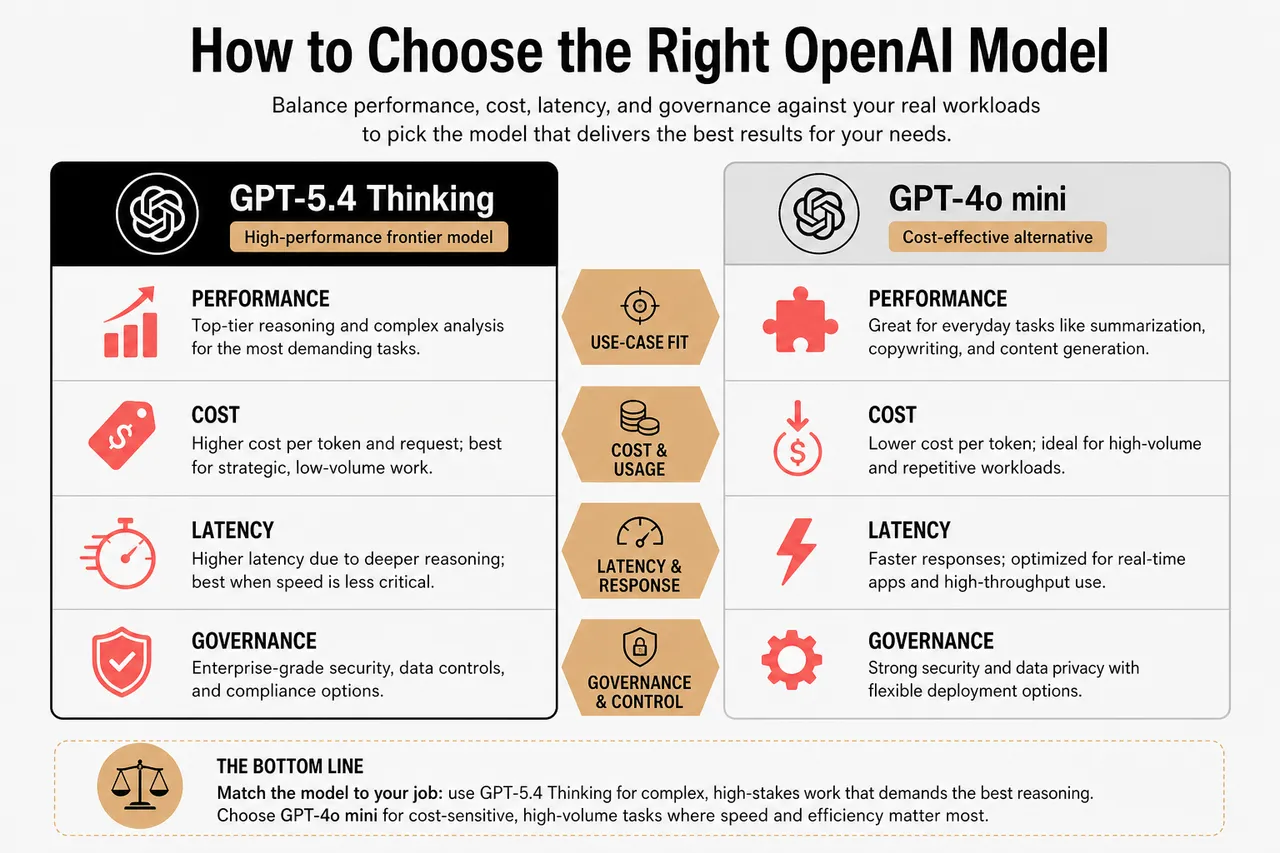
Factors to Consider: Performance, Cost, Latency, and Governance
Picking the best model for your job is all about balance. You need to weigh performance, cost, latency, and governance requirements against your actual workloads. Frontier models like GPT-5.4 Thinking deliver top-tier reasoning, but may be overkill for tasks such as simple summarization or short-form copywriting where GPT-4o or GPT-4.1 mini are more cost-effective.
- Performance and modality: Start by asking which modalities you need: text-only, text-plus-images, or full multimodal including audio and video. For example, if your primary need is legal analysis, a high-reasoning text model like GPT-5.4 Thinking is appropriate. If you mostly need marketing visuals, DALL·E 3 or Sora should be central, with GPT-4o handling copy. Assess benchmark data, but validate performance on your real samples.
- Cost and usage patterns: Estimate how often and how much you will use the model. High-volume use (such as summarizing thousands of internal emails) may favor smaller API models or open weights. Strategic, low-volume tasks (like quarterly risk assessments) can justify using the most capable frontier models. Monitor token usage and cost per request, and experiment with prompt engineering and caching to reduce expenditure.
- Latency and responsiveness: If instant responses are essential, such as in live chat, code autocomplete, or real-time translation, prioritize models and deployment setups that minimize latency. This may mean using lighter variants, regionally hosted APIs, or local open-weight instances for the snappiest experience. For background analysis jobs, you can tolerate higher latency in exchange for deeper reasoning.
- Privacy, compliance, and control: Consider regulatory requirements and internal policies. Sensitive workloads in healthcare or finance may call for enterprise-grade deployments with strict data handling guarantees, or a hybrid stack where the most confidential data is processed by self-hosted open weights. Make sure you understand logging, retention, and access controls in any API you use.
When choosing, it helps to follow a structured evaluation loop that tools like ChatGPT 247 can support. Start with a short pilot, run the same tasks across two or three models, and compare outputs for accuracy, tone, and robustness. Gather feedback from end users, track failure modes, and adjust your model selection and prompt patterns accordingly.
- Pinpoint your main need: Map each use case to a primary modality and task type (drafting, reasoning, translation, coding, creative) to narrow your model shortlist.
- Quantify demand and constraints: Estimate daily and monthly volume, budget ceilings, latency expectations, and privacy boundaries before committing to any one model.
- Run realistic trials: Test candidate models on real data samples, not just synthetic benchmarks, to uncover strengths and weaknesses in your specific context.
- Iterate with governance in mind: As adoption grows, establish clear guidelines for human review, data retention, and model usage so that AI remains a trustworthy partner.
Best Practices for Model Selection in 2026
Most organizations succeed by treating model selection as an ongoing process rather than a one-time decision. New releases such as GPT-5.4, o3, or future GPT-5.5 updates can change the trade-offs within months, so staying informed and regularly re-evaluating your stack is essential. ChatGPT 247 can help by surfacing up-to-date comparisons and practical prompts tailored to evolving capabilities.
- Combine three reference models in pilots: A practical setup is to pick one frontier model to define quality, one smaller or cheaper model to probe latency and cost limits, and one open-weight alternative to evaluate portability and on-premise deployment. This triangulation reveals where paying for the frontier model truly matters and where leaner options suffice.
- Fine-tune open weights, engineer prompts for APIs: For open-weight models, fine-tuning on your domain data (documents, tickets, code) can close much of the gap with proprietary APIs. For OpenAI models, careful prompt design, system instructions, and tool configuration often deliver bigger gains than simply switching to a larger model.
- Align models with team workflows: Instead of choosing models in isolation, embed them into existing tools: IDEs, CRM systems, document editors, analytics dashboards. Measure how they change actual behavior, such as time to complete tasks or error rates, and adjust model choices based on those metrics.
- Start small and scale intentionally: For lean operations or individuals, begin with ChatGPT 247 and default models like GPT-4o before investing in enterprise contracts or infrastructure. As you uncover high-impact use cases, you can upgrade to GPT-5.x, integrate DALL·E 3, or pair APIs with self-hosted open weights.
Recent Advancements and Trends in OpenAI Models (2026)
Open-Weight Ecosystem and Frontier APIs: A New Balance
By 2026, the “model wars” have largely given way to ecosystem thinking. OpenAI’s frontier models such as GPT-5.4 and o3 set high ceilings for reasoning and reliability, while open-weight models across the community offer flexibility, experimentation, and cost control. Rather than asking which single model is best, teams now frame decisions around workloads and deployment patterns.
Industry analyses describe practical winners as divided into buckets like frontier API quality, high-volume API throughput, open-weight general use, open coding, and long-context experimentation. This framing encourages organizations to pick different tools for different jobs: a top-tier GPT model for mission-critical analysis, an efficient mini model for routine tasks, and an open-weight specialist for custom workflows. ChatGPT 247 helps readers understand these buckets and design stacks that match their priorities.
Enterprise AI and Industry Adoption
Enterprise AI has entered a new phase as frontier models become production staples. OpenAI highlights rapid growth in large-scale deployments of ChatGPT Enterprise, Frontier models, and Codex-derived tools, which power everything from customer support bots to document automation systems. Financial institutions use GPT models to analyze filings and market news, healthcare providers experiment with AI-assisted documentation and triage, and manufacturers explore vision-based quality control.
Studies and market reports now estimate that a significant share of knowledge work tasks involve AI assistance, with adoption particularly strong in software development, marketing, operations, and data analysis. The result is a growing divide between organizations that systematically integrate AI into workflows and those that treat it as a one-off tool. Platforms like ChatGPT 247 aim to bridge this gap by empowering individuals and smaller teams to adopt best practices quickly.
What to Expect in the Near Future
The pace of progress in AI is not slowing down. OpenAI has signaled upcoming releases such as GPT-5.5 and continued improvements to reasoning, multimodal capabilities, and tool orchestration. Future models are expected to offer smoother integration with cloud providers and developer platforms, including partnerships that make frontier models available within major ecosystems like AWS.
- More powerful multimodal agents: Models will increasingly handle text, images, audio, and video in one conversation, coordinating tools like browsers, code interpreters, and internal APIs to act as full-fledged agents rather than static assistants.
- Deeper integration with enterprise platforms: OpenAI is expanding its presence in enterprise environments, offering managed access, observability, and security features so that AI can be embedded directly into collaboration suites, CRMs, and analytics tools.
- Lower costs and efficiency gains: Ongoing model efficiency improvements make it possible to deliver strong performance at lower cost and hardware requirements. This will help small businesses and individuals access advanced AI through platforms like ChatGPT 247 without large upfront investment.
- Hybrid AI stacks as the norm: The future is likely to involve combinations of frontier APIs, open weights, and domain-specific tools, giving organizations finer control over performance, cost, and governance.
- Continuous capability upgrades: Regular model updates will keep expanding what AI can do, especially in reasoning, long-context handling, and multimodal understanding, so periodic reassessment of your model choices will remain important.
Data-Driven View: Adoption, Use Cases, and Model Buckets
Key Market and Adoption Insights
To make sense of the fast-moving landscape, it helps to look at adoption and usage trends across industries. While exact figures vary by report, several consistent patterns have emerged in recent market analyses and industry white papers.
- Rapid growth of generative AI spending: Analysts estimate that global spending on generative AI technologies has surged into tens of billions of dollars annually, with compound annual growth rates exceeding traditional software segments. This growth is driven by enterprises rolling out AI across customer support, development, and operations, and by smaller businesses adopting platforms like ChatGPT 247 for content and automation.
- High penetration in software and marketing teams: Surveys of knowledge workers suggest that a majority of software engineers and digital marketers now use AI tools weekly, often relying on models like Codex variants for coding and GPT-4o or GPT-5 for content ideation and campaign optimization. This consistent use illustrates how language models have become integral, not optional, in these professions.
- Expanding use in operations and data analysis: Operations managers and analysts are increasingly turning to AI for summarizing reports, generating dashboards explanations, and simulating scenarios. Reasoning models such as o3 and GPT-5.4 Thinking play a growing role in translating raw numbers into narrative insights that stakeholders can act on.
- Emerging but cautious adoption in regulated sectors: Healthcare, finance, and public sector organizations are moving more slowly, often limiting AI to documentation and decision support while maintaining strict human oversight. Enterprise offerings from OpenAI and hybrid stacks with open weights are popular here because they provide clearer control over data flows and compliance.
- Rising demand for multimodal experiences: User research shows that people increasingly expect AI systems to handle text, voice, and visuals together. This demand fuels investment in multimodal GPT, DALL·E, and video models, making cross-media capabilities a competitive differentiator for platforms like ChatGPT 247.
Comparing Model Buckets: Frontier APIs vs Open Weights
For clarity, it can be helpful to compare how different categories of models stack up on practical dimensions such as reasoning quality, cost, context handling, and openness. While specific scores change with each release, the relative positions are stable enough to guide decisions.
| Model Bucket | Typical Examples | Reasoning & Quality | Cost Profile | Context & Modality | Openness & Control | Best For |
|---|---|---|---|---|---|---|
| Frontier API quality | GPT-5.4 Thinking, o3 | Highest reasoning and reliability, strong on complex tasks and multi-step analysis. | Premium pricing, suitable for high-value or low-volume tasks where accuracy matters most. | Large context windows, robust multimodal support (text plus images, tools, sometimes audio). | Managed by OpenAI, strong enterprise features but limited self-hosting. | Strategic analysis, legal and financial workflows, research, and agent systems. |
| High-volume API workhorses | GPT-4o, GPT-4.1 mini | Very good general performance, sufficient for most everyday tasks. | More affordable, optimized for frequent use in content, chat, and automation. | Moderate to large context, solid multimodal capabilities for mainstream use cases. | API-based deployment, simple integration via platforms like ChatGPT 247. | Customer support, content generation, documentation, and internal tools. |
| Open-weight generalists | Llama 4, other open LLMs | Competitive performance, especially after fine-tuning on domain data. | Infrastructure-based costs, scalable for very high-volume workloads. | Increasingly large context windows and growing multimodal support. | Full control over deployment, data, and customization; requires technical expertise. | On-premise summarization, classification, and tailored internal assistants. |
| Open coding specialists | Open-source code LLMs, GPT-5.3 Codex (API) | Strong coding and debugging abilities, tuned for developer workflows. | Cost varies; open weights reduce API spend at scale. | Text plus code, tool use with IDEs and CI/CD systems. | Hybrid: some are fully open, others offered via APIs with agent features. | Code generation, refactoring, testing, and dev automation agents. |
| Long-context experimenters | Models with 1M+ token windows | Designed to maintain coherence over very long documents and sessions. | Higher cost per request, but efficient for large-scale document workflows. | Massive context windows, sometimes multimodal inputs. | Mix of open weights and APIs, depending on provider. | Regulation analysis, large codebase navigation, and archival search. |
Responsible Use, Governance, and FAQs
Responsible AI and Governance Considerations
As OpenAI models become woven into everyday workflows, responsible use and governance are increasingly important. OpenAI publishes guidance and recommendations on safe deployment, emphasizing the need for human oversight, robust evaluation, and clear boundaries for models acting as agents. Organizations are encouraged to treat AI outputs as suggestions rather than ground truth, particularly in high-stakes domains.
Practical governance measures include setting review requirements for certain tasks, logging prompts and outputs for auditability, and defining red lines for what AI systems should not do, such as making unverified medical diagnoses or financial decisions without human approval. Platforms like ChatGPT 247 can help users apply these principles by providing curated best practices, example policies, and prompts that encourage critical thinking rather than blind acceptance.
FAQ: Common Questions About OpenAI Models
To round out this guide, here are answers to some frequently asked questions that individuals and businesses often raise when exploring OpenAI models through tools like ChatGPT 247.
- Which OpenAI model should I start with for general use? For most users, GPT-4o is a strong starting point. It offers balanced performance, supports text and images, and has reasonable latency and cost. As your needs become more complex, you can experiment with GPT-5.x or o3 for deeper reasoning, and add DALL·E 3 or Sora for creative work.
- How can I keep costs under control when using OpenAI APIs? Monitor token usage, choose models that match task complexity, and use caching and batching where possible. For high-volume but low-stakes tasks, consider smaller models or open-weight alternatives. ChatGPT 247 can help you design workflows that minimize unnecessary calls while preserving quality.
- Is it safe to use OpenAI models with sensitive data? Safety depends on your deployment choice and policies. Enterprise offerings provide stronger guarantees and controls, while open-weight models allow full self-hosting. Regardless of model, implement data minimization, access controls, and human review for sensitive decisions, and avoid sending highly confidential information unless you are confident in the environment’s protections.
The Future of OpenAI Models and AI Adoption
Key Takeaways and Next Steps
In 2026, the world of OpenAI models is more diverse and accessible than ever. Whether you need a high-performance frontier model, a reasoning specialist, a creative tool for images or video, or a hybrid stack that blends APIs with open weights, there is an option for every goal and budget. As you evaluate your choices, focus on the tasks you actually need to accomplish, the level of risk and accuracy involved, and the governance framework you can support.
- Diverse tools for varied users: OpenAI models now cover more ground and reach more users, from solo creators using ChatGPT 247 for content and ideation to global enterprises embedding GPT-5.4 into mission-critical systems. This spectrum allows each user to find a level of sophistication and investment that fits their situation.
- Staying current as capabilities evolve: Because model capabilities change rapidly, keeping up with release notes, benchmarks, and ecosystem trends is essential. Revisiting your model choices every few months helps ensure you are benefiting from improvements in reasoning, multimodality, and cost efficiency.
The OpenAI models of today empower anyone to create, automate, and solve problems in ways that were out of reach just a few years ago. With platforms like ChatGPT 247 making exploration easier, now is an ideal time to test how these models can amplify your workflows, products, and creative projects. Start small, learn from real-world experiments, and gradually let AI become a powerful, well-governed partner in your next initiative.