
Your team is already using AI tools, whether you’ve blessed it or not. The real risk isn’t experimentation; it’s the chaos of ungoverned adoption: leaked client data, inconsistent outputs, and compliance nightmares that could’ve been avoided with a single-page framework. ChatGPT 247 helps individuals and businesses interested in AI solutions explore AI technologies like ChatGPT without stumbling into preventable pitfalls.
This guide walks you through building a lightweight AI usage policy that protects your organization while keeping innovation alive, covering essential guardrails, practical implementation steps, and real-world examples you can adapt today. No legal jargon, no bureaucracy, just clarity.
Why Your Organization Needs an AI Policy in 2026
AI tools like ChatGPT, automated image generators, and real-time translation services have quickly become staples in the modern workplace. By 2026, it is common to see AI chatbots resolving customer questions at all hours, or teams using automated translation to break down language barriers in global projects. These advances boost productivity, but without some basic guardrails, they can also open the door to serious problems. Picture a well-meaning employee pasting sensitive financial data into an online chatbot, or a marketing team using an unapproved image generator that accidentally shares proprietary designs.
The Risks of Unregulated AI Use
Letting everyone use any AI tool however they like creates a few real dangers that are now well documented across industries:
- Data privacy violations: Regulators in multiple jurisdictions have warned that feeding personal or client data into unmanaged AI tools can constitute a data breach, triggering mandatory notifications, fines, and contractual penalties. A single upload of a confidential client list to a public chatbot can expose thousands of records, forcing expensive incident response and eroding client trust.
- Intellectual property leaks: When developers paste proprietary source code or product designs into external AI services for debugging or generation, they may inadvertently grant those providers broad license to store and reuse that information. This makes it harder to protect trade secrets, complicates patent strategies, and can undermine your competitive edge.
- Inconsistent work quality and hidden bias: Without rules or review processes, AI-generated content can drift from brand standards, include subtle inaccuracies, or embed bias into hiring, lending, or customer support decisions. Employees may overtrust outputs because they seem authoritative, only discovering the problem after complaints or audit findings.
- Regulatory and contractual breaches: Many modern contracts and sector regulations now contain explicit clauses on automated decision systems and data processing. Unapproved AI use can violate client agreements, labor rules, or sector-specific obligations in fields such as financial services, healthcare, and education.
These issues are no longer hypothetical. Over the last 12 to 18 months, supervisory bodies, professional associations, and ethics councils have published case studies of organizations facing investigations, reputational damage, and remediation costs after unmanaged AI use led to accidental data exposure, biased decisions, or misleading public communications.
The Benefits of a Clear AI Policy
Having a simple, clear AI policy does more than just check a compliance box. It provides a shared framework so employees can use tools like ChatGPT 247 confidently, and it gives leadership a way to steer experimentation toward outcomes that match the organization’s values and risk appetite.
- Clarity on approved tools and data types: A well-crafted policy tells employees which AI platforms they may use, which use cases are encouraged, and which data classes are off-limits. That clarity reduces hesitation and inconsistent judgment, replacing guesswork with consistent expectations.
- Space for innovation with clear guardrails: When the allowed and prohibited uses of AI are spelled out, teams can experiment freely within those boundaries. They can use ChatGPT 247 for internal FAQs, idea generation, and workflow automation, while knowing that customer-sensitive data, hiring decisions, or regulatory filings require extra oversight.
- Demonstrable commitment to ethics and compliance: Clients, regulators, and employees increasingly ask how organizations govern AI. A concise policy supported by training and monitoring shows that you take fairness, privacy, and accountability seriously, which can be a differentiator in competitive bids and talent recruitment.
- Alignment with broader digital and security programs: A strong AI policy connects to your existing data protection, information security, and acceptable use policies. This reduces duplication, makes audits easier, and ensures AI risk is treated as part of your Generally governance system rather than a standalone concern.
Even small businesses benefit from clear guidelines. The goal is not to slow down creativity, but to give your team a reliable foundation for trying out new AI solutions via platforms such as ChatGPT 247, whether it is automating FAQs, generating fresh marketing visuals, or streamlining translations for international projects.
Step-by-Step Guide: Drafting an AI Policy for Employees
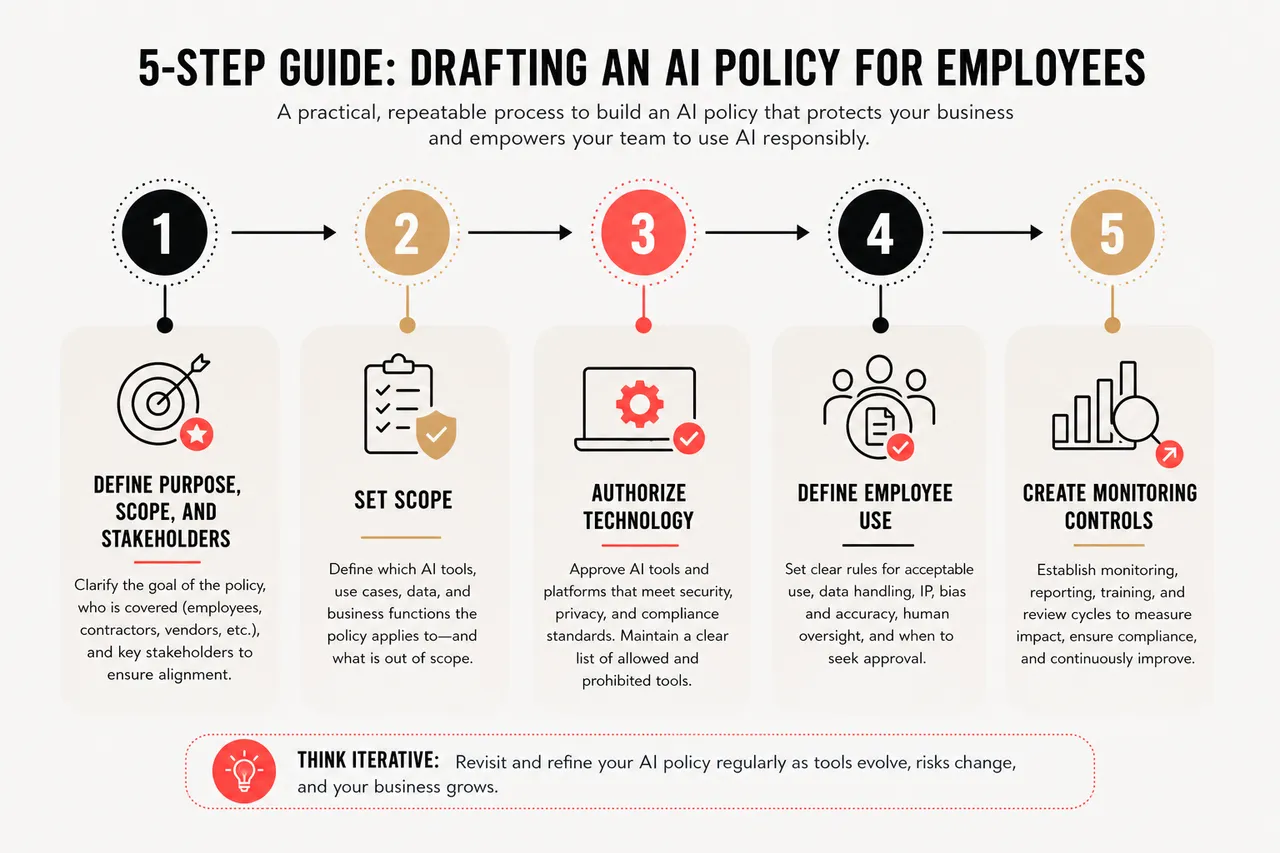
Creating a practical AI policy does not have to mean endless meetings or dense legal language. Multiple recent frameworks from HR, compliance, and technology specialists converge on a similar, manageable sequence: understand your AI strategy, set scope, authorize technology, define employee use, and create controls for monitoring and improvement. Here is a straightforward approach you can adapt to your organization and integrate with how you already use ChatGPT 247.
Define Purpose, Scope, and Stakeholders
Start by answering three simple but foundational questions. Doing this upfront anchors the policy in your real business priorities rather than abstract principles.
- What is the goal? Clarify the primary objectives behind adopting an AI policy, such as protecting customer and employee data, complying with labor and privacy rules, and encouraging smart use of AI to reduce manual work. Explicit goals help you prioritize which rules must be strict and where you can allow more flexibility. For instance, a company focused on customer trust may set tighter limits on external content generation, while a design agency might emphasize intellectual property controls.
- Who is covered? Decide whether the policy applies only to employees or also to contractors, vendors, temporary staff, and partners who access your systems or handle your data. Many organizations now extend AI rules to third parties because external consultants or agencies frequently use generative tools to deliver work products. Documenting coverage avoids gaps where external contributors use AI in ways that conflict with your standards.
- Who needs a say? Involve HR, IT, legal, compliance, security, and operational leaders early. These groups see different aspects of AI risk and opportunity: HR focuses on hiring and performance tools, IT on infrastructure and integration, legal on regulatory impact, and business units on productivity use cases. Engaging them at the start helps ensure the policy is realistic and improves buy-in during rollout.
By getting all key voices at the table early, you build a policy that people understand, see as legitimate, and are more likely to follow in practice.
Identify Approved AI Tools and Use Cases
The next step is to define which AI systems are permitted and for what purposes. This list will shift over time, so design it to be easy to update while keeping the core logic stable.
- Inventory current and likely AI use: Map how teams already use platforms such as ChatGPT 247, internal chatbots, analytics systems, image generators, or translation tools. Include shadow use where people have adopted free tools informally. This inventory gives you a baseline of real behavior, not just official deployments.
- Approve tools and categorize use cases: Create a register of authorized tools with categories such as “always allowed,” “allowed with review,” and “prohibited.” For example, you might permit ChatGPT 247 for internal Q&A, content drafting, and FAQ automation, require extra review for customer-facing content, and prohibit its use for making hiring or credit decisions without human oversight. Clear categories make decisions easier for employees and for managers approving new experiments.
- Document contracts and data protections: For enterprise tools, record any contractual terms that affect data handling, such as whether provider systems train on your data or offer dedicated environments. This helps employees understand why certain tools are preferred and supports IT and procurement in vetting new AI services.
- Add an approval pathway for new tools: Include language like “Only AI tools listed in Appendix A are authorized for business use. To use other tools, employees must request approval from IT or the AI governance contact.” This keeps the door open for innovation while ensuring new tools are reviewed for security, legal, and ethical implications before wide adoption.
Set Usage, Data Privacy, and Security Guidelines
Once you know which tools and use cases are in scope, you can define practical rules for how employees should interact with them. These rules translate broad privacy and security principles into day-to-day behavior.
- Rules for data input: Specify what categories of information must never be entered into public or third-party AI tools, such as full names, account numbers, health information, financial records, legal strategies, or proprietary technical designs. Encourage anonymization or use of sample data when employees need to test workflows or ask for help with problems that involve sensitive topics.
- Standards for reviewing outputs: Make it explicit that AI cannot be the sole decision-maker for critical business functions and that all AI-generated content must be reviewed by a human before being acted upon or shared externally. This applies to marketing copy, customer communications, analytical recommendations, and draft policies. Encourage reviewers to check factual accuracy, tone, compliance with policies, and potential bias.
- Storage and retention expectations: Clarify how AI-generated files, transcripts, and datasets should be stored, retained, or deleted. For example, outputs that contain client insights may need to be stored within your secure document systems and subject to retention schedules, while disposable drafts can be deleted once final content is produced. Align these rules with your existing data protection program.
- Region-specific legal references: If you operate in jurisdictions with specific AI or data rules, point employees to those obligations in plain language. This may include privacy regulations, labor rules governing automated decision tools, or sector standards on algorithmic accountability. Even a short reference helps employees understand why certain restrictions exist.
These usage guidelines should be simple enough for employees to remember and apply, but detailed enough to guide decisions when they are under time pressure or exploring unfamiliar AI capabilities.
Outline Compliance and Review Procedures
Policies need maintenance. AI tools evolve quickly, and so do expectations from regulators, clients, and employees. Building a review and compliance process into your policy helps it stay fresh and usable.
- Policy ownership and governance: Assign clear responsibility for maintaining the policy, ideally to a cross-functional group that can see both risk and opportunity. Some organizations establish an AI governance board or designate a lead in compliance or risk who convenes stakeholders when updates are needed.
- Regular review cadence: Set a minimum review cycle, such as annually, while allowing for interim updates when major changes occur in technology, regulation, or business strategy. Communicate any revisions clearly so teams understand what has changed and why.
- Feedback and incident channels: Provide a simple way for employees to ask questions, suggest improvements, or report concerns. This can be a dedicated email address, form, or workflow. When people see that their input leads to better rules and practices, they are more likely to engage with the policy actively.
- Connection to existing disciplinary and audit processes: Where appropriate, reference how significant misuse will be handled, in line with your broader code of conduct and information security policies. This does not need to be punitive in tone, but it should make clear that deliberate or repeated violations carry consequences.
A clear, one-page or short-form policy often works better than an extensive document full of dense clauses. The details about workflows and approvals can live in supporting guidance, while the core policy focuses on principles, responsibilities, and high-level rules.
Best Practices and Common Pitfalls in AI Policy Implementation
Once the policy is drafted, the challenge shifts to implementation. Organizations that succeed tend to treat AI governance as an ongoing dialogue and learning process rather than a one-time announcement. Those that struggle often swing to extremes, either locking down tools so tightly that teams ignore the rules or leaving guidance so vague that employees are unsure how to proceed. The following practices help maintain the right balance.
Involve Employees and Encourage Feedback
AI is used in the flow of daily work, so the people closest to that work need a voice in how rules are designed and applied.
- Co-design policy elements with frontline teams: Run workshops or listening sessions in key departments to understand how employees already use AI and where they see friction or risk. Invite them to comment on draft rules, especially those that affect their productivity. Their input will highlight hidden use cases and reveal where guidelines need more nuance.
- Use surveys and pilot programs: Before fully rolling out the policy, test it in selected teams or regions and gather structured feedback through surveys. Ask whether rules are clear, whether they support the intended work, and where more examples or resources would help. Adjust the policy based on these insights to increase relevance.
- Recognize contributions to responsible AI use: Highlight stories where employees raised useful concerns, suggested safer workflows, or created training materials that helped colleagues. Recognition signals that engaging with AI policy is valued, not just compliance overhead.
Provide Ongoing Training and Support
AI literacy is uneven across organizations. Some employees are experienced users; others are cautious or unfamiliar. Training should close these gaps and reinforce the norms described in your policy.
- Practical, scenario-based training: Offer sessions that show how tools like ChatGPT 247 work in your business context, using realistic examples. Rather than focusing only on features, walk through scenarios such as drafting client emails, summarizing documents, or creating FAQ responses, and discuss what data is safe to use and how to review outputs.
- Accessible, bite-sized resources: Host short guides, quick videos, and FAQs on your intranet so employees can refresh their understanding exactly when they need it. Organize resources by use case (for example, marketing, support, HR) so teams can quickly find relevant material.
- Department AI champions: Appoint local experts or enthusiasts who can answer questions, share tips, and escalate issues where policy clarification is needed. These champions serve as bridges between centralized governance and everyday practice, helping the policy evolve alongside real-world usage.
Avoid Overly Restrictive or Vague Policies
Policies that are too tight drive AI use underground, while policies that are too loose leave employees uncertain. Both outcomes increase risk.
- Replace blanket bans with targeted controls: Rather than prohibiting all AI tools, focus restrictions on high-risk contexts, such as processing sensitive personal data or making high-impact decisions without human review. Allow experimentation in low-risk areas with anonymized data and clear review steps, so teams gain experience while staying within safe boundaries.
- Use concrete, operational language: Avoid generic statements like “use AI responsibly,” which are open to interpretation. Instead, spell out specific behaviors, such as “do not upload customer identifiers to external tools” or “always label AI-generated drafts when sharing them for review.” Concrete guidance is easier to remember and enforce.
- Provide examples of allowed and prohibited use: Include illustrative scenarios in the policy or accompanying guidance that show typical tasks employees face. For example, contrast an acceptable use of ChatGPT 247 for brainstorming article titles with a prohibited use involving copying entire confidential reports into an external prompt.
Communicating and Enforcing Your AI Policy
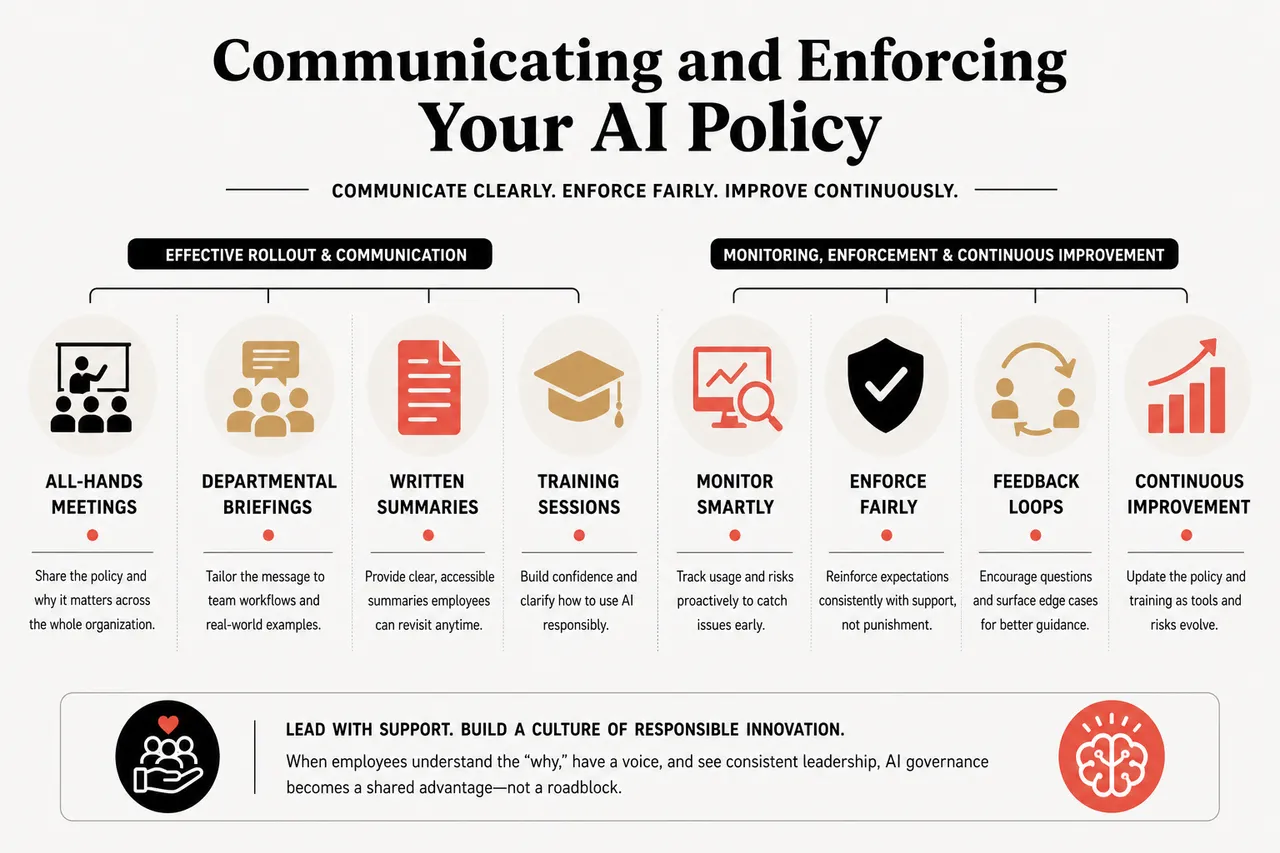
An AI policy is effective only if employees are aware of it, understand what it means for their work, and see that leadership cares about applying it consistently. Communication and enforcement should emphasize support and learning rather than punishment, while still making expectations clear.
Effective Rollout and Communication Strategies
Plan your rollout the way you would launch a new product or major initiative. The message, the messenger, and the modality all matter.
- Use multiple channels tailored to different audiences: Combine all-hands meetings, departmental briefings, written summaries, and intranet posts to reach employees with varied preferences and schedules. In larger organizations, local leaders can adapt core messages to their teams’ workflows and examples.
- Explain the “why” as much as the “what”: When introducing the policy, describe the risks it addresses and the opportunities it preserves. For instance, highlight how consistent use of ChatGPT 247 can improve response times or reduce repetitive tasks, while the guardrails prevent data leaks and brand damage.
- Encourage questions and dialogue: Make it clear that employees can ask for clarifications without consequence. This reduces quiet confusion, surfaces edge cases that might need updated guidance, and fosters a culture where AI governance feels collaborative.
Monitoring, Enforcement, and Continuous Improvement
Monitoring and enforcement should aim to reinforce safe habits and catch issues early, not to discourage experimentation.
- Use proportionate monitoring mechanisms: Depending on your size and risk profile, you may use IT audits, log reviews, or automated alerts to flag unapproved tools or unusual data flows. Design these systems to respect privacy while focusing on patterns that genuinely matter.
- Apply a tiered response to incidents: When policy breaches occur, start with education and coaching for minor or first-time issues. Reserve stricter actions for deliberate or repeated violations, in alignment with your existing disciplinary procedures. Clear, fair responses build trust in the system.
- Continuously refine policy and guidance: Treat monitoring and incident reports as learning inputs. If a particular rule is frequently misunderstood, adjust its wording or provide more examples. If new use cases emerge, add them to your acceptable use framework and training materials.
By connecting monitoring, enforcement, and learning, you maintain a policy that adapts to new tools and practices while keeping core principles stable.
AI Policy Templates and Real-World Examples
Many organizations find it easier to start from a template and tailor it to their context, rather than drafting an AI policy from scratch. ChatGPT 247 can play a role in this process by helping you adapt examples and check for clarity, while you ensure accuracy and legal fit with your advisors.
Sample AI Usage Policy Template
You can use the following streamlined structure as a starting point and expand or contract sections depending on your size, sector, and existing governance framework.
- Purpose: Describe how AI should support your organization, such as enabling effective, secure, and ethical use of tools like ChatGPT 247 to reduce manual work and improve decision support. Make clear that AI augments human judgment rather than replacing it for critical decisions.
- Scope: Specify who and what is covered, including employees, contractors, and relevant vendors, as well as the categories of AI systems in use (for example, generative text tools, vision models, translation engines, recommendation systems). This scope ensures consistent expectations across roles and technologies.
- Approved Tools: List the AI platforms currently authorized for use, such as ChatGPT 247 for internal content drafting, a designated image generation tool for marketing, and a selected translation service for global communications. Maintain an appendix that can be updated as new tools are evaluated and approved.
- Usage Guidelines:
- Explain what types of data may be entered into each tool and which must never be shared, emphasizing anonymization and minimal disclosure principles. Include clear examples to illustrate safe and unsafe inputs.
- Require human review of AI-generated outputs before external use, and encourage tagging or labeling drafts generated with AI when circulating them internally for feedback, so reviewers know what they are seeing.
- Define when employees must seek approval before using AI in new workflows, and which roles or teams can grant that approval.
- Compliance and Ethics: Reference relevant regulations, privacy laws, sector codes, and internal policies that relate to AI use, such as information security standards or codes of conduct. Emphasize fairness, transparency, and accountability as guiding values.
- Monitoring, Reporting, and Consequences: Outline how AI use may be monitored, how employees can report concerns or suspected misuse, and how violations will be handled in line with organizational policies. Aim for a tone that stresses support and improvement while making boundaries clear.
- Review and Updates: State that the policy will be reviewed regularly or when major AI developments occur, and describe how employees will be notified of changes. Encourage ongoing feedback so the policy remains practical.
Case Study: AI Policy at a Mid-Sized Company
Early in 2026, a mid-sized consulting firm noticed that employees were using a mix of AI tools, including ChatGPT-style services and design generators, to support client work. While productivity gains were evident, there were close calls with data privacy, inconsistent messaging across proposals, and concerns about how AI might be used in sensitive analyses.
The leadership team decided to create a concise, one-page AI usage policy supported by guidance documents for specific departments. The policy outlined approved tools, prohibited use cases, and a simple rule that all AI-generated client materials required human review before delivery. The implementation process included:
- Interactive workshops with real scenarios: Consultants walked through anonymized examples of how they had used AI, identifying points where data sensitivity or client expectations required different handling. This helped translate policy rules into day-to-day judgment calls.
- Quarterly feedback and tool updates: A short survey every quarter captured new use cases, friction points, and suggestions. The approved tools list and guidance were updated accordingly, with changes highlighted in team meetings.
- Department AI ambassadors: Each practice area appointed an AI ambassador who fielded questions, shared emerging best practices, and liaised with the central governance group when new tools or workflows needed review.
Within months, the company observed fewer compliance incidents, smoother onboarding for new AI solutions, and increased confidence among consultants in using AI responsibly. Clients also responded positively to clear explanations of how AI supported their projects and how human experts remained accountable for final outcomes.
New Dimensions: Metrics, External Alignment, and Future-Proofing Your Policy
Beyond drafting and rollout, organizations increasingly look at how AI policies can be measured, connected to external frameworks, and kept resilient as technology evolves. Adding these dimensions does not require complex new structures; small, well-chosen practices can make your AI policy more robust and valuable over time.
Tracking AI Adoption and Impact with Practical Metrics
Monitoring basic indicators of AI use helps you see whether the policy is supporting the right kind of adoption and where more guidance might be needed.
- Usage and adoption metrics: Track how many teams actively use tools like ChatGPT 247, the volume of AI-assisted tasks, and the share of workflows that incorporate AI in some way. These figures show whether the policy has enabled productive use or left employees hesitant, and they help leadership decide where to invest in further training or integration.
- Risk and incident metrics: Record the number and type of AI-related incidents, such as data mishandling, output errors, or client concerns. Look for patterns across departments or tools. A low incident rate coupled with strong adoption can signal that your guardrails are working; clusters of similar issues may highlight where rules or training need refinement.
- Efficiency and quality indicators: Measure the time saved on routine tasks, improvements in response times, or quality ratings given by customers or internal reviewers for AI-supported outputs. These metrics help demonstrate the business value of responsible AI use and justify continued investment in platforms like ChatGPT 247.
Aligning Your AI Policy with External Standards and Regulations
As governments, professional bodies, and industry groups publish AI guidance, aligning your internal policy with these reference points can reduce regulatory risk and enhance stakeholder trust.
- Map internal rules to regulatory themes: Compare your policy’s sections on transparency, human oversight, data governance, and fairness to the key themes that appear in emerging legal frameworks and ethical guidelines. This mapping helps identify gaps and gives you language to use with regulators and clients when describing your approach.
- Integrate AI policy with existing compliance programs: Connect AI rules to your privacy, security, and ethics training modules and audit plans. This integrated approach prevents AI from being treated as a separate silo, making it easier for compliance teams to oversee the full digital risk landscape.
- Monitor external developments through designated roles: Assign someone in legal, compliance, or risk to keep an eye on new AI-related standards, and give them a channel to propose updates to your policy. This keeps you from falling behind and allows you to respond proactively rather than reactively.
Designing Your Policy to Evolve with AI Capabilities
Because AI tools gain new features rapidly, your policy should be written in a way that can adapt without constant major rewrites.
- Use principle-based rules with tool-specific guidance: Structure your core policy around enduring principles like human oversight, data minimization, and transparency, while placing detailed instructions for specific tools in separate guides that can be updated more frequently. This separation helps keep the main policy stable.
- Include a review mechanism for new use cases: Encourage employees to propose new AI applications through a simple intake process, where experts can assess benefits and risks. As approved use cases expand, update your acceptable use lists and examples so the policy keeps pace with innovation rather than hindering it.
- Leverage AI itself for policy maintenance: Use platforms like ChatGPT 247 to assist in consolidating feedback, drafting revisions, and generating examples that explain complex points. Human reviewers remain in charge of decisions, but AI can reduce the effort required to keep documentation current.
Building a Culture of Responsible AI Use
Developing a simple, focused AI policy is not just about rules. It is about creating a culture where employees see AI as a powerful tool that they can use creatively and safely, with clear norms and support. When the policy is understandable, regularly discussed, and reinforced through training, metrics, and examples, it becomes a shared reference point rather than a forgotten document.
By setting expectations, providing practical guidance, and encouraging feedback, you help everyone use AI tools like ChatGPT 247 with confidence and creativity. Start with the structures and practices outlined here, adapt them to your context, and revisit them as your organization and the broader AI landscape evolve. When your team knows how AI fits into your values, workflows, and responsibilities, they can focus on using it to move your business forward securely, ethically, and responsibly.