
Customer service teams are drowning in repetitive queries while customers expect instant answers at 3 a. m. AI chatbots have shifted from clunky scripts to intelligent assistants that actually solve problems, but the gap between hype and reality remains wide. For individuals and businesses exploring AI solutions, platforms like ChatGPT 247 make it easier to deploy these tools across real-world applications without the usual technical headaches.
This guide walks you through five concrete ways AI chatbots are transforming support right now, complete with working examples and the hidden pitfalls nobody talks about. You’ll see what actually works, what fails, and how to avoid expensive mistakes before your first deployment.
The Evolution and Importance of Chatbot Customer Service in 2026
Chatbot customer service is all about using AI powered bots to connect with customers across websites, apps, and messaging platforms. These virtual assistants step in to answer questions, provide support day or night, and handle repetitive tasks, freeing up human agents for issues that need a personal touch.
Over the last decade, chatbot technology has grown from simple, rule based tools to smart, conversational partners. Today’s chatbots understand language, follow context, and learn from every interaction. This progress means that in 2026, chatbot customer service is no longer a bonus, customers expect fast, accurate, and friendly help whenever they reach out.
- Chatbot customer service uses AI to make customer interactions quicker and more efficient, shortening average handling times and reducing queues during peak demand.
- Modern chatbots are now essential for meeting today’s high customer expectations, particularly in sectors like ecommerce, banking, and telecom where customers expect instant self service.
- Platforms such as ChatGPT 247 help individuals and businesses experiment safely with these capabilities, providing ready made templates, analytics, and integrations so they can move from pilot projects to production without building everything from scratch.
While some people hope chatbots will fully replace human agents, the most successful support teams use a blended approach. AI handles the busywork and routine questions, while humans step in for more complex or sensitive situations where empathy, negotiation, or judgment is critical.
What Is Chatbot Customer Service?
At its core, chatbot customer service means using AI driven bots to answer customer questions, help with troubleshooting, and automate basic tasks like tracking orders or booking appointments. Whether it is a chat popup on your website, a message on WhatsApp, or even a voice assistant, these bots offer help wherever your customers are.
Unlike static FAQ pages or simple keyword bots, modern chatbots use natural language processing to understand intent, fetch information from knowledge bases, and guide users through multi step workflows. This makes them suitable for scenarios such as insurance claims intake, subscription changes, product configuration, or proactive outage notifications, not just basic question answering.
How AI Chatbot Support Has Evolved
Early chatbots felt robotic, responding only to specific keywords and often leaving customers frustrated. Fast forward to 2026, and AI chatbots now use powerful language models, remember context over several turns, and connect directly with business systems like CRMs, order management platforms, and ticketing tools.
This evolution lets them solve more complex problems, personalize every conversation, and keep improving through feedback loops. With platforms like ChatGPT 247, teams can plug bots into internal and external knowledge bases, capture unresolved questions, and retrain their models regularly so the chatbot becomes a living part of the support operation rather than a static widget.
5 Ways AI Chatbots Transform Customer Service
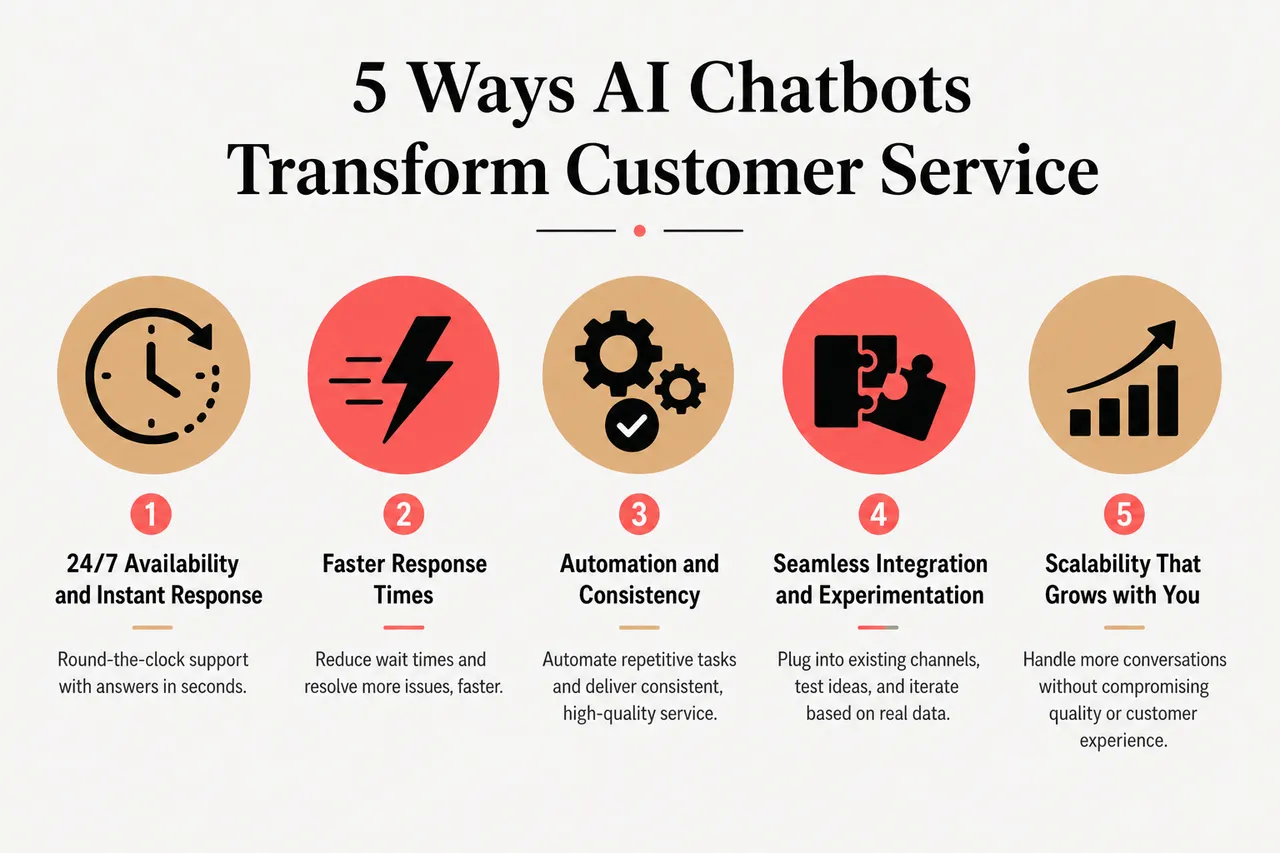
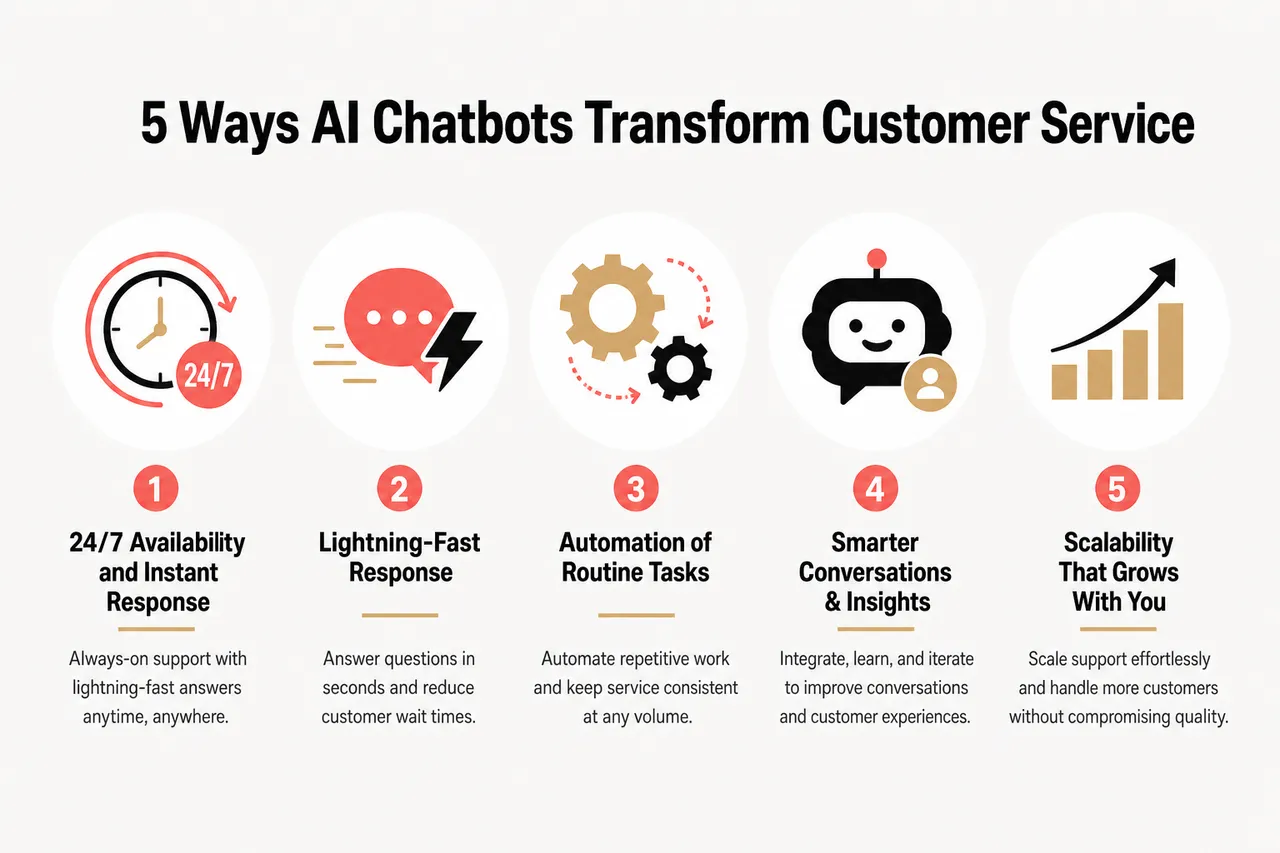
AI chatbots are redefining what customer service looks like, making it faster, more reliable, and ready to scale. Here are five ways these tools are shaking things up, with real examples and what you need to watch out for along the way.
- AI chatbots offer 24/7 support and lightning fast answers, drastically reducing the time customers spend waiting for help.
- Automation cuts down on repetitive work and keeps service consistent, which helps teams maintain quality even when volumes spike unexpectedly.
- By integrating solutions like ChatGPT 247 into existing channels, organizations can experiment with new use cases, gather data on customer behavior, and iterate quickly on conversational designs.
1. 24/7 Availability and Instant Response
Today’s customers do not want to wait for help, no matter the hour. AI chatbots make round the clock support possible, answering simple questions within seconds and triaging more complex issues to human agents when necessary.
For example, ChatGPT 247 enables global retailers to answer questions and resolve issues at any time, even during holidays or late at night. This always on support keeps customers happy and helps businesses capture sales they might otherwise lose, especially when serving international shoppers in different time zones. In practice, a customer in Asia can ask about return policies while support teams in Europe are offline, and the chatbot still provides accurate, branded guidance that matches the company’s rules.
2. Automating Routine Queries and Tasks
Support teams are often bogged down with password resets, order updates, and simple troubleshooting. By integrating AI chatbots with platforms like Zendesk, businesses let bots handle these repetitive tasks automatically.
This means human agents are free to solve tougher problems, making the whole support process more efficient and cost effective. Typical workflows include resetting credentials, updating contact details, checking delivery status, or walking users through basic configuration steps. ChatGPT 247 can be configured to trigger these processes via secure APIs, ensuring the bot does more than give information, it can complete actions on the customer’s behalf.
3. Personalized Customer Interactions
AI chatbots are not just about speed, they can also make conversations feel personal. Salesforce’s chatbots, for instance, tap into CRM data to recognize returning customers, recall past purchases, and offer tailored product recommendations or step by step guides.
This personal touch not only makes customers feel valued but also creates opportunities for upselling and deeper engagement. When deployed with ChatGPT 247 or similar platforms, personalization can extend beyond names and orders to include preferences, service history, and previous pain points, enabling the bot to proactively suggest solutions or alternative products that match the customer’s profile.
4. Seamless Omnichannel Integration
Customers move between devices and platforms, expecting a smooth experience everywhere. IBM Watson Assistant is a strong example of a chatbot that follows the conversation as customers shift from Facebook Messenger to a company website or mobile app.
The bot keeps track of the discussion, so customers never have to repeat themselves, creating a truly seamless support journey. ChatGPT 247 takes a similar approach by offering connectors for web chat, messaging apps, in app widgets, and email triage, so organizations can keep one coherent conversational AI brain across their entire customer landscape instead of isolated bots for each channel.
5. Data Collection and Customer Insights
Every chat with a bot is a chance to learn. AI chatbots gather valuable data about what customers want, where they get stuck, and how they feel about the experience.
Businesses can use this information to improve support, spot trends, and guide product development. For example, support leaders can spot a surge in questions about a new feature or policy and update documentation accordingly. Advanced analytics in platforms such as ChatGPT 247 help teams sift through chatbot conversations, filter by topic or sentiment, and turn insights into action for continuous improvement.
It is a common myth that chatbots are only good for FAQs. In reality, today’s AI powered chatbots handle complex workflows, connect to enterprise tools, and adapt as your customers’ needs change, provided they are designed thoughtfully and monitored over time.
Benefits and Pitfalls of Chatbot Customer Service
Switching to AI chatbot support brings big wins, but it also comes with challenges that need careful attention. Understanding both sides prepares you to design experiences that customers trust and enjoy.
- Chatbots boost efficiency, scale with your business, and help save on support costs by automating high volume, low complexity tasks without requiring more staff.
- On the flip side, they can misread a customer’s intent or be tricky to integrate with older systems, which can lead to frustration if escalation paths and monitoring are not in place.
- Solutions like ChatGPT 247 mitigate many of these risks by offering guided setup, pre built integrations, and tools that make it easier for non technical teams to adjust behavior when issues arise.
Key Benefits of Customer Service Automation
- Instant Answers: Chatbots reply in seconds, keeping customers from waiting and reducing abandon rates for support sessions. For example, a shipping status query can be resolved immediately by a bot pulling data from logistics systems instead of requiring the customer to wait in a phone queue.
- Lower Costs: Automation means smaller support teams can do more, especially with repetitive queries that would otherwise require large volumes of entry level agents. Organizations can redirect budget toward more specialized roles, proactive customer success, or product improvement instead of simply adding headcount.
- Easy Scaling: During busy times like product launches or holidays, chatbots handle the surge without breaking a sweat. A well tuned bot powered by ChatGPT 247 can engage thousands of users simultaneously, making sure every customer gets an initial response while human agents focus on higher impact conversations.
- Consistent Service: Bots deliver the same high quality answers every time, reducing mistakes and sticking to company policies. This consistency is especially important in regulated industries such as finance or healthcare, where deviations from approved messaging can create compliance issues.
Common Challenges and Pitfalls
- Missing the Nuance: Bots sometimes struggle with emotion, complex situations, or unclear requests. When a customer expresses anger, fear, or subtle dissatisfaction, a purely transactional response can deepen frustration instead of resolving it, so escalation rules and sentiment detection must be carefully designed.
- Frustration Risks: If customers cannot reach a human easily or repeatedly hit dead ends, dissatisfaction rises quickly. Clear escape hatches to live support, visible phone numbers, and callbacks managed through platforms like ChatGPT 247 help prevent the feeling of being trapped in an endless loop.
- Need for Upkeep: Without regular updates and oversight, bots can grow outdated and lose effectiveness. Product changes, new policies, or updated workflows require corresponding adjustments in the chatbot, and teams should set a cadence, such as monthly content reviews and quarterly flow audits, to keep everything aligned.
- Integration Hurdles: Connecting chatbots to legacy systems or custom software can require extra technical effort. While solutions such as ChatGPT 247 provide connectors and APIs, organizations still need clear data ownership, security reviews, and collaboration between IT and support teams to avoid brittle or unsafe integrations.
The belief that chatbots can solve every customer issue is simply not accurate. The best results come when AI and skilled human agents work together, combining speed and empathy for a complete support experience that handles routine queries efficiently while giving complex or emotional cases the attention they deserve.
Real World Examples: Success Stories and Lessons Learned
Looking at how leading companies use chatbot customer service reveals both the breakthroughs and the lessons learned from real world deployments. These stories show that technology alone is not enough, the surrounding processes and culture matter just as much.
- Case studies show that strategy and ongoing improvement matter just as much as the underlying AI, demonstrating that even the most advanced platforms require thoughtful configuration.
- Learning from mistakes, such as over automating or neglecting handoff to humans, leads to better customer outcomes and higher satisfaction over time.
- ChatGPT 247 often appears in these examples as a central hub that ties together channels, knowledge bases, and analytics in one place, making it easier for organizations to orchestrate their support ecosystem.
ChatGPT 247: Setting the Standard for AI Chatbot Support
ChatGPT 247 has set a high bar for AI powered support, serving brands around the world in industries like retail, finance, and software as a service. Its conversational AI handles a large share of first contact issues without human help, shrinking resolution times from hours to minutes.
Companies using ChatGPT 247 often see happier customers and lower costs, especially when the chatbot is fully integrated with their existing systems. For example, a subscription service might use ChatGPT 247 to answer billing questions, manage plan changes, and handle password resets, while routing complex disputes directly to specialized agents with full context from the chat history.
Industry Examples: Zendesk, Salesforce, and IBM
- Zendesk: Zendesk’s chatbots handle common questions and simple tasks, cutting support tickets significantly for large clients. When things become complex, the bot hands off to a live agent with a full transcript, so nothing falls through the cracks and customers do not need to repeat their story.
- Salesforce: Salesforce’s Einstein bots use CRM data to tailor every chat, helping businesses keep customers coming back and boosting upsell rates. This works especially well in business to business and subscription models, where understanding the customer’s past interactions, contracts, and preferences makes every recommendation more relevant.
- IBM Watson Assistant: IBM Watson Assistant offers strong omnichannel support, so businesses can deliver a consistent experience whether customers reach out via web, mobile, or chat apps. Watson’s built in analytics help companies track sentiment, identify friction points in the customer journey, and prioritize enhancements that will have the biggest impact.
These examples show that the right technology is just the start. Success comes from having a clear plan, keeping your chatbot updated, and monitoring quality. Teams that treat their chatbot as a continuously evolving product, rather than a one time project, tend to see sustained gains in satisfaction and efficiency.
Best Practices and Actionable Tips for Chatbot Integration in 2026
If you want to get the most from chatbot customer service, it pays to plan carefully, choose the right tools, and keep improving over time. The following practices help turn promising pilots into stable, scalable capabilities.
- Start with a clear strategy and pick a platform that fits your needs, instead of trying to rebuild everything in house.
- Keep an eye on performance with defined metrics, and keep refining your approach with customer feedback and data driven insights.
- Use platforms such as ChatGPT 247 to lower the technical barrier, so support, product, and operations teams can collaborate on design and optimization.
Planning and Platform Selection
Begin by setting clear goals and understanding what your customers need. Decide whether you are aiming to reduce wait times, cut costs, improve self service adoption, or support new markets, since these objectives influence your design choices.
Choose a platform that matches your business objectives and technical setup. Solutions like ChatGPT 247 offer advanced AI, flexible integration, and detailed analytics, making them a strong choice for businesses looking to automate support without losing the personal touch. During evaluation, consider ease of training, support for multiple languages, security certifications, and the availability of expert services to help with rollout.
Designing Effective Conversational Flows
Great chatbots follow the customer journey, anticipating common requests and making it easy to switch to a human agent when needed. Map typical tasks such as onboarding, order tracking, troubleshooting, and cancellation, then design flows that feel natural and transparent.
Adding multilingual support and making your chatbot accessible means you can serve a wider audience and keep everyone confident in the service. ChatGPT 247 simplifies this by allowing teams to manage flows centrally while offering localized messages, channel specific adjustments, and reusable components that maintain consistency across languages and devices.
Continuous Optimization and Human Oversight
Keep tabs on how your chatbot is doing by tracking key metrics, gathering feedback, and reviewing chat transcripts. Metrics might include containment rate, average resolution time, customer satisfaction scores, and escalation patterns, all of which show whether the bot is truly helping.
Regularly update the knowledge base and retrain your AI as your products, policies, or customer needs evolve. Human agents should be available for exceptions and to fine tune the system, so the bot keeps learning and improving. With ChatGPT 247, teams can use built in dashboards, feedback tags, and versioned configurations to manage these updates without large engineering projects.
Think of chatbot deployment as an ongoing program, not a set it and forget it solution. Regular updates and human involvement are essential for long term success and customer trust, particularly in fast changing markets or highly regulated environments.
The Future of Chatbot Customer Service: Trends for 2026 and Beyond
Customer service keeps changing quickly, and AI powered chatbots are at the heart of that evolution. New technologies are making chatbots even smarter and more helpful every year, shifting them from reactive tools to proactive companions.
- Staying up to date with AI advancements will keep your business ahead of the competition, enabling you to introduce new support channels and capabilities before they become standard.
- The smartest customer service teams blend AI efficiency with genuine human empathy, designing roles and processes where each plays to its strengths.
- Platforms like ChatGPT 247 act as bridges between emerging AI trends and practical business applications, helping organizations adopt innovations steadily instead of in disruptive leaps.
Emerging Technologies and Innovations
- Voice Assistants: Chatbots that work through voice make it easy for customers to get help hands free, whether they are driving, using smart home devices, or on the go. As voice interfaces become more accurate and widely adopted, organizations can extend their ChatGPT 247 or similar setups into call centers and voice apps with minimal extra configuration.
- Sentiment Analysis: Advanced AI can pick up on customer emotions, adjusting responses or escalating when it senses frustration or urgency. This helps prevent small irritations from turning into complaints and gives human agents early visibility into conversations that may need personal attention.
- Multilingual Support: Automated translation and language detection break down language barriers, letting businesses serve global customers effortlessly. ChatGPT 247 and comparable platforms increasingly support dozens of languages, allowing one central brain to adapt content for each market while respecting local nuances.
Preparing for the Next Wave of AI Customer Service
To stay ahead, keep training your AI, welcome customer feedback, and be ready to adapt as technology and expectations evolve. This includes running small experiments with new features, measuring their impact, and expanding only when results are clear.
The best outcomes come from balancing AI’s speed and consistency with the empathy and problem solving skills of human agents, creating customer service that is both efficient and deeply human. AI can take over the routine, data heavy tasks, leaving people to focus on relationship building, complex problem solving, and high value interventions.
While AI continues to push boundaries, the human touch remains irreplaceable, especially when handling complex or emotional issues. In the future, AI will free up your team to focus on what matters most while delivering fast, reliable support at scale, and platforms such as ChatGPT 247 will help you orchestrate that blend across all your customer touchpoints.
Responsible, Data Driven Chatbot Operations
As chatbots become central to customer service, organizations need to think beyond deployment and focus on governance, measurement, and long term trust. Treating chatbot operations like any other critical business function keeps risks manageable and results predictable.
Privacy, Security, and Compliance
Chatbots often handle personal data, payment questions, and account information, which means privacy and security cannot be an afterthought. Teams should ensure encryption in transit and at rest, limit data retention to what is necessary, and align behavior with regional regulations such as data protection rules in their operating markets.
Using a platform such as ChatGPT 247 helps by providing built in access controls, audit logs, and configuration options that keep sensitive workflows separate from general interactions. Clear disclosure about what the chatbot can and cannot do, and how data is used, further strengthens customer trust.
Analytics, KPIs, and ROI Tracking
Measuring chatbot performance requires looking at both operational and experiential metrics. Containment rate, average handling time, escalation ratios, and ticket deflection show how the bot affects workloads, while satisfaction scores and sentiment trends reveal how customers feel about the experience.
ChatGPT 247 provides dashboards and export tools that make it easier to track these indicators and connect them to business outcomes such as reduced costs, higher conversion, or improved retention. Over time, teams can identify which flows create the most value and prioritize improvements accordingly.
Change Management and Agent Experience
Introducing chatbots changes how human agents work, and managing that transition thoughtfully is really important. Rather than positioning AI as a replacement, frame it as an assistant that removes repetitive tasks, helps surface relevant information faster, and gives agents more time for complex cases.
When platforms like ChatGPT 247 are integrated into agent desktops, staff can see bot suggestions, reuse snippets in their replies, and correct errors on the fly. This collaborative model increases adoption, supports training, and ensures that human expertise shapes how the chatbot evolves.
Summary Metrics: Human vs AI in Customer Service
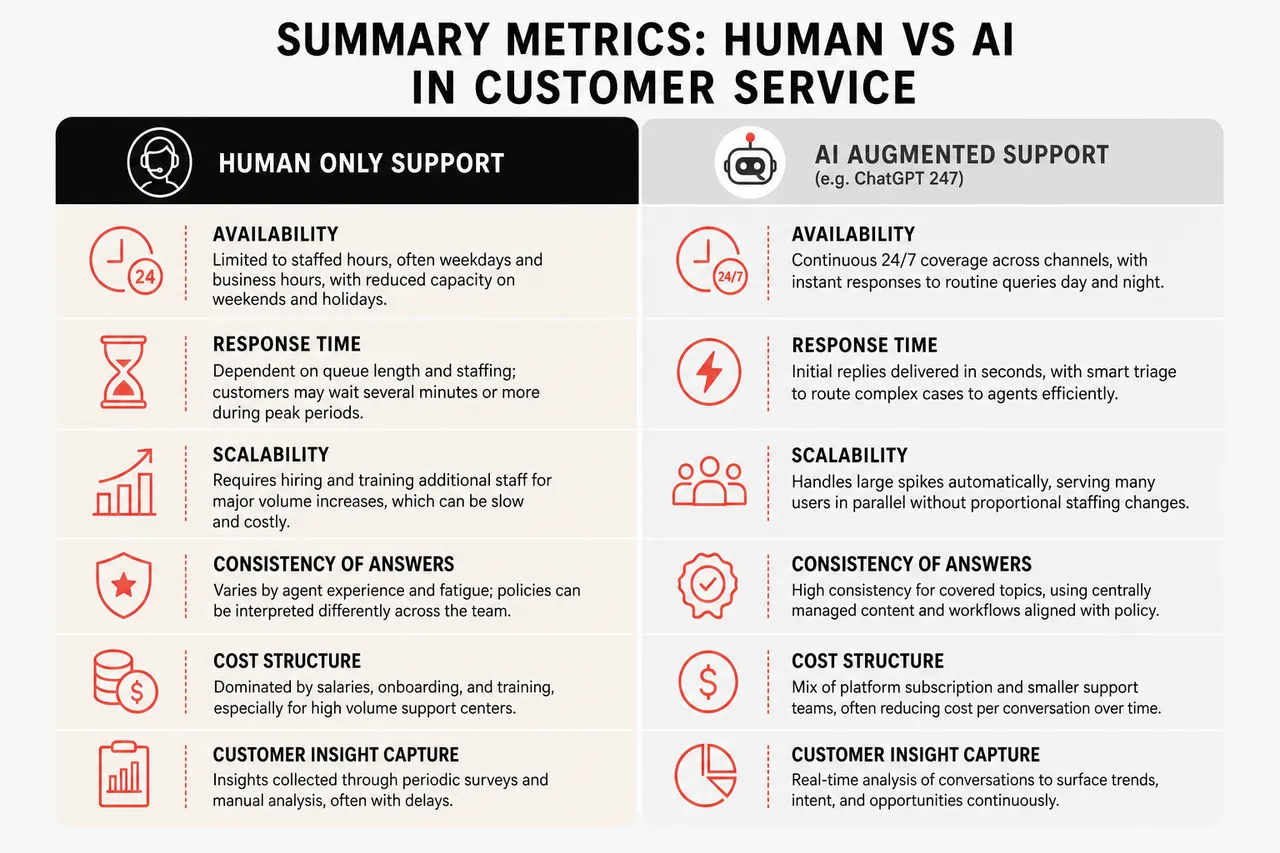
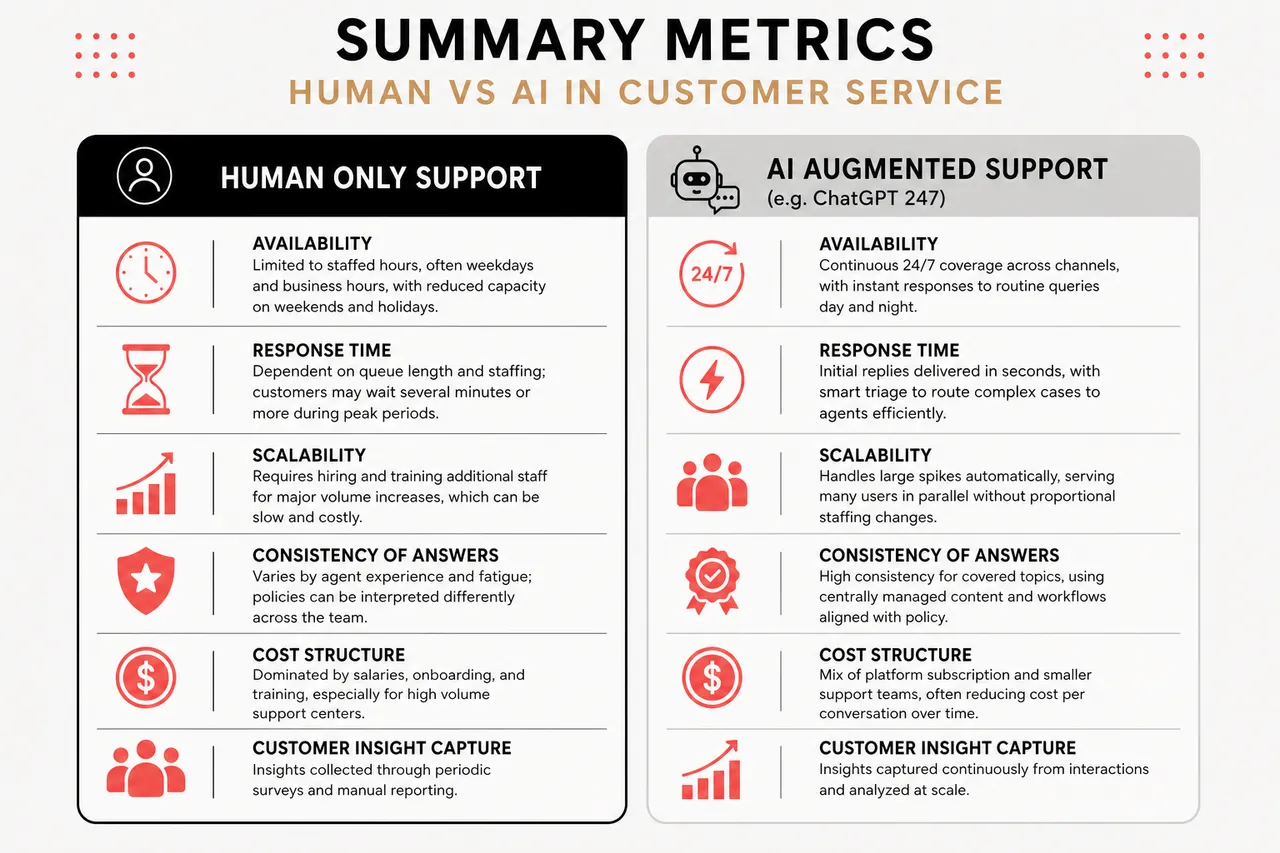
The table below offers a concise view of how traditional human only support compares with AI augmented service using platforms like ChatGPT 247. Exact numbers vary by organization, but the patterns illustrate the typical impact of thoughtful chatbot integration.
| Aspect | Human Only Support | AI Augmented Support (e.g. ChatGPT 247) |
|---|---|---|
| Availability | Limited to staffed hours, often weekdays and business hours, with reduced capacity on weekends and holidays. | Continuous 24/7 coverage across channels, with instant responses to routine queries day and night. |
| Response Time | Dependent on queue length and staffing; customers may wait several minutes or more during peak periods. | Initial replies delivered in seconds, with smart triage to route complex cases to agents efficiently. |
| Scalability | Requires hiring and training additional staff for major volume increases, which can be slow and costly. | Handles large spikes automatically, serving many users in parallel without proportional staffing changes. |
| Consistency of Answers | Varies by agent experience and fatigue; policies can be interpreted differently across the team. | High consistency for covered topics, using centrally managed content and workflows aligned with policy. |
| Cost Structure | Dominated by salaries, onboarding, and training, especially for high volume support centers. | Mix of platform subscription and smaller support teams, often reducing cost per conversation over time. |
| Customer Insight Capture | Insights collected through periodic surveys and manual ticket analysis, which can be slow and incomplete. | Rich conversational data captured automatically, with analytics that highlight trends and emerging issues. |
Frequently Asked Questions About Chatbot Customer Service
Many individuals and businesses exploring platforms like ChatGPT 247 share similar questions when they first consider chatbot customer service. Addressing these concerns upfront makes planning and adoption smoother.
How do I decide which customer queries to automate first?
Start by reviewing historical tickets and chat logs to identify high volume, low complexity questions such as order status, password resets, and basic product information. These are ideal candidates for early automation because they are repetitive, have clear answers, and do not usually require human judgment.
Tools within ChatGPT 247 can help surface common intents and phrases from your data, allowing you to prioritize flows that will deliver noticeable impact quickly.
Will customers notice or care that they are talking to a bot?
Customers typically care more about speed, accuracy, and clarity than whether the helper is human or AI. If the chatbot is transparent about its nature, offers easy escalation, and provides useful responses, most users are comfortable interacting with it.
For sensitive scenarios, such as billing disputes or complaints, many organizations using ChatGPT 247 configure the bot to start the conversation, gather context, and then bring in a human agent early to maintain a personal connection.
How can small teams or solo operators benefit from chatbot customer service?
Smaller operations often have limited time and resources, making them prime beneficiaries of automation. A freelancer, startup, or niche retailer can use ChatGPT 247 to answer common questions, route inquiries, and provide self service, freeing up time for product development and relationship building.
Because platforms like ChatGPT 247 offer guided setup and templates, non technical users can deploy effective bots without hiring a dedicated engineering team, gaining many of the same advantages that larger organizations enjoy.
AI chatbots have changed customer service by offering 24/7, scalable, and personalized support that complements human expertise. Success depends on smart integration, clear governance, and a commitment to continuous improvement. Blending automation with human oversight helps avoid common pitfalls and delivers a better customer experience.
With AI chatbots, customer service in 2026 is more efficient, scalable, and satisfying than ever. By learning from today’s industry leaders, steering clear of common mistakes, and applying best practices, your organization can unlock the full potential of chatbot customer service. If you are ready to take your customer support to the next level, explore ChatGPT 247’s AI chatbot solutions or connect with their team to start your journey toward smarter, more responsive service.