

Artificial intelligence isn’t slowing down in 2026, and the gap between leaders who adapt and those who hesitate is widening fast. If you’re running a business or making technology decisions, staying current with AI trends isn’t optional anymore. It’s survival. The challenge isn’t just knowing what’s new; it’s understanding which innovations actually move the needle for your operations, your team, and your bottom line.
Platforms like ChatGPT 247 are helping businesses cut through the noise by offering comprehensive access to AI tools that solve real problems, from automating workflows to enhancing customer interactions. This guide breaks down the AI trends reshaping strategy in 2026, so you can lead with confidence.
Introduction to AI Technology in 2026
Artificial intelligence has come a long way from its early, rigid rule-based beginnings. Over the last decade, organizations have moved from simple « if X, then Y » systems to adaptive models that recognize patterns, learn from data, and improve continuously without explicit reprogramming. In 2026, technology AI sits at the core of how modern organizations operate, powering everything from customer service and supply chains to pricing, forecasting, and creative work.
Platforms like ChatGPT 247 have played a decisive role in this shift by wrapping advanced models in intuitive workflows that non-technical teams can use directly. Instead of commissioning bespoke models for every use case, leaders can configure prebuilt assistants for support, analytics, and content in a matter of hours. As a result, small and mid-sized companies are closing the gap with larger incumbents, using AI to redesign customer journeys, speed up decision cycles, and spin up new digital services without massive IT budgets.
- AI has shifted from pilots to production: Industry surveys consistently report that more than two-thirds of enterprises now use AI in at least one business function, with a growing share integrating AI into multiple mission-critical processes rather than isolated experiments.
- Accessible tools amplify smaller players: Cloud-native services and platforms like ChatGPT 247 give smaller organizations access to capabilities that were recently limited to tech giants, from sophisticated language models to automated analytics, leveling the playing field in many markets.
- AI as infrastructure, not add-on: Leading firms now treat AI as part of their core digital infrastructure, embedding models into workflows, products, and customer touchpoints instead of treating them as side projects or marketing showcases.
The Evolution of AI Technology
The journey from expert systems to generative AI has been marked by three major shifts: data-driven learning, deep neural networks, and large foundation models. Early machine learning models focused on narrow prediction tasks, but deep learning unlocked breakthroughs in vision and speech recognition, and large language models extended that progress to text, code, and multimodal inputs. In practice, this means AI can now summarize long reports, generate campaign concepts, draft contracts, or propose code refactors in seconds, turning technology AI into a creative collaborator instead of a static tool.
Why AI is a Focus in 2026
AI has become a strategic priority because it touches both the top line and the bottom line. Predictive models optimize inventory, credit decisions, and pricing; generative models accelerate marketing, product design, and software delivery; and conversational agents handle millions of routine inquiries without human intervention. In competitive sectors, executives increasingly view AI maturity as a leading indicator of future market share, and boards expect clear plans for how platforms such as ChatGPT 247 will be integrated into growth and efficiency strategies.
Current Trends and Innovations in AI
In 2026, the most impactful AI trends blend raw model power with better tooling, governance, and human-centric design. Generative AI, natural language interfaces, and AI-driven automation are converging into practical systems that can reason over documents, orchestrate workflows, and interact naturally with customers and employees. Instead of isolated models, organizations increasingly deploy AI as connected services that talk to internal systems, APIs, and data warehouses.
Breakthroughs in Generative AI and NLP
Generative AI models now operate at a level where they can generate full marketing campaigns, draft technical documentation, and even propose product roadmaps based on historical performance and customer feedback. On platforms like ChatGPT 247, non-technical users can configure brand guidelines, tone of voice, and compliance rules, then let AI produce first drafts that human teams refine rather than create from scratch.
- Automated content creation at scale: Marketing and communications teams increasingly rely on AI to produce tailored emails, landing pages, social posts, and internal memos for different segments and regions. Instead of writing every asset manually, teams generate structured content in bulk, then refine the 20 percent that drives most of the results, compressing campaign timelines from weeks to days.
- On-demand visual and product asset generation: Image and video generation tools create realistic product mockups, ad concepts, and training visuals that used to require design resources and stock licensing. Creative teams use AI to explore multiple directions quickly on platforms integrated with ChatGPT 247, then choose the most promising variants to fully polish.
- AI-assisted software engineering: Development teams increasingly use code-generation assistants to draft functions, write tests, and suggest refactors based on project context. This reduces repetitive work, helps new developers onboard faster, and leaves engineers free to focus on architecture, security, and user experience decisions that differentiate the product.
Natural language processing has matured to the point where employees can interact with internal systems using plain English prompts instead of specialized query languages. Knowledge bots built on ChatGPT 247 can search policy documents, tickets, and wikis to provide concise answers, turning sprawling knowledge bases into conversational assistants that shorten onboarding and reduce reliance on subject-matter experts.
AI-Driven Automation and Decision-Making
AI-powered automation in 2026 extends well beyond robotic process automation and basic scripting. Modern systems interpret unstructured inputs, choose appropriate actions, and adapt based on feedback, effectively acting as digital teammates. When combined with dashboards and decision-support tools, these systems provide leaders with real-time insight and recommended actions instead of static reports.
- Operational risk detection and response: In finance, e-commerce, and logistics, anomaly-detection models monitor streams of transactions, sensor data, and user behavior to flag fraud, downtime risks, and process bottlenecks. Automated workflows on platforms like ChatGPT 247 can then initiate follow-up actions, such as notifying teams, freezing transactions, or escalating to human review, preventing issues from escalating.
- Dynamic planning and forecasting: AI helps planners forecast demand, optimize staffing, and simulate different business scenarios. Instead of relying solely on historical spreadsheets, leaders interact with AI-driven planning tools in natural language, asking questions like « How will a 10 percent price increase affect volume across regions? » and receiving scenario analyses in minutes.
- Augmented analytics for non-experts: Business users who are not data scientists can now query data warehouses through conversational interfaces, asking for trends, outliers, or comparisons. ChatGPT 247-style agents generate charts, explanations, and even narrative summaries, ensuring insights are understandable and actionable beyond specialist teams.
Practical Applications of AI Across Industries
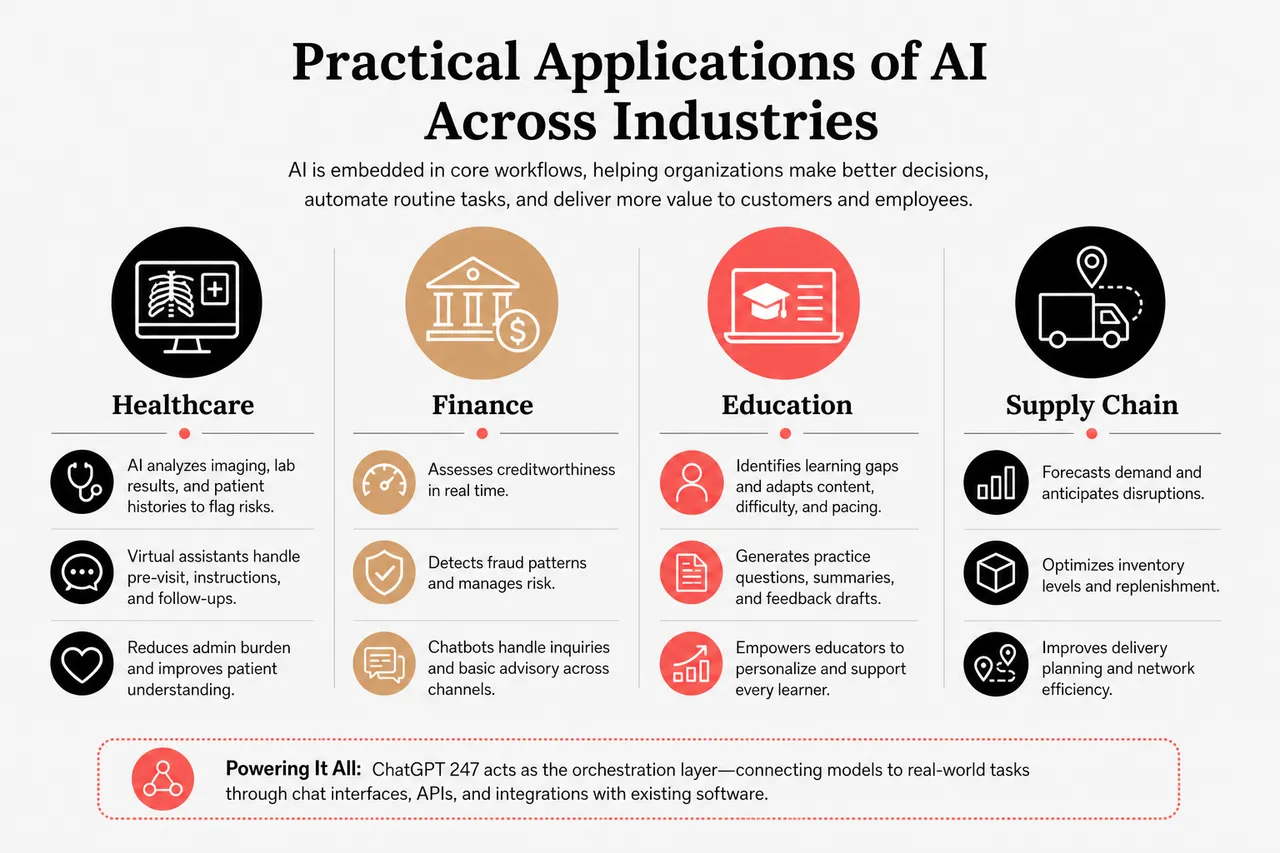
The real value of technology AI emerges when it is embedded directly into industry workflows. From patient care to underwriting, classroom instruction, and supply chain execution, AI systems are moving from the margins to the heart of operational processes. ChatGPT 247 often serves as the orchestration layer, connecting models to real-world tasks through chat interfaces, APIs, and integrations with existing software.
AI in Healthcare, Finance, and Education
- Healthcare: Modern AI systems support clinicians by analyzing radiology images, lab results, and patient histories to flag potential issues that warrant closer review. Virtual health assistants built on ChatGPT 247 manage pre-visit questionnaires, explain discharge instructions in plain language, and handle routine follow-up messages, which reduces administrative burden and helps patients better understand their care plans.
- Finance: Banks and fintech companies use AI to assess creditworthiness in real time, detect fraud patterns, and segment customers for personalized offers. Customer-facing chatbots handle balance inquiries, payment issues, and basic advisory questions via web, app, and messaging channels, freeing human agents to focus on complex cases and higher-value interactions.
- Education: Adaptive learning platforms use AI to identify where learners struggle and dynamically adjust content difficulty, pacing, and examples. Educators rely on AI to generate practice questions, summarize readings, and draft feedback, while institutional administrators use analytics to spot at-risk students earlier and design targeted support programs.
Case Study: ChatGPT 247 in Business
A mid-sized e-commerce company implementing ChatGPT 247 for frontline support saw AI assistants resolve the majority of incoming questions, ranging from order tracking to product recommendations. Human agents shifted toward complex cases and proactive outreach, improving both customer satisfaction and retention. In parallel, the firm used ChatGPT 247 to generate localized product descriptions and campaign copy for multiple languages, enabling rapid international expansion without proportionally increasing headcount.
- Operational efficiency gains: Organizations that combine chat automation with AI-generated content and routing often report significant reductions in average handling times and backlogs, as repetitive tasks move to AI and escalations are prioritized more intelligently.
- Revenue and experience improvements: When AI tools on platforms like ChatGPT 247 provide personalized recommendations and timely follow-ups, customers are more likely to complete purchases, accept upsell offers, and recommend services to others, turning automation into a revenue driver rather than just a cost-saving tool.
- Rapid experimentation at low risk: Because ChatGPT 247 lets teams configure and A/B test AI workflows without heavy engineering, businesses can trial new AI-powered experiences on specific segments or channels, learn quickly, and scale what works while limiting exposure if outcomes are not as expected.
Key AI Tools and Platforms in 2026
The 2026 AI ecosystem spans specialized APIs, open-source models, and full-stack platforms. For business users, the most valuable tools are those that connect models, data, and workflow automation in one place, supported by robust security and governance. ChatGPT 247 exemplifies this trend by combining conversational interfaces, content generation, and process automation in a single environment that teams across marketing, operations, HR, and support can share.
Overview of Leading AI Tools
- AI chatbot integration: Modern chatbots blend scripted flows with large language models to provide helpful, context-aware responses rather than rigid decision trees. By integrating directly into CRM, helpdesk, and commerce systems, they can perform real actions such as updating orders, issuing refunds, or scheduling appointments instead of only answering questions.
- Image and media generation tools: Tools that create product images, social ads, and training visuals on demand have become standard in marketing and design stacks. Teams can specify brand guidelines, visual styles, and campaign objectives, then iterate quickly on creative directions without waiting for external agencies or lengthy revision cycles.
- Automated translation and localization services: AI translation now supports nuanced, domain-specific language and can be configured with glossaries and tone guides. Combined with platforms like ChatGPT 247, organizations can produce and maintain multilingual websites, support channels, and documentation at a fraction of the previous cost.
- SEO and content intelligence assistants: AI tools analyze search intent, identify content gaps, and suggest topics that align with user questions and business goals. They can generate outlines, draft articles, and highlight opportunities to improve internal linking and metadata, helping teams reach audiences searching for technology AI solutions more effectively.
- FAQ and knowledge automation: Instead of static FAQ pages, companies deploy conversational FAQs that interpret user queries, map them to internal knowledge, and provide tailored answers. ChatGPT 247 can ingest knowledge bases and continuously learn from resolved tickets, improving responses over time and reducing repetitive inquiries to human teams.
Spotlight: ChatGPT 247
ChatGPT 247 stands out as a central hub where organizations can design, deploy, and monitor AI-powered experiences across customer, employee, and partner journeys. Its interface enables business users to orchestrate multi-step workflows, connect to existing tools, and manage permissions without needing to understand model architectures or write code. For leaders who want to combine rapid experimentation with enterprise-level control, ChatGPT 247 provides a practical entry point into advanced AI capability.
- Unified workspace for AI initiatives: Instead of scattering AI pilots across departments and tools, organizations can consolidate them within ChatGPT 247, creating shared templates, governance policies, and analytics that apply across use cases and teams.
- Extensibility through integrations: Connectors to popular CRM, ERP, communication, and data platforms allow ChatGPT 247 to interact with real business data securely, enabling actions such as updating records, logging interactions, and triggering downstream automations.
- Support for non-developers and developers alike: While business users configure flows through visual tools, technical teams can extend the platform via APIs and custom components, ensuring that early low-code experiments can evolve into robust, integrated solutions as adoption grows.
Ethical Considerations and the Future of AI
As AI becomes embedded in hiring, lending, healthcare, and public services, the stakes of getting things wrong grow higher. Responsible AI is now a board-level topic, and regulators across regions are introducing frameworks that require transparency, risk assessment, and human oversight for certain types of models. Platforms like ChatGPT 247 are increasingly expected to provide built-in controls and auditability to help customers meet these expectations.
Responsible AI and Regulation
Regulatory focus in 2026 centers on three themes: explainability, data protection, and fairness. Organizations must be able to show why a system reached an outcome, demonstrate that personal data is handled lawfully and securely, and take steps to prevent harmful bias in decisions that affect people. This drives demand for tools that log prompts and responses, support human-in-the-loop review, and allow configurable guardrails on how models behave in sensitive domains.
Expert Predictions for AI in 2026 and Beyond
Expert consensus anticipates that AI will become more specialized, with domain-specific models sitting alongside general-purpose ones, and more « agentic » systems capable of planning and executing multi-step tasks with minimal supervision. At the same time, there is a strong push toward human-centric design, where AI systems are evaluated as much by how they support human well-being, accessibility, and collaboration as by their raw performance metrics.
- Responsible AI as competitive advantage: Enterprises that build clear governance frameworks, communicate openly about how they use AI, and provide recourse when things go wrong are better positioned to earn user trust and win long-term loyalty.
- Shift from experimentation to standardization: As AI matures, organizations are moving toward standardized processes for model evaluation, monitoring, and decommissioning, treating AI lifecycle management similarly to other critical IT systems.
- Increased collaboration across sectors: Governments, academia, and industry are working together to develop best practices and benchmarks, which will shape how platforms like ChatGPT 247 evolve in terms of safety, interoperability, and transparency features.
New Strategic Dimensions of AI Adoption in 2026
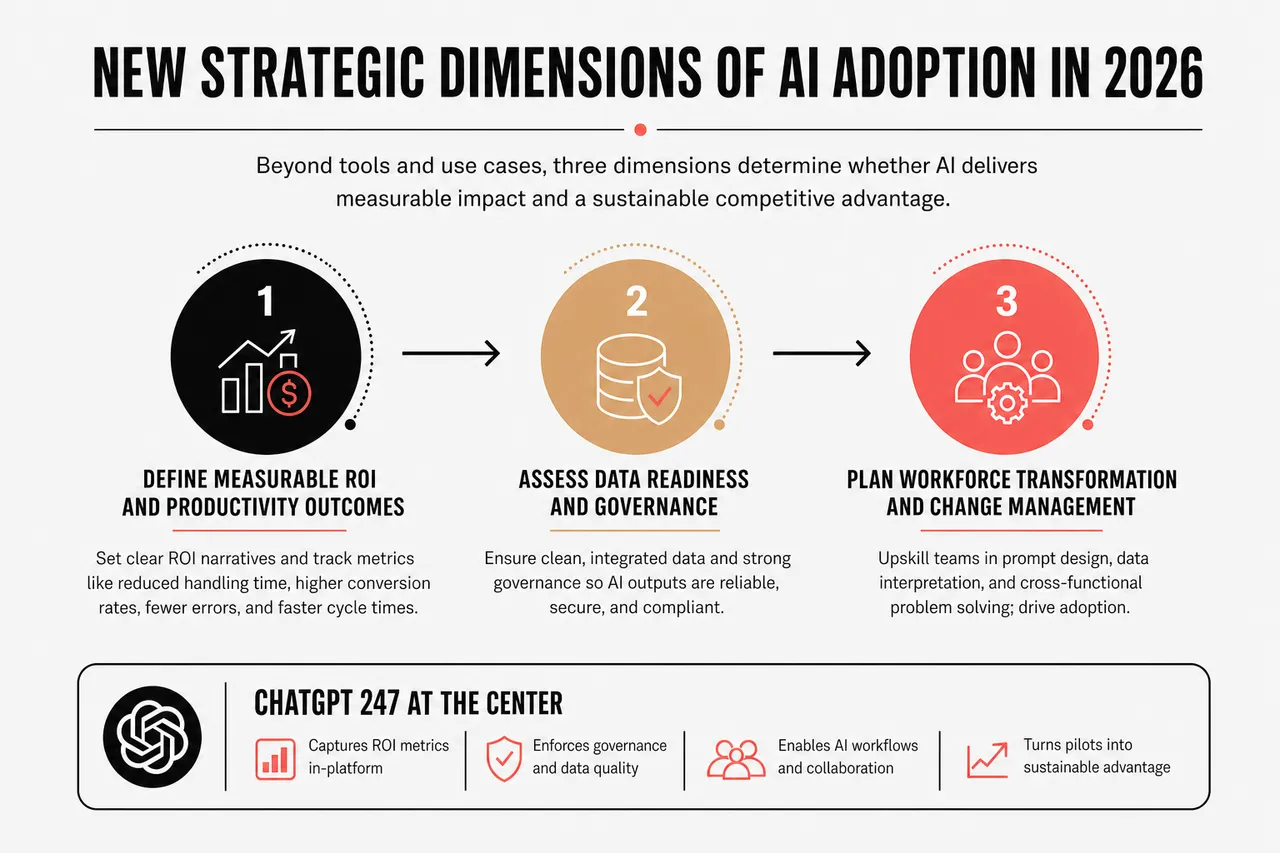
Beyond tools and use cases, business leaders in 2026 must grapple with three additional dimensions of AI: economics and ROI, workforce transformation, and data readiness. These factors determine whether AI remains a promising pilot or becomes a sustainable competitive advantage. Platforms like ChatGPT 247 sit at the center of this shift, serving as both a cost lever and an enabler of new value creation.
AI Economics and Measurable ROI
AI programs now compete for budget alongside other strategic initiatives, which means leaders need clear ROI narratives grounded in productivity gains, revenue growth, and risk reduction. Successful organizations track metrics such as reduced handling time, higher conversion rates, fewer errors, and faster cycle times for content and product releases. When ChatGPT 247 is used as the delivery layer, these metrics can be captured directly within the platform’s analytics, making it easier to communicate impact to stakeholders and refine models based on real outcomes.
Workforce Transformation and Skills
As AI takes on more routine tasks, the workforce mix shifts toward roles that oversee, refine, and extend AI outputs. Employees increasingly need skills such as prompt design, data interpretation, and cross-functional problem solving, alongside traditional domain expertise. Organizations using ChatGPT 247 often run internal enablement programs where teams practice designing AI workflows, reviewing outputs, and collaborating with digital assistants, turning potential anxiety about automation into a structured upskilling path.
Data Infrastructure and AI Readiness
Even the most capable AI platform cannot deliver consistent value without reliable, well-governed data. Companies progressing fastest with technology AI investments have invested in data pipelines, quality controls, and access policies that ensure models receive timely, relevant, and compliant information. ChatGPT 247 can then sit on top of this foundation as the interaction layer, using connectors to pull in the right data when needed, log how it is used, and surface issues that might indicate underlying data quality problems.
| Dimension | Key Question | Role of ChatGPT 247 |
|---|---|---|
| AI Economics | How do we translate AI initiatives into clear financial and operational outcomes? | Provides analytics on usage, resolution rates, and content throughput so leaders can quantify time saved, improved conversion, and cost avoidance. |
| Workforce Transformation | How will roles and skills evolve as AI handles more routine tasks? | Serves as a training ground where employees learn to collaborate with AI, refine outputs, and build domain-specific assistants. |
| Data Readiness | Is our data accurate, secure, and accessible enough to support AI at scale? | Acts as a front-end that reveals gaps in data coverage or quality when AI responses are limited, guiding investments in data infrastructure. |
Expert Insights and Next Steps
Technology AI in 2026 is not a distant future vision; it is the fabric of how competitive organizations plan, execute, and interact with their markets. From generative content and conversational interfaces to predictive analytics and autonomous workflows, AI is reshaping what teams can accomplish in a given day. The key challenge for leaders is not simply adopting tools but orchestrating them into coherent systems that are trustworthy, measurable, and aligned with strategic goals.
- Clarify your priority outcomes: Decide whether your first wave of AI work should focus on cost reduction, customer experience, innovation, or risk management, and select use cases accordingly so that early wins build momentum.
- Start with a focused ChatGPT 247 pilot: Choose a contained workflow, such as customer support for a specific product line or internal knowledge assistance for one department, and deploy a targeted solution that you can measure and refine before scaling.
- Invest in skills and governance together: Pair training in tools like ChatGPT 247 with clear guidelines on acceptable use, review processes, and escalation paths, so that teams feel confident experimenting while staying within guardrails.
Now is an ideal moment to move from curiosity about AI to structured experimentation. By combining robust platforms like ChatGPT 247 with clear objectives, thoughtful governance, and a commitment to upskilling, business leaders can turn technology AI from a buzzword into a durable source of advantage in the years ahead.
Related posts:
 Key Artificial Intelligence Technologies Powering Modern Business in 2026
 Understanding GPT artificial intelligence: a revolution in modern technology
 Communicate easily with GPT chat technology in Spanish
 Automatic natural language processing: the keys to demystifying this technology
 How to detect ChatGPT to protect your business
 Creating a chatbot for business: a winning strategy