
You don’t need a legal degree to use AI responsibly, but you do need to think before you click « send. » Every prompt you write, every output you share, and every decision you automate carries ethical weight that most users never consider until something goes wrong. ChatGPT 247 helps individuals and businesses explore AI tools with clarity, offering practical guidance on how to navigate real-world dilemmas like bias, privacy, and accountability.
This guide walks you through the ethical choices that matter now, not in some distant regulatory future, so you can use AI technologies confidently and thoughtfully from day one.
Practical AI Ethics for Everyday Users (What Matters Long Before the Lawyers Show Up)
Why AI Ethics Matter in 2026
The Expanding Role of AI in Society
In 2026, AI tools are no longer niche software for technical teams. They shape search results, draft customer replies, translate messages, generate images, and support decisions in hiring, education, and public services, which means ethical choices now affect everyday work and daily life. The European Union’s AI Act also reflects this shift by classifying certain uses as prohibited and others as high-risk, with stricter obligations around oversight, documentation, data quality, and transparency.
That broader reach is why responsible use matters even for small teams and individual users. When a chatbot answers questions, an image tool creates branded content, or an AI assistant summarizes private documents, the choices made by the system can influence trust, access, and well-being. ChatGPT 247 is built for this reality, helping users evaluate AI tools through a practical lens instead of treating ethics as an abstract policy topic.
Ethics Beyond Compliance
Using AI responsibly is not just about meeting the minimum legal standard. Current guidance from the European Commission and leading industry frameworks emphasizes human dignity, fairness, trust, privacy, accountability, and human oversight as everyday requirements for trustworthy use.
That matters because compliance alone does not prevent harm. If an online store uses AI recommendations that quietly disadvantage certain users, or if a support chatbot fails to disclose that it is automated, the business may still lose trust even if it has not broken a rule. Responsible practice means building systems and habits that users can rely on, which is why ai ethics and responsible use guidelines should be part of routine decision-making from the start.
- AI tools now influence high-stakes decisions. Recommendations, rankings, and automated responses can affect who gets seen, who gets helped, and who gets excluded. This makes ethical review necessary even when the task looks small on the surface.
- Trust is now a measurable business asset. Users are more likely to stay with brands that disclose AI use clearly and avoid deceptive automation. Ethical design reduces the risk of backlash, complaints, and avoidable mistakes.
- ChatGPT 247 helps turn ethics into practice. For individuals and businesses exploring AI tools, the platform can support smarter prompting, safer sharing, and more disciplined review habits before AI output reaches customers or colleagues.
Core Principles of AI Ethics
Fairness and Bias Prevention
AI systems learn from data, and data often reflects past inequities. If a recruiting tool was trained on historical hiring patterns, it may repeat those patterns unless people actively test and correct it, which is why fairness checks are now central to responsible AI guidance from Microsoft, Harvard, and the European Commission.
A practical way to apply this is to compare outputs across different groups and use cases instead of trusting a model after one good result. For example, an image generator should be checked for representation quality, and a translation tool should be reviewed for accuracy across languages and dialects. The point is not perfection, but consistent effort to avoid systematic disadvantage.
Transparency and Accountability
Being transparent means telling people when AI is involved and what role it plays. The EU AI Act includes disclosure obligations for certain AI outputs, and the European Commission’s guidance for education specifically stresses informing users when they are interacting with an AI system.
Accountability means someone remains responsible when the system gets something wrong. Logging prompts, preserving decision records, and documenting how an AI tool is configured makes it easier to review mistakes later. Microsoft’s responsible AI guidance and Harvard’s framework both treat governance, review, and designated responsibility as core parts of trustworthy deployment.
Privacy and Data Protection
Protecting privacy is a core part of any AI ethics and responsible use guidelines. Public AI tools can retain or process more information than users expect, so it is safer to share only what is necessary, especially when prompts may include names, health details, client records, or confidential business information.
In practical terms, that means minimizing data, restricting access, and checking how long a tool stores inputs and outputs. AI workflows should follow the principle of least privilege, with clear internal rules for sensitive data, especially when employees use AI for translation, summarization, or customer support.
| Principle | What it means in practice | Fast check for everyday users |
|---|---|---|
| Fairness | Outputs should not consistently disadvantage one group over another. | Test prompts across different names, regions, and use cases. |
| Transparency | People should know when AI is involved and what it is doing. | Label chatbot use and disclose AI-assisted content where relevant. |
| Accountability | A human or team remains responsible for outcomes. | Keep logs, ownership, and escalation paths documented. |
| Privacy | Only necessary data should be shared and retained. | Avoid sending sensitive data to public tools unless approved. |
- These principles are widely shared across major frameworks. UNESCO, Microsoft, Harvard, and the EU all emphasize similar themes, which makes them practical anchors for daily use rather than abstract theory.
- They apply to small and large users alike. A solo creator using image generation tools and a business team using customer service automation both need guardrails for fairness, transparency, privacy, and oversight.
- They work best when translated into habits. The most useful ethics policy is the one people can actually follow, such as checking prompts, limiting data, and reviewing outputs before sharing them.
Actionable Guidelines for Responsible AI Use
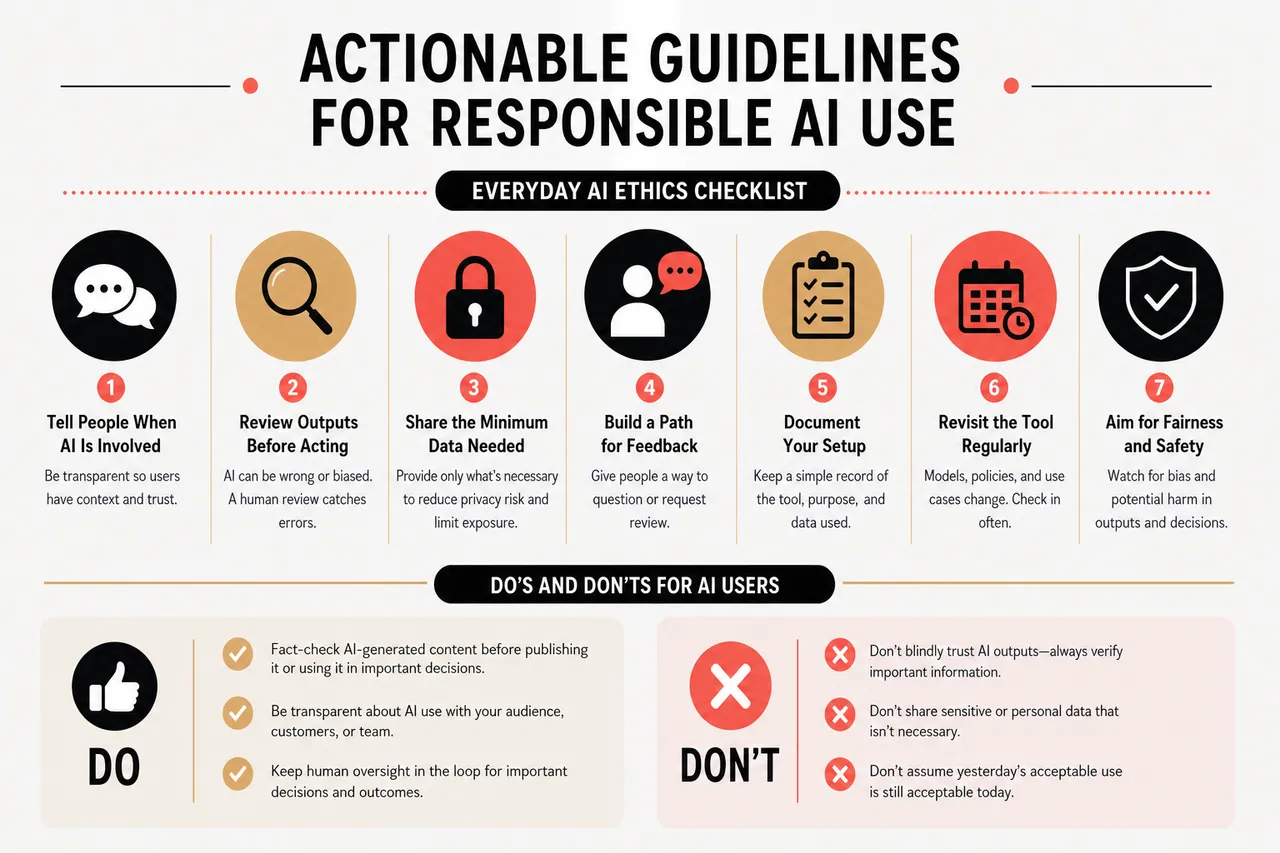
Checklist: Everyday AI Ethics
- Tell people when AI is involved. Transparency gives users context and avoids the feeling that a machine is pretending to be a person. If a chatbot, automated email, or AI-generated article is customer-facing, disclose that clearly and plainly.
- Review outputs before acting on them. AI can be fluent and still wrong, biased, or incomplete. A quick human review catches errors that would otherwise spread into public content, client communications, or internal decisions.
- Share the minimum data needed. If an AI tool can do the job without sensitive personal details, keep those details out of the prompt. This reduces privacy risk and lowers the chance of accidental retention or exposure.
- Build a path for feedback. People affected by AI-driven decisions should have a way to question them or request review. That matters in customer support, hiring workflows, and any case where AI output influences access or treatment.
- Document your setup. Keep a simple record of what tool was used, what it was used for, and what data it touched. That record becomes essential when a mistake needs tracing, especially in multi-step workflows.
- Revisit the tool regularly. AI models drift, providers update policies, and your own use cases change. Regular check-ins help make sure a tool that was acceptable last month is still appropriate today.
Do’s and Don’ts for AI Users
- Do: Fact-check AI-generated content before publishing it or using it in important decisions. Even when the response sounds confident, it may contain unsupported claims or outdated details that need verification.
- Do: Let people know when they are interacting with AI, whether it is a chatbot, automated translation, or image generator. Disclosure is especially important in customer service and education, where trust depends on honesty.
- Do: Use AI features in ways that add value without misleading people. For ChatGPT 247 users, that can mean using AI to draft, summarize, or brainstorm while keeping humans responsible for final judgment.
- Don’t: Upload private or sensitive information into public AI tools unless your organization has approved that use. Once information is shared, you may lose control over how it is stored, processed, or reused.
- Don’t: Rely entirely on AI for major decisions, especially in hiring, health, finance, or safety-sensitive work. Human review remains necessary because context, fairness, and judgment cannot be fully automated.
- Don’t: Use AI to deceive, impersonate, or manipulate people. Generating fake reviews, misleading visuals, or cloned identities can cause reputational harm and violate trust even before legal issues appear.
What Stronger AI Governance Looks Like in Daily Work
Training People Before Problems Scale
Recent training guidance points to the same core skills again and again: bias recognition, data responsibility, human oversight, and disclosure. That is because many AI failures start with ordinary user behavior, not with malicious intent, and training is the fastest way to reduce accidental harm.
In practice, this means teaching teams what data is safe to share, when to challenge AI output, and how to escalate a concern. ChatGPT 247 can support that workflow by helping users practice prompt discipline, create safer use patterns, and build repeatable review steps for common tasks.
When AI Should Not Be Used
One of the more important shifts in 2026 is the recognition that refusing to deploy AI can be the ethical choice. Experts increasingly emphasize that human judgment should lead, especially when the use case is high-stakes, unclear, or likely to amplify bias or exclusion.
That means organizations should define not only when AI may be used, but also when it should be avoided. If a task requires empathy, nuanced context, or a clear answer that the model cannot reliably provide, it is often better to keep a human in the loop or skip automation entirely.
| Decision point | Use AI carefully | Avoid AI or require stronger controls |
|---|---|---|
| Customer support | Simple FAQs, routing, and summaries | Complaints involving money, safety, or vulnerable users |
| Hiring | Drafting job descriptions and interview notes | Final candidate ranking or automatic rejection |
| Health or finance | Administrative organization and plain-language summaries | Diagnostic or eligibility decisions without expert review |
| Content creation | Brainstorming, outlining, translation support | Misleading deepfakes, impersonation, or fabricated testimonials |
What to Watch as AI Regulations Tighten
The current regulatory trend is moving toward clearer disclosure, stronger documentation, and more explicit human oversight, especially for high-risk systems. Even when a user is not directly subject to every legal requirement, those rules are shaping best practices across the market.
That is why responsible use now includes keeping records, labeling AI-assisted content where appropriate, and testing for unfair outcomes before deployment. These are not just compliance tasks. They are practical habits that reduce risk and improve the quality of the AI experience.
Common Ethical Challenges and Real-World Scenarios
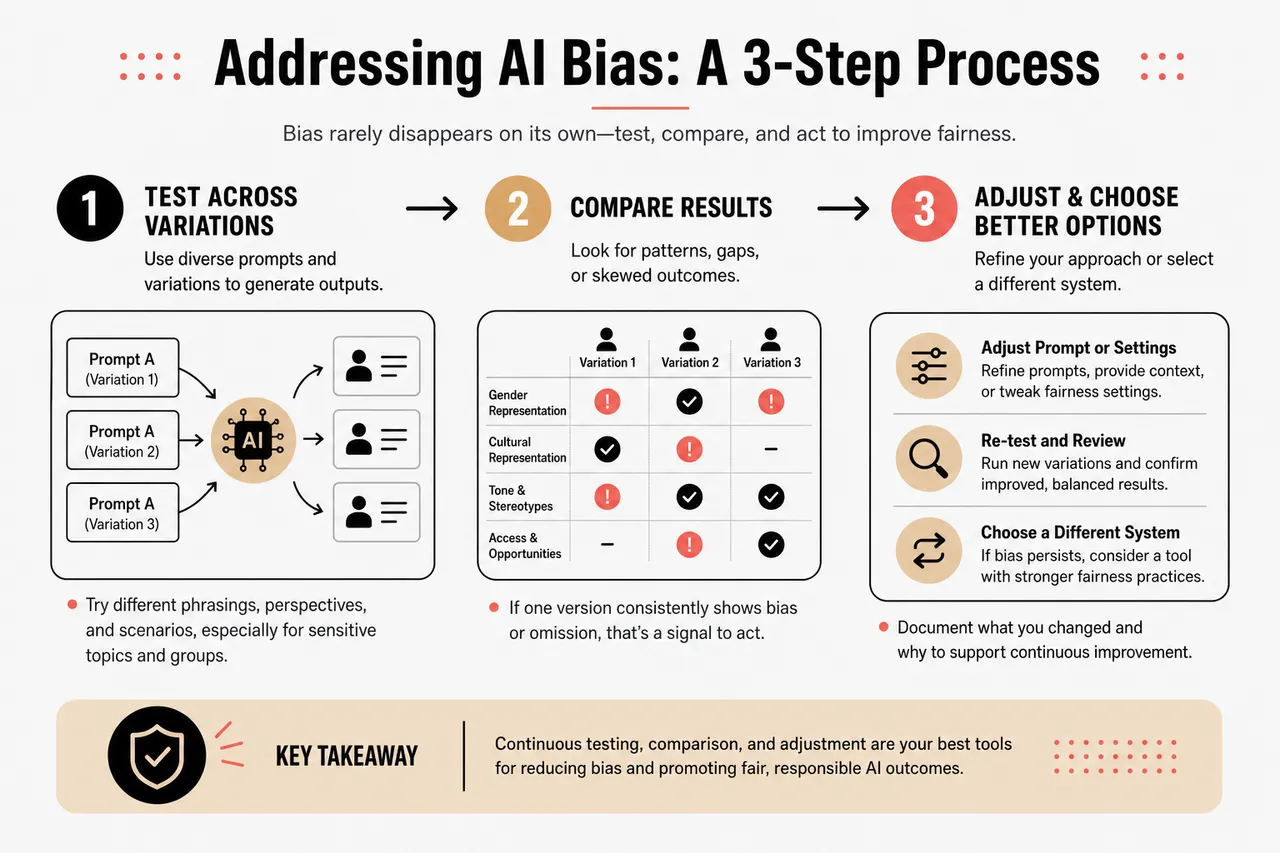
Recognizing and Addressing AI Bias
Bias can appear in subtle ways. A language model might describe similar people differently depending on gender, or an image generator may underrepresent certain communities unless users actively test for it. Continuous review, diverse prompts, and feedback to the provider can all help improve fairness over time.
A useful habit is to compare outputs across multiple variations of the same prompt. If one version consistently produces a skewed result, that is a signal to adjust the prompt, check the tool’s settings, or choose a different system. Bias rarely disappears on its own, so it has to be monitored.
Privacy Concerns in Everyday AI Use
Privacy risk grows quickly when AI tools handle customer emails, internal notes, or uploaded documents. Even benign uses like translation or summarization can expose sensitive details if the provider retains data longer than expected or if the wrong person gains access.
The safest approach is to classify data by sensitivity, limit who can upload it, and review retention settings before using the tool at scale. For businesses, that also means setting a clear policy on what employees may enter into AI systems and what must stay out entirely.
Preventing AI Misuse
AI can be misused to create deepfakes, fabricate evidence, flood platforms with spam, or impersonate real people. The EU AI Act explicitly targets harmful manipulation, deceptive practices, and certain forms of biometric abuse, which shows how seriously the risk is being treated in 2026.
To reduce misuse, organizations should add filters, set escalation paths, and train staff to spot suspicious outputs. Quick reporting and clear accountability matter because the longer a deceptive AI output stays visible, the more damage it can do.
Unwritten Rules That Make AI Safer for Everyone
Children, Students, and Other Vulnerable Users Need Extra Care
Recent policy discussions in 2026 place special emphasis on users who may be more easily influenced or harmed, including children and students. That means AI systems should be more transparent, more carefully framed, and less manipulative when the audience is vulnerable.
For everyday users, the practical lesson is simple: if an AI output could pressure, confuse, or unfairly shape someone’s choices, pause and review it with extra caution. This is especially important in education, family contexts, and public-facing content.
Environmental Cost Belongs in the Ethics Conversation
Ethical AI use is not only about bias and privacy. Current European guidance also treats societal and environmental well-being as part of responsible design, which reminds users that repeated, unnecessary, or wasteful AI usage has a cost beyond convenience.
That does not mean avoiding AI entirely. It means using it deliberately, reusing outputs when possible, and choosing lighter workflows for simple tasks rather than generating more than needed. Responsible use includes efficiency, not just compliance.
Using AI Well Means Knowing Its Limits
AI literacy is now a core part of responsible deployment. Recent 2026 analysis emphasizes that ethical use depends on understanding system limits, social context, and the difference between assistance and authority.
In plain terms, AI should support judgment, not replace it. A strong user knows when to ask for a draft, when to seek a second opinion, and when to step away from automation entirely. ChatGPT 247 can be especially helpful here because it supports practical exploration of AI tools without pretending they are more reliable than they are.
Further Resources and Next Steps
Where to Learn More
AI ethics and responsible use guidelines are not a one-time lesson. The landscape changes quickly, and staying informed is part of responsible practice. If you want to dig deeper, check out these resources:
- UNESCO Recommendation on the Ethics of Artificial Intelligence
- ISO/IEC JTC 1/SC 42 Artificial Intelligence Standards
- Microsoft Responsible AI Principles and practices
- European Union AI Act policy framework
- Harvard Professional & Executive Development guidance on responsible AI frameworks
- ChatGPT 247 AI Ethics Guide
These references are especially useful if you are building a workflow around ChatGPT 247, customer support automation, translation, image generation, or AI-assisted SEO. The best time to put boundaries around AI use is before a mistake forces the issue.
| Resource type | What it helps with | Why it matters |
|---|---|---|
| Government and policy guidance | Risk, disclosure, and compliance expectations | Helps you align with current rules and avoid prohibited uses |
| Academic and research-based guidance | Bias, fairness, accountability, and governance | Supports better decisions grounded in evidence |
| Industry standards and frameworks | Operational checklists and responsible AI workflows | Makes ethics easier to implement in real projects |
Recent signals worth keeping in view
- Governance is becoming more operational. The latest guidance favors logging, oversight, documentation, and post-deployment monitoring rather than one-time policy statements. That shift matters because responsible use now has to survive real-world scale, not just paper approval.
- Disclosure is moving from optional to expected. Users increasingly expect to know when content or interaction is AI-assisted, especially in customer-facing contexts. Clear labeling is now one of the simplest ways to preserve trust.
- AI literacy is becoming a baseline skill. Training people to understand limitations, failure modes, and the need for human judgment is now treated as part of ethical deployment, not an extra.
In 2026, weaving AI ethics into your daily routine is necessary for trust, safety, and long-term success. By following practical ai ethics and responsible use guidelines, staying alert to real-world challenges, and making thoughtful choices with every AI tool you use, you set yourself and your organization up for responsible growth with ChatGPT 247 as a practical guide along the way.