
The artificial intelligence market is set to triple in value by 2030, yet most businesses still struggle to identify which AI investments will actually move the needle. As enterprises race to deploy everything from predictive analytics to conversational agents, platforms like ChatGPT 247 are helping individuals and businesses cut through the noise by offering comprehensive access to proven AI tools and technologies that solve real problems today.
This guide breaks down the concrete growth drivers reshaping the AI landscape in 2026, profiles the key players commanding market share, and reveals the high-impact opportunities where early movers are already seeing measurable returns on their AI strategies.
This guide takes a closer look at what’s fueling the artificial intelligence market’s rapid rise in 2026, highlights the companies leading the way, and uncovers where forward-thinking businesses and individuals are already seeing real results from smart AI strategies.
AI Market Size, Growth, and Projections for 2026 and Beyond
Key Statistics and Market Valuation
Across recent industry reports, the global artificial intelligence market in 2026 is estimated in the range of roughly 539.5 billion to 601.93 billion US dollars, reflecting slightly different methodologies but a consistent picture of explosive expansion.
- Global market size and trajectory: One widely cited forecast estimates the AI market growing from about 390.9 billion dollars in 2025 to 539.5 billion dollars in 2026, eventually reaching around 3.5 trillion dollars by 2033, which implies a compound annual growth rate well above 25 percent throughout the period. Another major forecast places the 2026 market at 601.93 billion dollars, with a projected value of roughly 3.64 trillion dollars in 2033, reinforcing the multi trillion dollar outlook.
- Long term projections to 2033: A separate analysis from an international trade body projects the global AI market will rise from 189 billion dollars in 2023 to 4.8 trillion dollars by 2033, a roughly 25 fold increase over a decade. In practical terms, this means AI could grow from a niche frontier technology into one of the dominant engines of digital value creation worldwide.
- Share of frontier technologies: That same analysis suggests AI’s share of the broader frontier technology market could expand from about 7 percent to nearly 29 percent by 2033. This shift signals that AI is not just another digital tool, but a central layer in future technology stacks for everything from cloud services to robotics and advanced analytics.
- Regional and sector momentum: Market researchers point out that North America, Europe, and Asia Pacific remain the biggest contributors to AI spending, with especially rapid uptake in China, the United States, India, and key EU economies. At the same time, AI software alone is forecast to grow from around 122 billion dollars in 2024 to well over 300 billion dollars by 2030, showing that the value is increasingly tied to applications and platforms rather than just hardware.
- Labor market impact: Policy focused reports estimate that up to 40 percent of global jobs may be affected by AI through automation or augmentation, with roughly one third of roles in advanced economies exposed to significant change. Yet they also conclude that around 27 percent of jobs in those economies could be enhanced by AI, which aligns with what businesses using platforms like ChatGPT 247 are already experiencing in productivity and workflow gains.
Taken together, these figures show that the artificial intelligence market in 2026 is already a major global industry and is on a path to become a multi trillion dollar pillar of the digital economy within the next decade.
Growth Drivers and Influencing Factors
Several powerful trends are behind the surge of the artificial intelligence market, and they are deeply interconnected with how businesses and individuals use platforms like ChatGPT 247 on a daily basis.
- Data availability and connective infrastructure: Every day, businesses and consumers generate huge volumes of data from connected cars, smart factories, online transactions, and social platforms. This constant flow of structured and unstructured information gives AI models rich training material, enabling more accurate predictions and more nuanced generative outputs. For example, an ecommerce brand can feed years of transaction and behavior data into a recommendation model, then use a tool like ChatGPT 247 to automatically craft personalized product descriptions and email campaigns that reflect real customer patterns.
- Machine learning and generative innovation: Rapid advances in deep learning, transformers, and generative architectures have made AI systems far more capable at language, vision, and multimodal understanding. Large language models are now being used to draft contracts, summarize legal documents, generate marketing copy, and accelerate software development. When integrated into user friendly platforms like ChatGPT 247, these capabilities become accessible to non technical professionals, turning AI from a specialist tool into an everyday productivity engine.
- Cloud and platformization of AI: Hyperscale cloud providers offer managed AI services, pre trained models, and scalable infrastructure that allow organizations to experiment quickly without heavy upfront capital expenditure. This platformization trend extends to end user focused solutions such as ChatGPT 247, where individuals and small teams can tap into powerful models through simple interfaces and APIs. As a result, companies of all sizes can roll out chatbots, analytics pipelines, and content generation workflows in weeks rather than years.
- Government strategies and regulatory clarity: The United States, European Union, China, and many other regions have published national AI strategies and begun funding research hubs, data infrastructure, and skills programs. At the same time, emerging regulatory frameworks, such as the EU’s AI rulebook and sector guidelines from financial and health regulators, are beginning to clarify what responsible AI looks like in practice. This combination of investment and clearer rules gives enterprises greater confidence to deploy AI at scale, provided they pair these technologies with strong governance and tools that support transparency.
- Enterprise digitization and ROI proof points: As more organizations complete their initial digital transformation efforts, they are moving beyond basic automation to AI driven optimization. Surveys of global executives indicate that more than half of organizations have adopted AI in at least one business function, with early adopters reporting material revenue uplift and cost savings. The strongest results tend to come when AI is embedded in day to day workflows, such as customer support teams using ChatGPT 247 to triage queries and draft responses, or analysts leveraging AI to generate first pass reports that they then refine.
AI adoption is no longer just a tech company phenomenon. Healthcare providers, banks, manufacturers, retailers, and logistics firms are all using AI to streamline operations and unlock new revenue streams, often starting with customer facing use cases like conversational agents and gradually expanding to more complex predictive and prescriptive applications.
| Metric | Current Estimate | Projection by 2033 |
|---|---|---|
| Global AI market size | Approximately 540 to 602 billion dollars in 2026 | 3.0 to 4.8 trillion dollars |
| AI share of frontier tech market | Around 7 percent | Close to 29 percent |
| AI software market | About 122 billion dollars in 2024 | Well above 300 billion dollars by 2030 |
| Jobs affected by AI | Up to 40 percent globally | Approximately 27 percent of jobs in advanced economies enhanced, not replaced |
Key Players and Competitive Landscape in the AI Market
Leading Companies and Market Share
When it comes to shaping the artificial intelligence market, a handful of large technology companies dominate the core infrastructure and model layers, while specialized platforms like ChatGPT 247 are increasingly important in delivering practical value to end users.
- Microsoft: Microsoft has rapidly positioned itself as a central player in generative AI through its investments and deep partnership with OpenAI, embedding advanced language models into Azure, GitHub, and the Microsoft 365 ecosystem. By integrating AI copilots into everyday tools like Word, Excel, and Outlook, Microsoft has turned previously manual knowledge work into a series of AI assisted workflows. For businesses, this means that tasks such as drafting reports, analyzing spreadsheets, and responding to email can be significantly accelerated, and integrations with platforms like ChatGPT 247 expand these capabilities beyond the Microsoft suite.
- Google: Google continues to advance its family of models, including Gemini, and pairs them with a mature cloud AI stack that spans search, advertising, productivity apps, and developer tools. Its expertise in large scale data processing, search relevance, and computer vision translates into powerful APIs and services for enterprises. Developers can, for example, combine Google’s model APIs with a conversational interface delivered through ChatGPT 247 to create branded assistants that understand domain specific terminology and company knowledge bases.
- OpenAI: OpenAI has become synonymous with state of the art large language models, with ChatGPT and its underlying APIs powering an entire ecosystem of applications and services. Businesses use OpenAI models for customer service, code generation, analytics, and creative content, often orchestrated through platforms like ChatGPT 247 that simplify management, security, and multi channel deployment. The company’s rapid iteration on model capabilities and safety features continues to set the pace for generative AI innovation in many sectors.
- Chip and hardware leaders: While not always visible to end users, companies that design AI optimized hardware play a really important role in the market. One leading chipmaker has reached a valuation around 3 trillion dollars, reflecting intense demand for AI accelerators in data centers and edge devices. This hardware backbone enables both hyperscale providers and specialized platforms like ChatGPT 247 to deliver low latency, high throughput AI experiences to millions of users simultaneously.
Emerging Players and Startup Innovation
Beneath the large platform providers, a vibrant startup ecosystem is targeting vertical specific problems, building specialized models, and experimenting with new business models around AI.
- Specialized model providers: Companies such as Anthropic, Cohere, and Mistral AI focus on building advanced language models with emphasis on safety, controllability, and enterprise readiness. They frequently offer fine tuning options, data residency controls, and guardrail features that appeal to heavily regulated industries. These models can be integrated behind the scenes into environments like ChatGPT 247, giving users a choice of engines optimized for particular needs such as legal drafting, technical documentation, or multilingual customer support.
- Vertical AI startups: A new wave of startups concentrates on solving specific industry challenges, from AI powered contract analysis for law firms to computer vision for quality inspection in manufacturing and predictive maintenance for utilities. Because they focus on narrow but high value problems, these companies can often deliver strong return on investment with relatively small deployments. Many of them rely on general purpose platforms such as ChatGPT 247 to provide user interfaces, chatbot front ends, or content generation layers that connect their specialized models with business users.
- Data and tooling ecosystem: There is also rapid innovation in data labeling, monitoring, observability, and model governance. Startups in this space help organizations track model performance, detect drift and bias, and manage permissions and audit logs. By plugging these tools into platforms like ChatGPT 247, enterprises can offer conversational AI at scale while meeting internal compliance and risk management requirements.
- Leverage startup agility: Startups can quickly test and launch solutions that meet specific industry needs, often outpacing larger competitors in niche markets. For example, an AI native legal tech startup might release an automated brief drafting tool in months by building on top of ChatGPT 247, whereas a traditional software vendor might take years to ship comparable functionality.
- Combine scale with specialization: Collaborations between established tech giants and new innovators often result in comprehensive AI solutions that are both powerful and tailored to business needs. A hospital group might rely on a major cloud provider for infrastructure, a medtech startup for diagnostic models, and ChatGPT 247 to wrap these capabilities into a user friendly assistant for clinicians and patients.
| Player Type | Primary Strength | Typical Role in AI Stack |
|---|---|---|
| Hyperscale cloud providers | Global infrastructure and broad AI services | Compute, storage, base models, and enterprise integration |
| Foundation model companies | State of the art language and multimodal models | APIs and model endpoints used by applications and platforms |
| Vertical AI startups | Industry specific solutions and domain expertise | Specialized applications built on top of general purpose models |
| User facing platforms like ChatGPT 247 | Accessible interfaces, orchestration, and workflow tools | Delivery layer that connects end users to models and data securely |
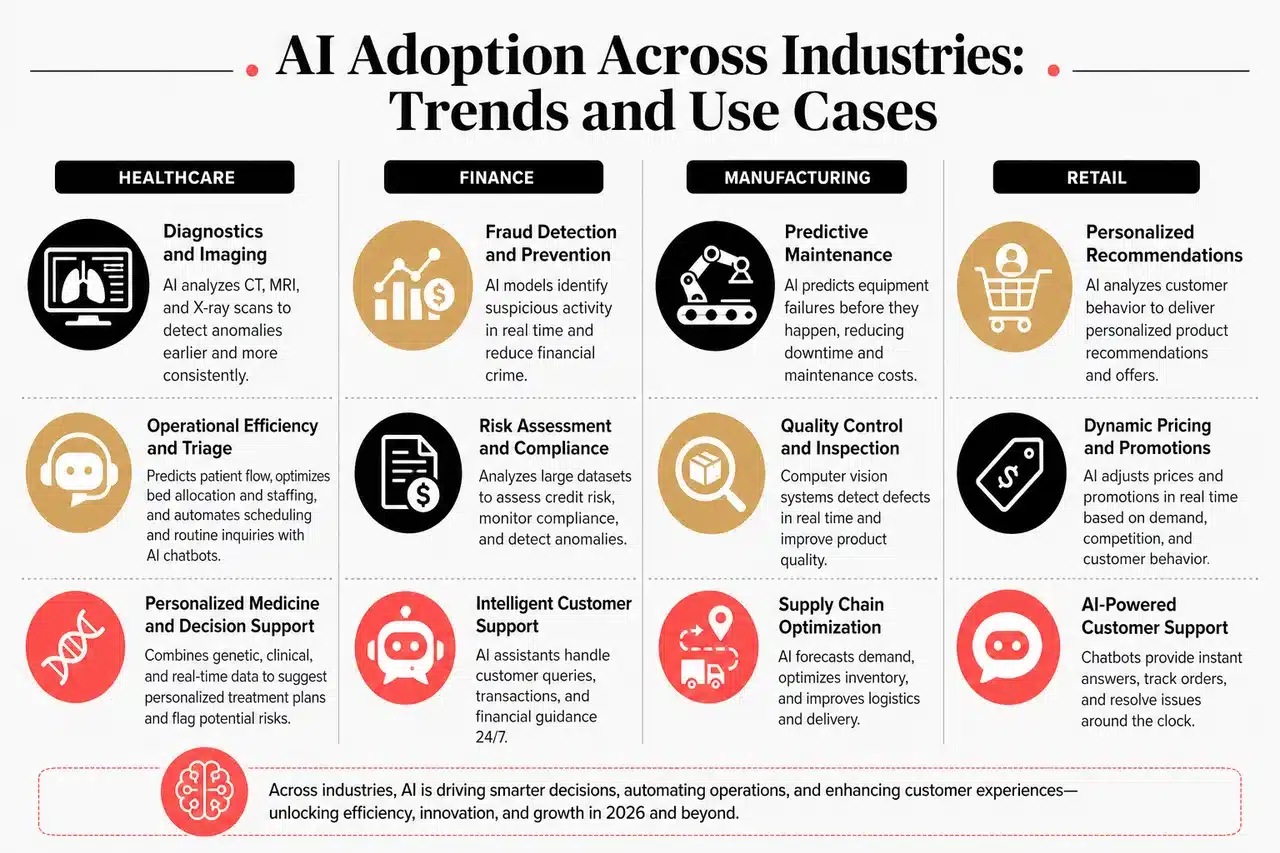
AI Adoption Across Industries: Trends and Use Cases
Healthcare Sector
Healthcare is often cited as one of the sectors with the highest potential impact from AI, and adoption is accelerating as evidence for improved outcomes and efficiency builds.
- Diagnostics and imaging: Deep learning models are now widely used to analyze CT, MRI, and X ray scans, helping radiologists detect anomalies earlier and with greater consistency. In some clinical studies, AI systems have matched or exceeded human experts in tasks such as identifying early stage cancers. Hospitals increasingly pair these diagnostic models with conversational interfaces, so that clinicians can query results or summarize findings through tools similar to ChatGPT 247 rather than navigating complex dashboards.
- Operational efficiency and triage: Predictive analytics assists with patient flow management, bed allocation, and staffing, reducing wait times and optimizing use of scarce resources. AI powered chatbots handle appointment scheduling, pre visit questionnaires, and routine follow up questions, freeing nurses and administrative staff to focus on higher value interactions. A healthcare provider using ChatGPT 247 as a front end for these systems can ensure that patients receive timely, consistent information while sensitive data remains securely managed in back end systems.
- Personalized medicine and decision support: By combining genetic information, medical history, and real time sensor data, AI systems can propose individualized treatment plans and highlight potential risks or side effects. Physicians remain in control of decisions, but AI can surface options that might otherwise be missed. Large language models integrated through platforms like ChatGPT 247 can also synthesize the latest research literature into concise summaries tailored to a specific patient case, helping clinicians keep up with rapidly evolving knowledge.
Finance and Manufacturing
In both finance and manufacturing, AI has moved from experimental projects to mission critical infrastructure that underpins risk management, operations, and customer engagement.
- Financial services and risk management: Banks and fintech firms rely on machine learning models to detect fraud in real time, evaluate credit risk, and comply with anti money laundering regulations. These systems monitor millions of transactions per second, flagging anomalies that human teams then review. Customer facing AI, often delivered through chatbots powered by platforms like ChatGPT 247, helps answer account questions, guide users through onboarding, and provide personalized financial advice that reflects each customer’s spending patterns and goals.
- Algorithmic trading and portfolio optimization: Investment firms use AI to analyze news, earnings reports, and market signals at machine speed, informing trading strategies and risk hedging. Generative models can draft portfolio commentary, summarize market movements, and create scenario based explanations for clients. By embedding these capabilities in tools like ChatGPT 247, asset managers can give relationship managers and analysts on demand research support that feels like a knowledgeable colleague available at all times.
- Manufacturing, robotics, and quality control: On factory floors, AI powered predictive maintenance systems monitor equipment vibrations, temperature, and performance metrics to predict failures before they occur, minimizing downtime. Computer vision checks product quality in real time, spotting defects that are too subtle or frequent for human inspectors. Manufacturers are also adopting collaborative robots guided by AI to handle repetitive, ergonomically challenging tasks. When combined with conversational interfaces, technicians can ask a tool like ChatGPT 247 for step by step repair instructions, safety checks, or process documentation while working hands free.
- Telecommunications and network optimization: Telecom operators employ AI models to forecast network demand, optimize routing, and proactively detect outages. AI assistants help customer service teams resolve connectivity issues and guide users through complex device setups. Integrating these capabilities into a centralized platform such as ChatGPT 247 enables telcos to offer consistent, high quality support across channels including web, mobile apps, and messaging platforms.
- Adapt AI to sector realities: How AI is adopted, and the use cases it enables, varies widely from one sector to another. Regulatory constraints, data availability, and risk tolerance all shape what is feasible. A hospital might begin with AI assisted triage and documentation, while a manufacturer might prioritize predictive maintenance and defect detection.
- Prioritize industry specific solutions: Industry targeted AI solutions can provide a serious edge by solving challenges that generic platforms alone may not address as effectively. Combining domain tuned models with a flexible orchestration layer like ChatGPT 247 helps organizations create assistants that understand industry jargon, workflows, and compliance rules out of the box.
| Industry | Primary AI Use Cases | Typical Benefits |
|---|---|---|
| Healthcare | Imaging analysis, triage chatbots, personalized treatment support | Earlier diagnoses, reduced wait times, more tailored care plans |
| Finance | Fraud detection, credit scoring, advisory chatbots | Lower losses, faster decisions, improved customer satisfaction |
| Manufacturing | Predictive maintenance, quality inspection, robotics | Reduced downtime, higher yield, safer workplaces |
| Telecommunications | Network optimization, proactive support, churn prediction | More reliable service, fewer support tickets, better retention |
Growth Drivers, Challenges, and Opportunities in the AI Market
Main Growth Drivers
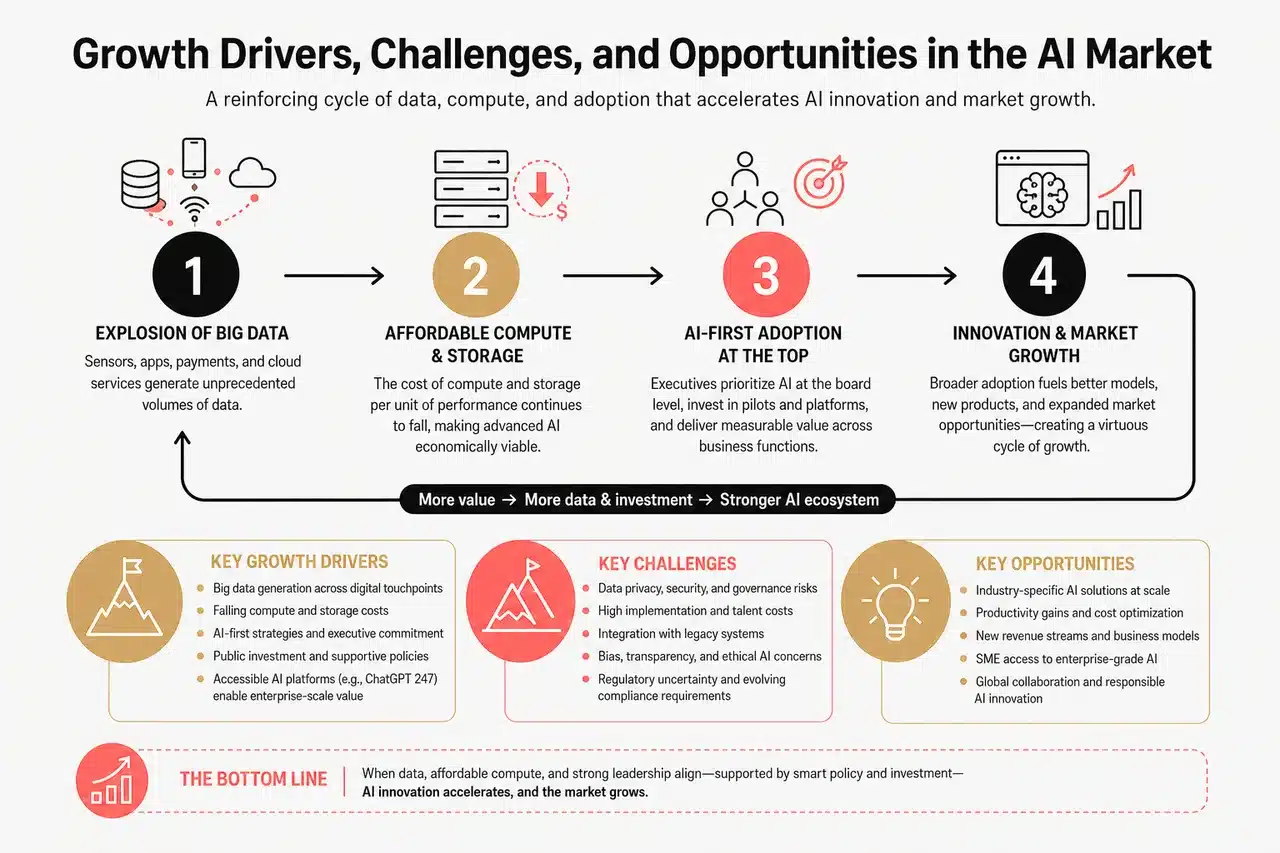
The forces propelling the artificial intelligence market are not only technological but also economic and policy led, creating a reinforcing cycle of innovation and adoption.
- Explosion of big data combined with affordable compute: Sensor networks, digital payments, mobile apps, and cloud services generate unprecedented volumes of data, while the cost of storage and compute per unit of performance continues to fall. This makes it economically viable for organizations to train and deploy sophisticated models. Platforms like ChatGPT 247 sit at the intersection of these trends, offering users the benefits of large scale AI without requiring them to manage infrastructure directly.
- Shifting executive priorities toward AI first strategies: Surveys of business leaders indicate that many now consider AI a board level priority, not just an IT project. Over half report that AI has already generated measurable value in at least one business function, and a significant subset plan to increase their AI investment in the next three years. This top down commitment translates into budgets for pilots, training, and platform adoption, with tools like ChatGPT 247 often serving as a visible early win for knowledge workers.
- Supportive public investment and policy frameworks: Governments are funding AI research centers, startup programs, and public data spaces, while multilateral organizations publish guidelines on responsible AI adoption. In practice, this can mean grants for AI projects in healthcare or manufacturing, tax incentives for digital modernization, and shared infrastructures that reduce barriers for smaller firms. Businesses that align projects with these initiatives, for example by using ChatGPT 247 to build AI driven services in strategically supported areas, can access additional support and credibility.
Key Challenges and Solutions
Despite the momentum, organizations regularly encounter significant obstacles when scaling AI, especially around trust, skills, and integration with existing processes.
- Data privacy, security, and sovereignty: As AI models become more capable, they often require access to sensitive customer, patient, or employee data. Regulations such as the General Data Protection Regulation and emerging AI specific laws demand strong safeguards around consent, retention, and cross border data flows. To address this, enterprises are adopting privacy preserving techniques like federated learning, synthetic data, and strict access controls. Platforms such as ChatGPT 247 increasingly offer configuration options that keep sensitive data within specified regions and allow administrators to control logging and retention policies.
- Bias, fairness, and explainability: AI systems can unintentionally encode and amplify historical biases present in training data, which is especially problematic in lending, hiring, and criminal justice contexts. Stakeholders and regulators are asking for clearer explanations of how models arrive at their outputs. In response, toolmakers are integrating model cards, bias evaluation dashboards, and explanation features that show influential factors in a decision. When using generative systems through ChatGPT 247, organizations can combine these capabilities with internal review workflows to ensure that AI assisted decisions are transparent and auditable.
- Talent shortages and organizational readiness: There is a widely documented shortage of experienced AI engineers, data scientists, and machine learning operations specialists, which can slow or stall ambitious programs. At the same time, many employees are unfamiliar with how to work effectively alongside AI. To bridge this gap, companies are investing in upskilling programs, partnerships with universities, and broader adoption of no code or low code AI tools. Platforms like ChatGPT 247 are particularly valuable here because they let non technical staff build chatbots, automations, and content workflows using natural language instructions instead of code.
Emerging Opportunities
For organizations and professionals ready to move beyond experimentation, the next wave of opportunities lies in combining generative and predictive AI, embedding them into core workflows, and focusing on measurable outcomes.
- Automation of knowledge work at scale: Many companies have already automated repetitive back office tasks such as invoice processing or basic IT support. Generative AI extends automation into more complex areas like report writing, proposal drafting, and customer communication. For example, a sales team can use ChatGPT 247 to generate customized pitch decks and follow up emails based on CRM data, while compliance teams use the same platform to review the content against policy guidelines before sending.
- AI powered decision intelligence: Predictive models have long been used for forecasting and risk scoring, but combining them with conversational interfaces and narrative generation allows decision makers to ask open ended questions and receive explanations in plain language. A logistics manager might ask ChatGPT 247 for the top three risk factors affecting on time deliveries next quarter, receive a data backed explanation, and then request suggested mitigation actions, all within a single interface.
- New AI native products and business models: Entirely new categories of products are emerging, such as virtual experts that provide 24 by 7 guidance in specialized domains, synthetic media services, and AI first educational platforms. Entrepreneurs can launch AI driven offerings with relatively modest resources by building on top of established foundation models and using platforms like ChatGPT 247 for user interaction, authentication, and billing integration. As AI regulations mature, businesses that design transparency and ethics into these offerings from the start will have a competitive advantage.
Future Outlook and Expert Insights for the AI Market
Anticipated Trends and Breakthroughs
Looking ahead to the next five to ten years, several themes are likely to shape how the artificial intelligence market develops and where value concentrates.
- Explainable and trustworthy AI by design: As regulations tighten and users become more aware of AI limitations, demand will grow for systems that can justify their recommendations in human understandable terms. This is especially important in healthcare, finance, and public sector decisions. Toolmakers are developing techniques that align model behavior with organizational policies and make it easier to trace which data or rules influenced a given output. ChatGPT 247, for instance, can be configured to surface citations, internal policy references, or step by step reasoning where appropriate, supporting both users and auditors.
- Autonomous and semi autonomous systems: Robotics, self driving logistics, and smart infrastructure will continue to expand, though often in controlled environments before full public deployment. Warehouses and ports are early adopters, using fleets of AI guided machines that collaborate with human workers. As these systems become more capable, organizations will need clear strategies for human oversight, escalation, and continuous learning. Conversational control interfaces, accessible through platforms like ChatGPT 247, offer operators a more intuitive way to monitor status and issue instructions.
- Domain specialized generative AI: Instead of relying solely on general purpose models, organizations are investing in models fine tuned on their own documents, coding standards, and industry regulations. This produces assistants that speak their language and respect their constraints. A law firm might have an AI that drafts briefs consistent with its house style, while an engineering team uses a model tuned to its codebase and design patterns. ChatGPT 247 supports this evolution by letting customers connect private data sources and configure specialized workspaces without exposing sensitive information to other tenants.
- Convergence with other frontier technologies: AI is increasingly intertwined with the Internet of Things, next generation networks, and eventually quantum computing. Real time data from sensors, vehicles, and industrial equipment feeds AI models that make split second decisions at the edge, while high performance computing accelerates training and simulation. Over time, quantum enabled algorithms may allow optimization and discovery problems that are intractable today. Organizations that treat AI as one component of a broader digital strategy, rather than a standalone initiative, will be better positioned to capture synergies as these technologies mature.
Actionable Insights for Stakeholders
Translating these trends into concrete actions requires a pragmatic approach that balances experimentation with governance and focuses on real business outcomes.
- For businesses: You really should establish a clear AI roadmap aligned with strategic objectives, starting with a portfolio of use cases that offer quick wins and strong learning value. Many organizations begin with customer support, internal knowledge search, and document automation projects delivered through a platform like ChatGPT 247, then expand into more complex predictive and decision support use cases. Investing in data quality, security frameworks, and change management is just as important as model selection for long term success.
- For individuals and teams: Developing AI literacy, including understanding basic concepts, limitations, and best practices, will become as essential as spreadsheet skills are today. Professionals in marketing, finance, operations, and other fields can dramatically increase their productivity by learning how to craft effective prompts, evaluate outputs critically, and design workflows that combine AI with human judgment. Using tools like ChatGPT 247 in a structured way, such as maintaining prompt libraries and reviewing performance regularly, turns experimentation into a repeatable capability.
- For entrepreneurs and innovators: The current stage of the market offers a unique window to build AI native products and services before competition fully saturates every niche. Areas such as small and medium business automation, industry specific knowledge assistants, and AI powered training and coaching platforms remain under served. By leveraging foundation models via ChatGPT 247 and focusing on a tightly defined user problem, founders can launch, iterate, and scale solutions faster than would have been possible in previous waves of technology.
- Integrate AI chatbots into core journeys: Embedding AI chatbots into websites, apps, and internal portals can boost customer engagement and automate common responses, while routing complex issues to human agents. ChatGPT 247 makes it feasible to deploy these assistants across multiple channels with consistent behavior and branding.
- Elevate visual and multilingual content: AI powered image generation tools can rapidly produce on brand visuals for campaigns, documentation, and social media, while automated translation services localize content into multiple languages in minutes. Combining these capabilities within ChatGPT 247 allows marketing teams to run global campaigns with far fewer bottlenecks.
- Use AI to strengthen discoverability and support: AI driven search engine optimization assistance can help identify relevant keywords, craft metadata, and generate structured content that performs well in search results. At the same time, FAQ automation powered by ChatGPT 247 can answer recurring customer questions instantly, reducing manual workload and improving satisfaction.
Strategic Layers of the AI Market: Infrastructure, Models, and Experience
Infrastructure and Compute Layer
Beneath visible AI applications lies a rapidly evolving infrastructure layer that determines what is technically and economically feasible. Data centers packed with specialized accelerators, high bandwidth networking, and efficient cooling enable the training and serving of large models at global scale. As demand surges, cloud providers are optimizing capacity and energy efficiency, while enterprises with sensitive workloads explore hybrid setups that keep certain models and data on premises. For users of platforms like ChatGPT 247, this complexity is abstracted away, but it is a key reason why powerful AI can be accessed on demand at relatively low marginal cost.
Model and Data Layer
Above infrastructure sits the model and data layer, where foundation models, fine tuned variants, and domain specific datasets interact. Organizations are increasingly treating training data as a strategic asset, investing in curation, labeling, and governance. Some choose to build proprietary models, while many others combine off the shelf models with their own data through techniques such as retrieval augmented generation. ChatGPT 247 operates in this layer by orchestrating how user prompts, knowledge bases, and external tools feed into model calls, ensuring that outputs are both context aware and policy compliant.
Experience and Workflow Layer
The top layer is the experience and workflow layer, where AI becomes visible to end users in the form of chat interfaces, copilots integrated into existing software, and automated processes. Success here depends not only on model quality but also on thoughtful interaction design, change management, and integration with existing systems of record. Platforms like ChatGPT 247 focus heavily on this layer, providing configurable templates, access controls, analytics, and integrations so that organizations can embed AI into day to day work without overwhelming users or disrupting established processes.
AI Market FAQs
How big is the artificial intelligence market in 2026, and how fast is it growing?
Most recent estimates place the global AI market between roughly 539.5 and 601.93 billion dollars in 2026, with forecasts suggesting it could reach between 3 and 4.8 trillion dollars by 2033. This implies a sustained annual growth rate above 25 percent, making AI one of the fastest expanding segments of the digital economy. For businesses, this pace means that competitive advantages from AI adoption can materialize quickly but may also erode as the technology becomes more widespread.
Which industries are seeing the strongest returns from AI today?
Healthcare, financial services, and manufacturing are among the sectors reporting the clearest and most immediate gains from AI, especially in areas like fraud detection, diagnostic support, and predictive maintenance. Retail, telecommunications, and professional services are also seeing strong results from AI powered personalization and customer service automation. Tools such as ChatGPT 247 are helping these industries package AI into accessible assistants and workflows that can be adopted by front line teams, not just data scientists.
What is the most practical way for a mid sized business to start using AI?
For most mid sized organizations, the most practical entry points are customer support automation, document and content workflows, and internal knowledge search. Starting with a platform like ChatGPT 247 allows teams to pilot AI chatbots, content generators, and internal assistants using existing data and processes, while keeping costs and complexity under control. Once early projects show value, businesses can expand into more advanced predictive analytics and decision support use cases, guided by clear metrics and governance structures.
The artificial intelligence market in 2026 is rewriting the playbook for how businesses and individuals innovate, compete, and grow. With the market already topping roughly 600 billion dollars and on track for multi trillion dollar expansion, the opportunities are wide open for those willing to embrace new technologies. Whether you are a global enterprise or an entrepreneur just getting started, understanding the key drivers, challenges, and opportunities in AI puts you in the best position to benefit from this new era. Now is the time to explore how AI can fit into your strategy, use platforms like ChatGPT 247 to experiment safely and at low cost, and take the next step toward a smarter, more productive future.