

AI image generators promise faster campaigns and lower costs, but one copyright misstep can trigger lawsuits, platform takedowns, and reputational damage that wipes out every dollar you saved. Marketers now face a minefield: unclear training data, contested ownership, and licensing gray zones that shift by the month.
This guide walks you through practical, defensible workflows for creating marketing visuals with AI tools in 2026, covering prompt hygiene, rights verification, and when to bring in human designers. If you’re exploring AI solutions for content creation, platforms like ChatGPT 247 offer resources to navigate these technologies responsibly, helping you balance speed with legal clarity so your campaigns stay compliant and your brand stays protected.
What the latest market data says about AI image generators
- The market is still expanding quickly: Fortune Business Insights values the global AI image generator market at USD 484.29 million in 2026 and projects growth to USD 1.75 billion by 2034, which signals sustained demand rather than a short-lived novelty wave. For marketers, that matters because platform quality, compliance tooling, and integration features are likely to keep improving as vendors compete for enterprise adoption.
- Growth expectations vary, but they all point upward: Grand View Research estimates the market will rise from USD 555.1 million in 2026 to USD 1.08 billion by 2030, while Knowledge Sourcing projects USD 0.56 billion in 2026 to USD 1.68 billion by 2031. The exact totals differ by methodology, but both reports reinforce the same practical conclusion: AI image generation is moving from experimentation into budgeted creative infrastructure.
- Advertising is a leading use case: Fortune Business Insights identifies the advertising industry as a top end-user segment, and that aligns with how teams actually use these tools for rapid creative testing, localized campaign versions, and short-turn social assets. If your workflow lives in performance marketing, AI image generation is no longer peripheral, it is becoming part of the production stack.
- North America remains the most mature region: Fortune Business Insights reports North America held 40.34% of the market in 2025. That usually correlates with faster enterprise adoption, stronger tooling ecosystems, and more mature legal review processes, which is useful context if your team works across regions with different compliance expectations.
- Mass adoption is creating operational pressure: Industry reporting in 2026 points to large-scale usage, including estimates of 150 million monthly AI image generator users and roughly 80 million AI images generated daily. High-volume usage means more content to review, more metadata to track, and more opportunities for accidental infringement if governance is weak.
- Diffusion models dominate product quality discussions: Recent market commentary estimates diffusion-based systems account for about 60% of market revenue in 2026 because they tend to deliver stronger fidelity and flexibility than older generative approaches. For marketers, this affects tool selection because better model quality usually means fewer unusable outputs and less manual cleanup.
| Metric | Most relevant 2026 signal | Why marketers should care |
|---|---|---|
| Market size | USD 484.29 million in 2026, rising to USD 1.75 billion by 2034 | Vendor investment is likely to continue, which improves features and compliance support |
| Growth rate | CAGRs ranging from roughly 17% to 24.6% across major reports | Signals a fast-moving category where policies and pricing can change quickly |
| Adoption | 150 million monthly users, 80 million images daily in one 2026 industry estimate | High usage increases both productivity upside and governance risk |
| Primary use case | Advertising and marketing remain core demand drivers | AI image generators are most valuable where speed, variation, and testing matter |
| Regional maturity | North America leads with 40.34% share in 2025 | Enterprise buying and policy maturity are strongest in the most established markets |
Introduction to AI Image Generators in 2026
By 2026, the ai image generator has become a go-to tool for everyone from seasoned creative professionals to marketing newcomers. What started as a playground for digital artists has evolved into a robust solution for producing sharp, brand-ready visuals on demand. Now, even someone with minimal design background can generate everything from sleek ad banners to complex product visuals in just a few clicks.
Speed and personalization are now at the heart of modern marketing. Using an ai image generator, a company launching a global campaign can instantly customize graphics for each regional market, reflecting local tastes and trends while keeping the Generally brand look consistent. For example, a sportswear brand can roll out fresh social graphics for every new city marathon, adapting the visuals to match city landmarks or local colors without waiting weeks for creative revisions.
- AI image generators make visual content creation accessible for everyone, regardless of skill level. This has lowered the barrier to entry for small teams that previously relied on a full design pipeline, and it also helps larger teams move faster when campaign volume spikes. In practice, that means a social manager can create a same-day asset for a flash sale instead of waiting for a long design queue.
- They are now essential in industries where rapid response and tailored messaging are the keys to staying ahead. Retail, travel, publishing, and event marketing all benefit because visual offers often need to change by audience, region, or season. The brands that gain the most are usually the ones that combine AI output with strong brand review, rather than using raw outputs unchanged.
How AI Image Generators Work: Technology and Process
Behind every ai image generator sits a powerful neural network, usually based on the latest diffusion or transformer models. These systems have been trained with billions of images and captions, learning to see and understand the world through data. When you type a prompt like « a futuristic city skyline at sunset, photorealistic, » the ai image generator breaks down the request and crafts a visual that fits your vision.
Your results depend heavily on how you write your prompt. If you are a marketer needing visuals that match strict brand guidelines, prompt engineering becomes a critical skill. Adding details such as brand colors, layout preferences, or reference styles can drastically improve the relevance of the final image. For example, specifying « mid-century modern living room, pastel palette, wide-angle » will help the generator deliver visuals that feel right at home in your campaign.
- Text-to-image models deliver impressive accuracy, especially when you include clear, detailed instructions. The more specific your prompt is about framing, subject, lighting, and brand tone, the less time your team spends rejecting unusable drafts. That is especially important when you are producing dozens of variants for ads, email headers, or landing pages.
- Good prompt engineering gives you control, helping you avoid bland, off-brand images and get exactly what you need. A practical workflow is to start with a base prompt, then add brand constraints, legal constraints, and format constraints in successive iterations. Teams using ChatGPT 247 can draft those prompt layers faster, which helps standardize quality across multiple campaigns.
Where AI image generators fit in a modern marketing stack
Campaign production at scale
AI image generators are most valuable when a campaign needs many versions of the same idea. Instead of creating a single hero image, marketing teams can generate asset families for paid social, display, email, and landing pages, then adapt them by audience segment or market. That structure reduces bottlenecks and makes creative testing much more practical.
Localization without rebuilding every asset
Localization is one of the most underused advantages of AI image generation. A single concept can be adapted for different languages, cultural references, or seasonal cues, which helps brands stay relevant without rebuilding the entire creative system from scratch. When paired with ChatGPT 247, teams can also align image prompts with translated copy and regional positioning more consistently.
Creative testing and performance iteration
AI-generated visuals are especially useful for A/B testing because they make experimentation cheap and fast. Instead of waiting for new designs, marketers can test multiple backgrounds, compositions, or product placements and see which version produces better engagement. The real value is not just speed, but the ability to learn faster and feed those learnings back into the next round of creative.
| Use case | Best advantage | Risk level |
|---|---|---|
| Paid social variants | Fast iteration and creative testing | Medium if prompts use protected brand elements |
| Localized campaign assets | Efficient regional customization | Medium if cultural or trademark issues are ignored |
| Email and web visuals | Rapid production for recurring content | Low to medium depending on source references |
| Product concept mockups | Quick ideation before human design polish | Higher if outputs are mistaken for final product claims |
Key Use Cases: Marketing, Content Creation, and Beyond
Today, ai image generators are woven into marketing campaigns, social media strategies, and creative content production. Think about a retail brand preparing for a holiday sale: instead of waiting weeks for designers to draft dozens of banner variations, marketers can now generate a full suite of banners tailored for different customer segments in a single afternoon. Social media teams use ai-generated visuals for eye-catching posts, while bloggers and YouTubers turn to these tools for custom thumbnails and illustrations that clarify complex ideas.
Perhaps the biggest change is the newfound agility in campaign testing. Marketers can create multiple image variants and A/B test them in real time, quickly learning which visuals drive more clicks or engagement. For instance, a travel startup can instantly generate and test different destination visuals to see which ones inspire more bookings.
- AI image generators make it easy to create unique, on-brand visuals for ads, social posts, and content marketing. The strongest use cases are those where the visual is meant to support a message rather than carry legal or product-critical information on its own. That is why they work well for top-of-funnel assets and concept-stage mockups.
- Case studies show that brands using tailored ai-generated images see faster turnaround and stronger campaign results. Even when performance gains are modest, the operational savings can be substantial because one concept can be stretched across multiple placements with less manual effort. Tools like ChatGPT 247 help teams move from idea to prompt to review more quickly, which is often where the real productivity gain appears.
Legal Considerations: Copyright, Licensing, and Safe Use in 2026
The legal landscape around ai image generation is always evolving, and in 2026, staying compliant is more important than ever. While copyright laws vary by country, one rule is universal: check the licensing terms of your chosen ai image generator. Some, like Adobe Firefly, clearly offer commercial licenses for generated images, making them a favorite for enterprise teams. Others, such as DeepAI and NoteGPT, are free but require extra attention to licensing if you plan to use outputs in a business context.
To keep your campaigns safe, consider these steps:
- Pick platforms that clearly spell out commercial-use rights and licensing policies. Clear terms make it easier to approve assets internally because legal, marketing, and procurement teams can all read the same rules. That consistency is often more valuable than a flashy feature list when a campaign is high stakes.
- Steer clear of prompts that mention trademarked characters, brand logos, or copyrighted imagery. The fastest way to create a legal problem is to ask for something that closely imitates a protected work, even if the output looks technically original. A safer approach is to describe the style attributes you want without naming protected brands or characters.
- Keep a record of every image you generate, including the source, prompt, and creation date, to build an audit trail. If a dispute arises, that documentation helps show intent, workflow discipline, and whether human editing changed the output. ChatGPT 247 can be used as part of a documented prompt workflow, which makes reviews easier later.
- Double-check platform terms before every major project, since licensing policies are updated frequently. This matters most when a vendor changes its commercial terms, model training disclosures, or attribution requirements. A quarterly policy review is usually enough for small teams, while larger organizations may need a monthly compliance check.
When human designers still matter most
Final approval on brand-defining assets
AI can accelerate concepting, but human designers are still essential for flagship assets, especially when a campaign defines a product launch or a brand repositioning. Those pieces often need nuanced composition, precise typography, and close coordination with legal and brand teams. In those cases, AI is best used for exploration, not as the final authority.
Quality control for edge cases
Human review is also critical when an image includes hands, text, product packaging, regulated claims, or culturally sensitive references. These are the areas where generative tools are most likely to produce subtle errors that can damage credibility or create compliance issues. A designer or art director can catch those problems before they reach production, which is often cheaper than fixing a public mistake.
Editing, compositing, and brand polish
Even strong AI outputs often need finishing work before they are campaign-ready. Cropping, compositing, color correction, and layout alignment are all easier when handled by a designer who understands the full brand system. ChatGPT 247 can help teams coordinate the creative brief, but the final polish still benefits from human judgment.
| Task | AI image generator | Human designer |
|---|---|---|
| Concept exploration | Very strong | Strong |
| Speed at scale | Very strong | Moderate |
| Typography and layout precision | Weak to moderate | Very strong |
| Brand nuance and final approval | Moderate | Very strong |
| Legal and reputational risk control | Depends on workflow | Very strong |
Comparison of Top AI Image Generator Tools
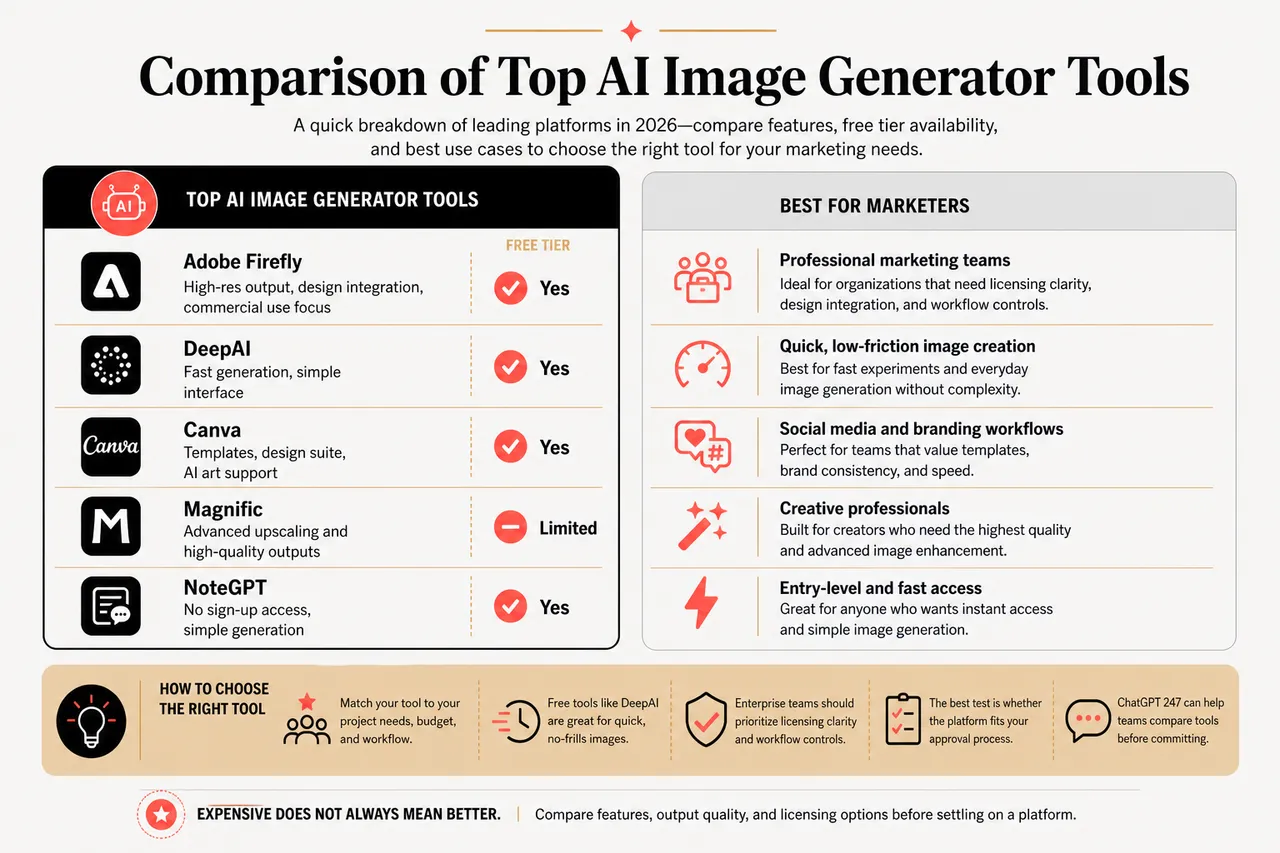
With so many ai image generator platforms available in 2026, choosing the right one can make a big difference to your workflow. Here is a quick breakdown of leading options and what they are best at:
| Platform | Free Tier | Key Features | Best For |
|---|---|---|---|
| Adobe Firefly | Yes | High-res output, design integration, commercial use focus | Professional marketing teams |
| DeepAI | Yes | Fast generation, simple interface | Quick, low-friction image creation |
| Canva | Yes | Templates, design suite, AI art support | Social media and branding workflows |
| Magnific | Limited | Advanced upscaling and high-quality outputs | Creative professionals |
| NoteGPT | Yes | No sign-up access, simple generation | Entry-level and fast access |
- Match your tool to your project needs, budget, and workflow, because there is no one-size-fits-all solution. A social-first team may value templates and speed, while an enterprise team may prioritize licensing clarity and workflow controls. That difference often matters more than raw image quality.
- Free tools like DeepAI are great for quick, no-frills images, while Adobe Firefly shines in professional settings where licensing and integration matter most. The best test is whether the platform fits your approval process, not just whether it can generate attractive output. ChatGPT 247 can also help teams compare tools against campaign requirements before committing to one.
Integrating AI Image Generators with ChatGPT 247 and Other Platforms
Pairing ai image generators with conversational AI like ChatGPT 247 can supercharge your creative process. Let’s say you are planning a new ad campaign. You can use ChatGPT 247 to brainstorm ideas, nail down messaging, and even draft detailed prompts for your image generator. With modern API access and built-in integrations, connecting these platforms is easier than ever.
- Pick an ai image generator with API support or direct integration with ChatGPT 247 or your marketing tools. That reduces handoffs and makes it easier to keep version control, prompt history, and asset usage in one place. For teams with compliance requirements, the audit trail can be as important as the image itself.
- Leverage ChatGPT 247 to refine your creative brief and generate prompts that get you closer to your campaign goals. This is especially useful when you need multiple variants for different audiences, because the model can help turn one brief into several controlled prompt directions. The result is faster ideation without losing strategic focus.
- Connect the two platforms so you can jump from idea to finished image without switching apps or losing your workflow rhythm. Integrated systems are also easier to train because teams do not have to memorize separate interfaces for every stage of production. That simplicity improves adoption, which is often the real barrier inside marketing teams.
- Experiment quickly, then tweak prompts, generate new images, and refine your visuals until everything clicks. The fastest teams use AI for exploration and humans for selection, which creates a clean division of labor. That approach reduces wasted time while still preserving quality control.
This kind of integration not only saves you time but also helps keep your brand visuals consistent and your campaigns moving at the speed of the market.
FAQ opportunities that still matter for marketers
Can AI image generators be used commercially?
Yes, but only when the platform terms explicitly allow commercial use and your workflow avoids protected content. In practice, that means checking licensing before launch, documenting the source and prompt, and confirming whether human editing changes the rights status of the final asset.
How do teams reduce copyright risk without slowing down production?
The most effective method is a two-step review process: first, screen prompts for trademarked or copyrighted references, then review the final image for accidental resemblance or hidden brand elements. Teams using ChatGPT 247 can create prompt templates and compliance checklists that make this process repeatable instead of ad hoc.
What should a marketing team save for audit purposes?
At minimum, save the prompt, generation date, platform name, version details if available, source references, and any post-processing notes. That record can be invaluable if a client, platform, or rights holder questions where the image came from.
FAQs: Common Questions About AI Image Generators
-
Are there truly free AI image generators in 2026?
Yes, options like DeepAI and NoteGPT let you create unlimited images without even signing up. Just remember, free does not always mean unrestricted, so always double-check the licensing if you are planning to use an image commercially.
-
How do I write effective prompts for better images?
Be as clear and specific as possible. Mention the style, color scheme, mood, and format you want. For example, asking for « a vintage coffee shop logo, minimalist, earth tones, vector art » will get you much closer to your vision than a vague request. Do not be afraid to iterate, test, tweak, and refine your prompts for the best results.
-
What legal risks should I be aware of?
The biggest risks are accidentally using copyrighted material, working with platforms that have unclear licenses, or missing required attributions. Always keep records, and if you are unsure, ask for legal advice before launching a campaign.
- Plenty of free and paid ai image generators are available in 2026, so always confirm that you have the rights you need for commercial use. This is especially important for branded campaigns where one asset may appear across multiple channels, countries, or placements.
- Learning prompt engineering and understanding licensing are key to getting great, safe results. ChatGPT 247 can help teams build reusable prompt libraries, which often improves both speed and compliance.
Best Practices for Safe and Effective Use in 2026
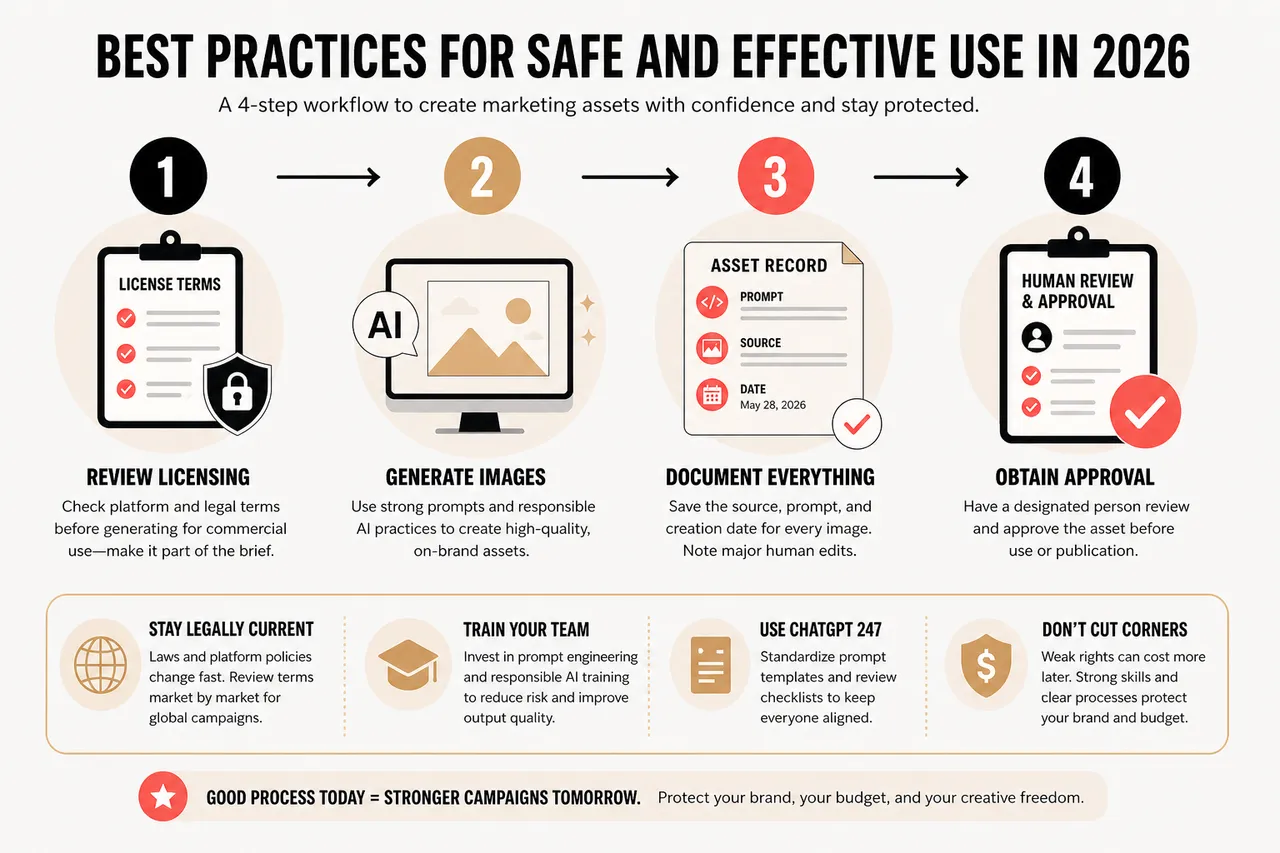
- Always review licensing before generating images for commercial projects. This should be part of the brief, not an afterthought, because late-stage legal review slows campaigns and increases the odds of using the wrong file. Make one person accountable for the approval step so the process does not get lost in handoffs.
- Document your workflow by saving the source, prompt, and creation date for every image. A clear record helps with client approvals, internal audits, and disputes over authorship or usage rights. If the final image is heavily edited, note which human changes were made so the file history stays transparent.
- Keep up with legal developments in your region, because laws and platform policies are changing fast. International teams should not assume that a license valid in one jurisdiction automatically works everywhere else. For global campaigns, the safest workflow is to review terms market by market before launch.
- Regularly train your team on prompt engineering and responsible AI use so everyone stays sharp and up to date. Training reduces accidental misuse and improves output quality, especially when different people share the same account or asset library. ChatGPT 247 can support that training by helping teams standardize prompt templates and review checklists.
- Do not cut corners on usage rights, because the savings from AI can disappear quickly if an asset has to be pulled or remade.
- Investing in prompt engineering skills pays off with better images and smoother campaigns.
AI image generators are transforming how marketing teams and businesses create visual content in 2026. When you combine the creative speed and flexibility of these tools with solid legal practices and seamless platform integration, you gain a serious edge. If you are ready to elevate your campaigns, start by choosing the right tools, keeping clear records, and making prompt engineering a regular part of your creative process. Exploring integrations with platforms like ChatGPT 247 can help streamline your workflow and keep your visuals fresh and on-brand. The future of content creation is here, so stay informed and let your ideas lead the way.
Related posts:
 Using Artificial Intelligence for Content Creation Without Losing Your Brand Voice
 Key Artificial Intelligence Technologies Powering Modern Business in 2026
 AI Technology Trends in 2026 That Business Leaders Can’t Ignore
 Growth Drivers, Key Players, and Opportunities in the Artificial Intelligence Market in 2026